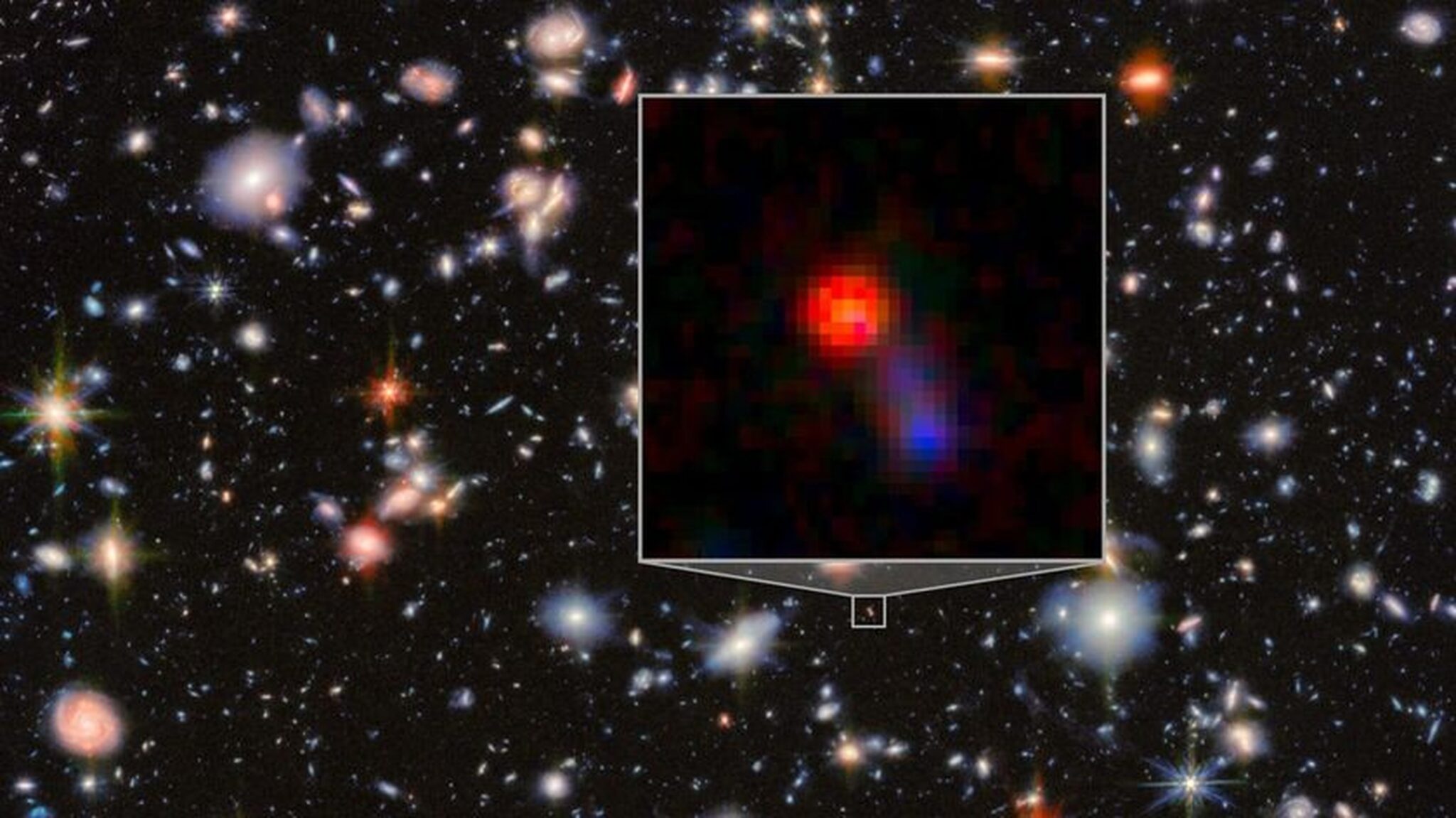
James Webb Space Telescope has discovered “little red dots” (LRDs), compact, infrared-emitting sources in the early Universe, likely representing young supermassive black holes accreting mass near the Eddington limit within dense cocoons of ionized gas.
In a new study published in Nature on January 14, the researchers investigated the identity of little red dots. These mysterious objects from the early universe exhibit characteristics of both galaxies and supermassive black holes, yet do not fit the description of either of them.
JWST first observed these little red dots in 2022, shortly after its launch and began collecting data. Initially, researchers assumed them to be compact, star-filled galaxies; they changed their assumption as the dots were present too early in the universe to have formed so many stars, at least under our current understanding of galactic evolution.
Later on, several other researchers suggested that the unusual objects might be early supermassive black holes. Light emitted by energized hydrogen atoms around the dots shows that the gas is moving at thousands of miles per second, tugged along by the gravitational pull of the object at the center.
Rodrigo Nemmen, an astrophysicist at the University of São Paulo in Brazil, wrote an accompanying article published in the journal Nature. According to him, “Such extreme speeds are a smoking gun of an active galactic nucleus,” meaning a starving supermassive black hole at the center of a galaxy that is pulling in matter.
In comparison to supermassive black holes, these little red dots haven’t been observed emitting X-rays or radio waves. And regardless of whether the dots are black holes or early galaxies, they appear to have a gigantic mass to have formed as early in the universe as they did.
To better understand their nature, researchers studied the spectra emitted from 30 little red dots, each one collected with JWST’s infrared instruments. They found that the light emitted from these LRDs matches the light that the team predicted would be emitted from a supermassive black hole surrounded by a dense cloud of gas. That gaseous cocoon could have trapped X-ray and radio emissions from the growing black holes, blocking them from reaching JWST.
When the team recalculated the masses of these LRDs under the new interpretation, they found that the dots were about 100 times less massive than previously thought. Together, the evidence suggests that LRDs are growing supermassive black holes that are accreting the surrounding gas.
References:
- https://www.livescience.com/space/cosmology/james-webb-telescope-saw-black-holes-emerging-from-cocoons-near-the-dawn-of-time-new-study-hints
- https://www.space.com/astronomy/black-holes/james-webb-space-telescopes-mysterious-little-red-dots-may-be-black-holes-in-disguise
- https://www.nature.com/articles/s41586-025-09900-4
Similar Articles:
- Cosmic Breakthrough: JWST Identifies Mysterious New Class of Black Hole Stars!
- Gaia BH3: The Colossal Black Hole Next Door