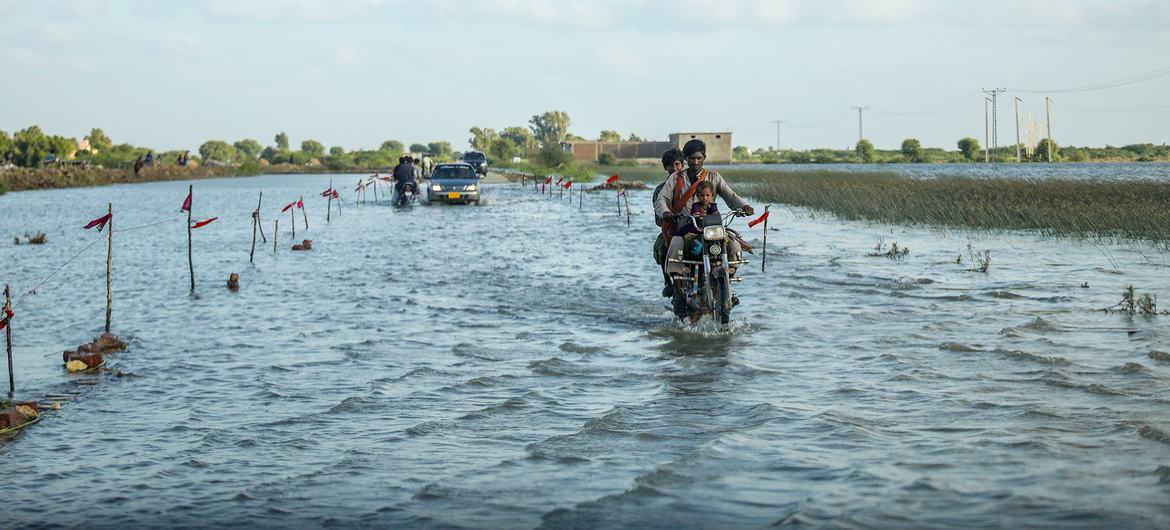
“We left our village and came to Larkana when the floods destroyed everything. But here, surviving is a constant struggle,” lamented old man Asif, who was sitting outside his tetered house in the district of Jhilmagsi in Balochistan province.
His house and that of other flood victims are made of fabric, bamboo, and other scraps that the migrants have assembled to create a semblance of shelter. The Tent City was established as part of the state’s response to manage and relocate displaced people across the district in 2022’s historic flooding.
Most of the displaced people across the world are situated in hot regions, such as Pakistan, and, like Asif, live in poor quality shelters with limited access to health services, which puts them at a high risk of exposure to extreme heat.
“Communities uprooted. People displaced and impoverished.” A phenomenon that seems to be taking root at a global scale, Pakistan presents a harrowing example of the devastating effects of climate change endured by those least responsible for it. Responsible for less than 1% of global greenhouse gas emissions, it finds itself on the front lines of climate breakdown (1). Between 2009 and 2023, a staggering 24 million Pakistanis were internally displaced by 107 separate disaster events (2).
The 2022 floods submerged one-third of Pakistan and displaced 8 million people overnight (3). In Sindh’s worst-hit districts, families like Asif’s faced a choice that wasn’t a choice: stay on land that may flood again, or leave everything they know. Stagnant water bred mosquitoes. Children ran fevers. The floods didn’t just drown fields- they poisoned what remained.
When floods submerged 22-year-old Kashif Abro’s family farm in Sindh province in 2011, they temporarily fled to Karachi, then returned. When the water came again in September 2022, they made the same journey, but this time they were not going back.
“We are not going back,” Abro says from a relief camp on Karachi’s outskirts, where 500 displaced families now live in tents. “There’s nothing for us” (4).
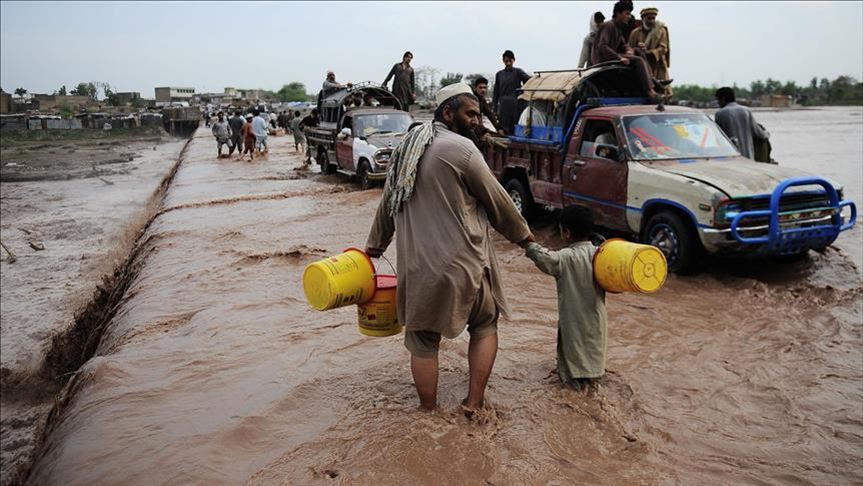
This extreme event, however, is only part of the story. The country is being steadily unmade by slow-onset disasters: the creeping drought in Tharparkar, the salinisation of the Indus Delta from sea-level rise, and the growing threat of glacial lake outburst floods in the northern mountains. These quieter crises are relentlessly uprooting communities, funnelling people toward already strained cities. Karachi alone is projected to absorb an additional 2.3 million climate migrants by 2050. (5)
Habibullah Khatti will soon leave his small village in Kharo Chan, a small town on Pakistan’s Indus Delta. Before he goes, he visits his mother’s grave to say goodbye. He doesn’t know what he’ll find in Karachi. He only knows what he’s leaving behind: salt-crusted land, empty houses, and an eerie silence where a community once lived.
“The saline water has surrounded us from all four sides,” Khatti says. He’s preparing to move his family to Karachi, joining tens of thousands already displaced from the delta region. (6) This is not a sudden disaster. It is a slow unmaking; a process repeating across Pakistan as climate change rewrites the map of where people can live.
Climate Change: The Unequal Weight of a Warming World
A 2020 analysis found that each severe weather event caused an average of 20,000 displacements in low-income countries compared to just 4,000 in the wealthiest. Over the last decade, the world’s poorest regions have recorded three times as many climate displacements as the richest nations. This is global inequality etched in human movement. (7)
The World Economic Forum’s 2026 Global Risks Report (8) ranks extreme weather as the number one long-term risk facing humanity. But for families like Khatti’s and Abro’s, this is not a future risk: It is their present.
Scientists propose ambitious fixes: artificial glaciers, satellite monitoring systems, solar-powered drones for remote data collection (9). But technology cannot help families who have no legal status, no land rights, no voice. The World Economic Forum warns of a “short-termism” trap: as geopolitical crises dominate headlines, long-term environmental risks fall down the policy agenda (8). Governments react to the last disaster instead of preparing for the next.
Pakistan, like most nations, lacks formal frameworks for planned relocation or urban integration. There is a policy vacuum at the heart of this crisis. We cannot keep building lifeboats without deciding where to row.
Ultimately, the dilemma of climate displacement is a mirror held up to our interconnected world: our decisions, our disparities, and our common future. The heartbreaking reality of families fleeing floodwaters or escaping wildfire-ravaged lands illustrates the climate crisis more powerfully than any abstract climatic chart.
The cotton that Kashif’s farm once produced would have become fabric. That fabric would have become shirts. Those shirts would have reached stores in cities whose citizens have never heard of Sindh. There are no far-off repercussions in an interconnected world: the ripple effect of devastation in the developing world will reach the wealthiest nations, and if action is not taken to navigate this crisis effectively, we will eventually run out of places to flee these catastrophic events.
The only question that remains is whether that motion will lead to a managed, if difficult, global adaptation or a chaotic collapse of the international order under the weight of an unmanaged crisis.
References:
- UNDP. Climate Promise- Pakistan. undp.org. [Online] https://climatepromise.undp.org/what-we-do/where-we-work/pakistan.
- Nausheen H. Anwar, Soha Macktoom, Muhammed Toheed, Adam Abdullah. How climate change-driven displacement is reshaping Pakistan’s cities. Asia News Network. [Online] 2026. https://asianews.network/how-climate-change-driven-displacement-is-reshaping-pakistans-cities/.
- British Red Cross. 2022 Pakistan floods: 1,700 killed and millions affected. redcross.org.uk. [Online] https://www.redcross.org.uk/stories/disasters-and-emergencies/world/climate-change-and-pakistan-flooding-affecting-millions.
- Joles, Betsy. Pakistan’s Climate Migrants Face Tough Odds. Foreign Policy. [Online] December 2022. https://foreignpolicy.com/2022/12/21/pakistan-climate-change-migration-flood/.
- Angaria, Waqas Alam. In Pakistan, sea level rise & displacement follow fisherfolk wherever they go. Mongabay. [Online] March 2025. https://news.mongabay.com/2025/03/in-pakistan-sea-level-rise-displacement-follow-fisherfolk-wherever-they-go/?_scpsug=crawled,53569,en_be91200e01c0fd133bd50b5f813064865a1e5405ccc1f4f2b84812f662a38f8f#_scpsug=crawled,53569,en_be91200e01c0fd133bd50b5f813064.
- Kuwait Times. Pakistan’s Indus sinks and shrinks. Kuwait Times. [Online] https://epaper.kuwaittimes.com/article?date=2025-08-06&page=06&article=76883.
- Carmen Aguilar Garcia, Philip Whiteside. Displaced by the Climate. Sky News. [Online] https://news.sky.com/story/climate-change-the-people-forced-from-their-homes-by-floods-wildfires-storms-and-sea-level-rise-12355533.
- World Economic Forum. Global Risks Report 2026. World Economic Forum. [Online] January 2026. https://www.weforum.org/publications/global-risks-report-2026/.
- Brent Minchew, Colin Meyer. We study glaciers. ‘Artificial glaciers’ and other tech may halt their total collapse. The Guardian. [Online] 2026. https://www.theguardian.com/commentisfree/2026/jan/07/we-study-glaciers-artificial-glaciers-and-other-tech-may-halt-their-total-collapse.
More from the author: The Roots of Inequality: Understanding Gender Disparity in Pakistan’s STEM Education

