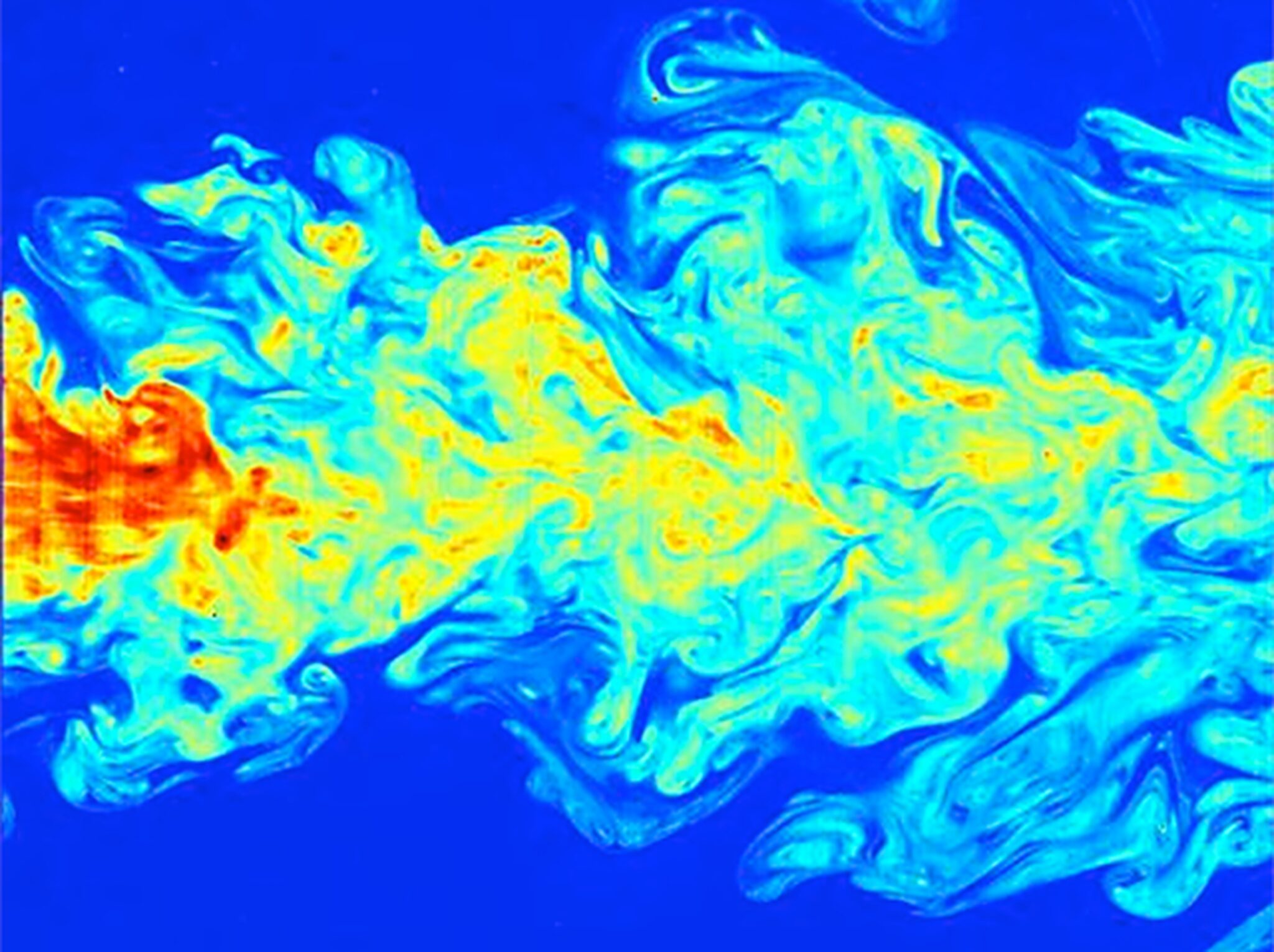
In a breakthrough more than a century ago, researchers solved one of the legendary problems posed by mathematician David Hilbert in 1900. In 2025, Zaher Hani of the University of Michigan, along with his colleagues, resolved a challenge that not only revisits the foundations of mathematics but also unifies several key laws of physics.
The problem—Hilbert’s sixth—called for deriving the laws that govern fluid motion from basic mathematical axioms. Hilbert believed that physics should rest on such first principles, but his vision remained unrealised for 125 years, until now.
In March 2025, Yu Deng from the University of Chicago, with his colleagues Zaher Hani and Xiao Ma from the University of Michigan, unveiled a framework that could connect classical mechanics and thermodynamics under a single mathematical framework.
The researchers outline a mathematically rigorous path from Isaac Newton’s particle-based view of matter to the large-scale equations that describe fluid motion.
Their approach builds on Boltzmann’s kinetic theory, which treats particle behaviour in terms of probabilities rather than individual trajectories. From there, the framework naturally connects to classical models, such as the Navier–Stokes equations, which are widely used to describe the flow of air and water.
The biggest problem for the researchers has been “time” itself. At the level of Newton’s laws, time is symmetric; the equations can only be run forward or backward and still get a valid result. But in thermodynamics, time clearly moves in one direction.
The researchers tackled this head-on by designing their methods to avoid contradictions. They used Feynman diagrams to track how particle interactions unfold over time without introducing paradoxes. Eventually, their approach helped to explain how time’s direction emerges from rules that don’t favor any direction at all.
Hani and his colleagues believe their equations could help improve models of air and ocean flow, particularly in complex environments such as hurricanes or turbulent currents. These settings are full of moving fluids that behave non-identically at different scales, making them ideal candidates for a unified approach.
By offering a bridge between the movement of individual particles and large-scale behavior, this new framework could refine how climate models account for heat and momentum.
Since the Navier-Stokes and Euler equations are used in weather simulations, adding deeper mathematical grounding could increase their accuracy and reliability – especially when tackling long-term predictions.
References:
- https://www.earth.com/news/mathematicians-may-have-solved-a-125-year-old-problem-linking-the-laws-of-physics/
- https://www.newscientist.com/article/2502845-mathematicians-unified-key-laws-of-physics-in-2025/
- https://www.scientificamerican.com/article/lofty-math-problem-called-hilberts-sixth-closer-to-being-solved/
Similar Articles:
- Weather wonders that left us puzzled in 2024
- Decoding Bennu: Groundbreaking 2024 research redefines life’s origin