Space has always been a mirror. When we look it up, we search for it but discover more about ourselves.
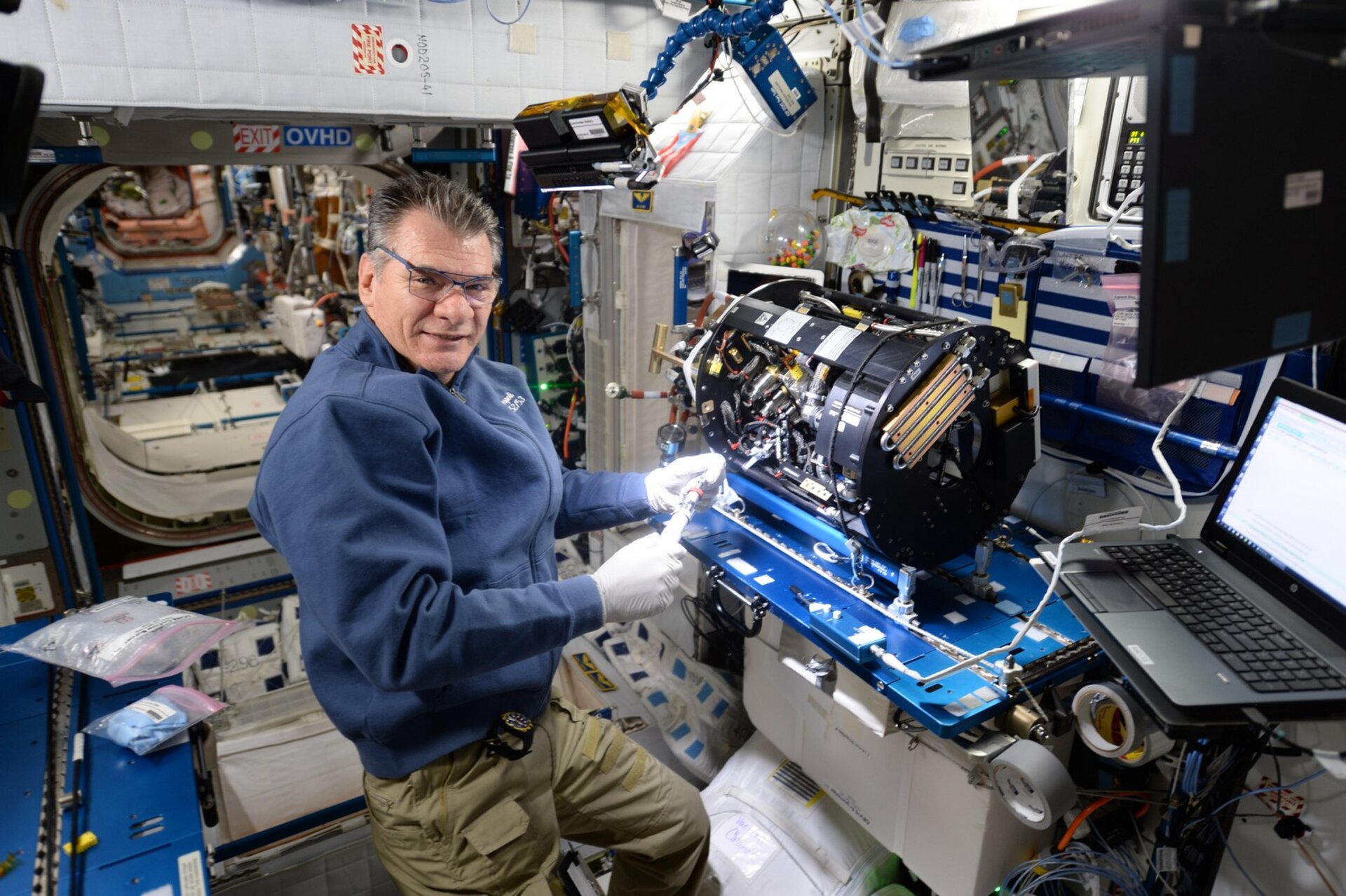
Orbiting 400 kilometers above Earth, the International Space Station (ISS) is not only a symbol of exploration. It is a laboratory where human biology is pushed beyond its design. In microgravity, bones begin to dissolve, muscles weaken, immunity becomes uncertain, and microbes adapt faster than we ever anticipated. [1–4]
“Every time we push beyond the familiar, we discover something new about what it means to be human.”
Thousands of kilometers above Earth, the International Space Station (ISS) orbits silently, a laboratory suspended between Earth and the infinite, where science and human experience merge in ways impossible to achieve on Earth. Every heartbeat, every cell, and every physiological response becomes a lesson in adaptation, resilience, and survival.
Astronauts aboard the ISS are not merely explorers; they are living experiments, revealing the hidden vulnerabilities of the human body and the extraordinary ways life adapts. The knowledge gained above is shaping medicine below, offering hope for conditions that have long resisted our understanding.
When Gravity Lets Go!
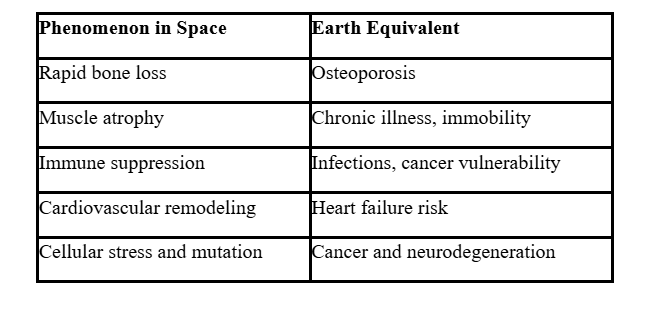
Gravity shapes life; it guides bone structure, muscle growth, blood circulation, and even cellular signaling. Remove it, and the human body responds in startling ways. Astronauts in orbit experience bone density loss of 1–2% per month, a rate far faster than osteoporosis on Earth [2,5].
Muscles, especially in the legs and back, weaken despite strict exercise regimens. Body fluids shift upward, increasing intracranial pressure and sometimes leading to blurred vision and long-term ocular changes. The immune system is compromised; latent viruses can reactivate, and the body struggles to fight routine infections. [1,4,6]
This acceleration of physiological decline is not just a curiosity; it is a window into disease mechanisms, compressed into months rather than years. It allows researchers to study interventions with unprecedented speed and efficiency.
“This is not a race against space.
It is a race against disease against time.”
Why Microgravity Matters for Medicine
Microgravity compresses years of human ageing into months. The ISS offers a rare advantage: accelerated insight into some of the most widespread health challenges on Earth. Astronauts experience in one mission what older adults experience in decades. Space lets scientists examine ageing while it accelerates.
When Gravity Disappears: Body Systems Under Pressure
Without gravity’s constant pull, bones stop forming, and calcium escapes into circulation [2,5]. Muscles shrink from disuse. [3] Blood redistributes toward the head, forcing the heart to adapt. [11] The consequences resemble some of the most serious public health concerns on Earth, but are revealed at a pace science can measure and respond to.
This has turned the ISS into a powerful model for developing better therapies for osteoporosis and cardiovascular decline.
The Immune System’s Breaking Point
Even short missions lead to altered white blood cell activity, cytokine changes, and shifts in the microbiome [1,4,6]. The ISS has become a unique testing ground to understand how stress accelerates disease, why some cancers evade immunity, and how microbes increase their resistance. Research in orbit is reshaping our understanding of infection and immunity.
Drug Discovery in Orbit
Protein structures are notoriously hard to analyze on Earth. Gravity interferes with crystal formation. In microgravity, crystals grow larger and more perfectly organized, allowing clearer structural maps of disease-driving proteins [9]. That clarity speeds drug development for cancer, neurodegeneration, and rare disorders. Space provides the stillness biology needs to reveal its architecture.
Organs on Chips: Human Physiology, Miniaturized
The ISS is now home to tissue-on-chip experiments: small living models of the human heart, bone, brain, and blood vessels. These systems help scientists watch how tissues age, mutate, and respond to treatment in real time. Medicine is becoming smaller, smarter, and more precise — tested far above the world it will treat.
Health Care Beyond Hospitals
In space, there is no emergency room. Innovation becomes a necessity. Remote ultrasound techniques and portable sequencing tools originally developed for astronauts are now used everywhere from rural clinics to disaster zones [10,13]. Real-time monitoring of physiological changes is improving outcomes both in orbit and on the ground. Space medicine is shaping the future of global health.
The Future Grows Upward
The ISS offers a rare perspective: remove gravity, and human vulnerability is exposed. But knowledge follows. From weakening bones to resilient microbes, from heart tissue to DNA repair, every experiment is designed with a dual mission. To safeguard astronauts as we push more into space and improve patient care across Earth. We often imagine space research as distant from everyday life. Yet some of the most practical answers to aging, cancer, and chronic disease are emerging from a laboratory where sunrise comes every ninety minutes.
Space is not escape, it’s life beyond words.
References:
- Crucian BE, et al. J Leukoc Biol. 2018;103(2):267–278.
- Smith SM, et al. Bone. 2015;81:712–720.
- Hargens AR, Vico L. J Appl Physiol. 2016;120(8):891–903.
- Choukèr A, Crucian B. Acta Astronaut. 2020;176:295–301.
- Grimm D, et al. npj Microgravity. 2022;8(1):1–13.
- da Silveira WA, et al. Cell Rep. 2020;33(11):108445.
- McCulloch AD, et al. Stem Cell Rep. 2021;16(10):2344–2356.
- Tanigawa N, et al. Crystals. 2021;11(5):530.
- Afshinnekoo E, et al. npj Microgravity. 2016;2:16035.
- Hughson RL, et al. J Appl Physiol. 2016;120(8):844–851.
- Garrett-Bakelman FE, et al. Science. 2019;364(6436):eaau8650.
- ISS National Laboratory. Benefits for Humanity. ISSNL; 2023.
- NASA. 20 breakthroughs from 20 years of science aboard the ISS. NASA.gov; 2024.
More from the author: In the Shadows of War— How Trauma Writes Its Legacy on the Bodies of Women and Children

Sadaf Sarfraz, currently a lecturer, holds an MPhil in Molecular Pathology and Genomics, complemented by a BSc in Medical Laboratory Technology. Contributing as a healthcare writer at Scientia-Pakistan, she passionately engages in calligraphy and art.

