On a cold morning in Peshawar, middle-school students gather around plastic cups of bright yellow turmeric water. When vinegar hits the liquid, it turns vivid red. Gasps ripple through the room. Whispers rise. “How did it change?” “Can we try again?” Eyes wide, hands pointing, voices overlapping, for many, it is the first time learning experience when science feels real, something to see, touch, and wonder about.
A science communicator conducting the session notes how the energy in the room shifts completely. “Students who normally sit quietly were leaning forward, speaking up, questioning everything,” she recalls.
Yet, as education researcher Nazir A. Jogezai points out, moments like this are rare. In much of Pakistan, science classrooms are dominated by rote learning and exam preparation, leaving little space for inquiry or experimentation. “Students often pass tests without ever handling a pipette or watching a chemical reaction,” he says. The system prioritises coverage over understanding, theory over hands-on experience, and curiosity suffers.
Even a simple turmeric experiment can feel revolutionary, hinting at what’s possible when students are free to explore and question.
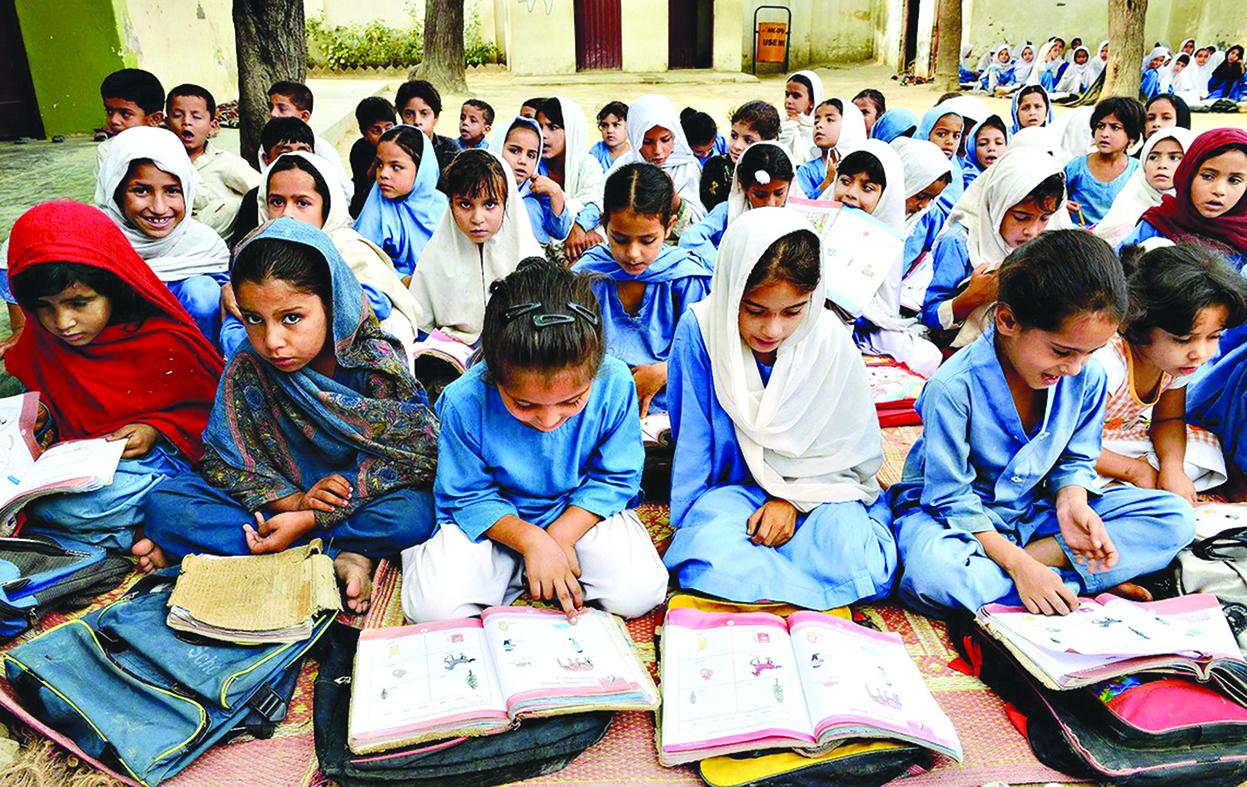
But for most schools in Pakistan, such moments are a rare occurrence. The numbers tell a daunting story: only about 60–61% of the population is literate, with a sharp gender divide, roughly 68% of men versus 53% of women. Nearly 26.2 million children, around 38% of those aged 5–16, are out of school. Public spending on education has fallen to just 0.8% of GDP, far below the 4–6% UNESCO recommends.
These gaps help explain why classrooms like the one in Peshawar often go without basic needs: roughly one-third of schools lack electricity or clean water, and nearly a quarter of primary schools operate with just a single teacher for all grades. Decades of underfunding have left Pakistan lagging far behind global standards, making hands-on, inquiry-driven science a rare experience.
The figures mirror what teachers see in the classroom every day.
“Science education in Pakistan is still based mostly on the rote learning (ratta) system,” says Shagufta Naheed, a high-school principal in a remote village, in an interview with Scientia Magazine. She explains that students “memorize concepts from textbooks without being taught how or why those things work in the real world.” For example, pupils might copy the equation for a chemical reaction without ever witnessing one in a lab.
“It’s really hard for students to fully understand scientific concepts,” Shagufta adds, because lab work often stays on paper, “there just aren’t enough resources, proper labs, or trained staff” to make experiments happen. The result is predictable: little creativity, little critical questioning, and students who treat science only as exam material.
Teachers say textbooks and lectures lose children within minutes. In Karachi, headmistress Durdana Tabassum observed that students quickly disengage from traditional science classes until something hands-on begins. At a recent school science fair, she noted the boys “are enjoying themselves and participating happily” as experiments replaced lectures. A facilitator explained, “We make the students do the experiments with us so that they will learn it for a lifetime.” One fifth-grader agreed: “I never thought I could learn science from these experiments.” By engaging curiosity and the senses, such activities turn rote routines into lasting lessons.
Recognizing this gap, non-profits and science-focused initiatives have stepped in to bring science into classrooms and communities across Pakistan. Science Fuse, a social enterprise, runs after-school clubs, summer camps, teacher-training programs, and traveling science shows to introduce hands-on STEM learning to low-income schools. Since its launch in 2016, it has partnered with roughly 250 schools, reaching 45,000 children and training 650 teachers—helping transform rote classrooms into spaces where curiosity can thrive.
Similarly, organizations like the Khwarizmi Science Society have long worked to popularize science through public lectures, festivals, and educational outreach, fostering critical thinking beyond textbooks. Media platforms such as Kaainat Studios are also playing a vital role by producing engaging science content and storytelling that connects young audiences with real-world scientific ideas. Together, these efforts are gradually reshaping Pakistan’s science education landscape—making it more interactive, accessible, and curiosity-driven.
The impact of these hands-on sessions is clear. Young students who had never touched lab equipment suddenly watch chemical reactions and ask “why” and “how” instead of just copying. One report noted children were “enraptured by the experiments and ended up learning a lot.” By actively doing rather than just listening, kids remember lessons for years. Their work aims to make science “relevant and meaningful”, showing students role models and practical applications that defy the old stereotype that “science is a very tough subject only boys can do”, by engaging girls equally in experiments.
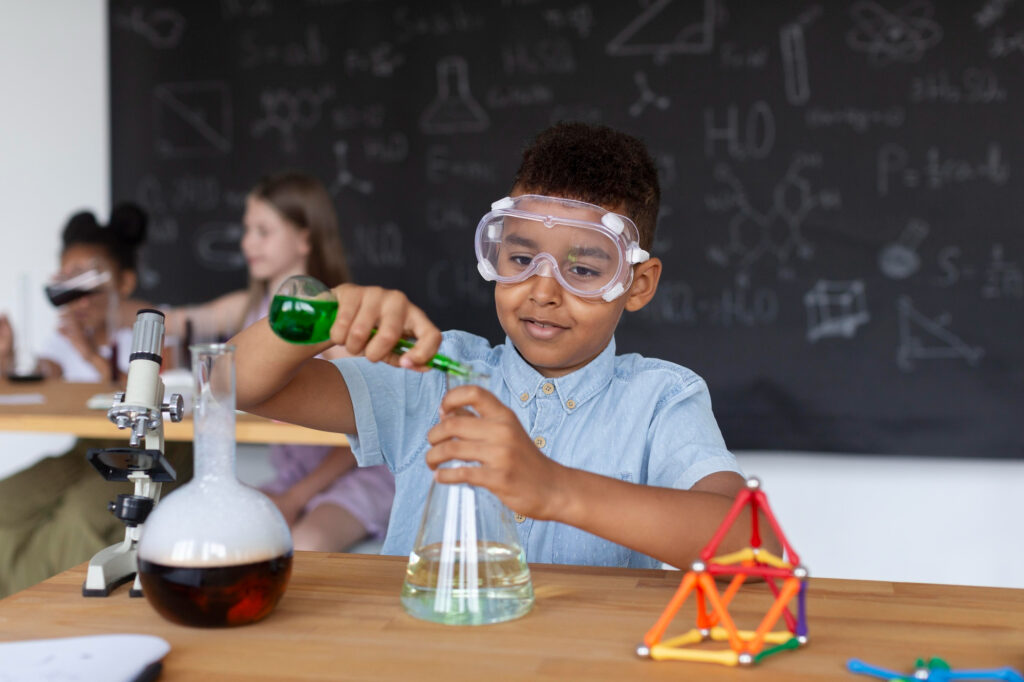
Education analysts at the Sustainable Development Policy Institute (SDPI) describe such initiatives as hopeful, but the scale of the crisis remains overwhelming. Serious underinvestment leaves most public schools without functioning labs or basic supplies. Without higher budgets and structural reform, Pakistan “will continue to struggle” with millions of undereducated youth. Nearly four in ten children still lack meaningful access to schooling, risking the country falling behind economically and socially. Writing in Dawn, columnist Nazir A. Jogezai argues that students “lose faith in what they are taught,” becoming “demotivated degree-holders rather than valuable human capital.”
Even so, signs of change emerge. In every makeshift lab, under a desk or in a borrowed hall, children who once stared at equations now eagerly mix vinegar and baking soda, curious about each reaction. “Learning happens when students do things, not just memorize them,” she notes, echoing Confucius: hear and forget, see and remember, do and understand. With more funding, trained teachers, and hands-on moments, even Pakistan’s poorest schools can nurture future scientists. Meanwhile, programs like Science Fuse are lighting a spark, one experiment at a time.
Referneces:
- Dawn. “The Rote Rut.”nhttps://www.dawn.com/news/1905221
- “Learning, a Privilege.” https://sdpi.org/10293/blogs-learning-a-privilege
- “Classroom Conundrum: The Hidden Crisis of Science Without Experiments with Shagufta Naheed.” https://scientiamag.org/classroom-conundrum-the-hidden-crisis-of-science-without-experiments-with-shagufta-naheed/
- The Express Tribune. “Students Learn to Love Science Through Interactive Learning.” https://tribune.com.pk/story/1361809/students-learn-love-science-interactive-learning
- Assembly – Malala Fund. “Building the Next Generation of Pakistani Women Scientists.” https://assembly.malala.org/stories/building-the-next-generation-of-pakistani-women-scientists
- UNICEF Pakistan. “Giving Every Child the Right to Education.”
https://www.unicef.org/pakistan/education
Similar articles:
Educating for Tomorrow: The Impacts of Science Communication in Sustainability Awareness
Palestine’s Hope in Science: Insights from Neuroscientist Abdulrahman Abou Dahesh
Saman Zara Shah is a science communicator and business student from Peshawar, striving to make science accessible through hands-on learning, storytelling, and writing that sparks curiosity and critical thinking.

