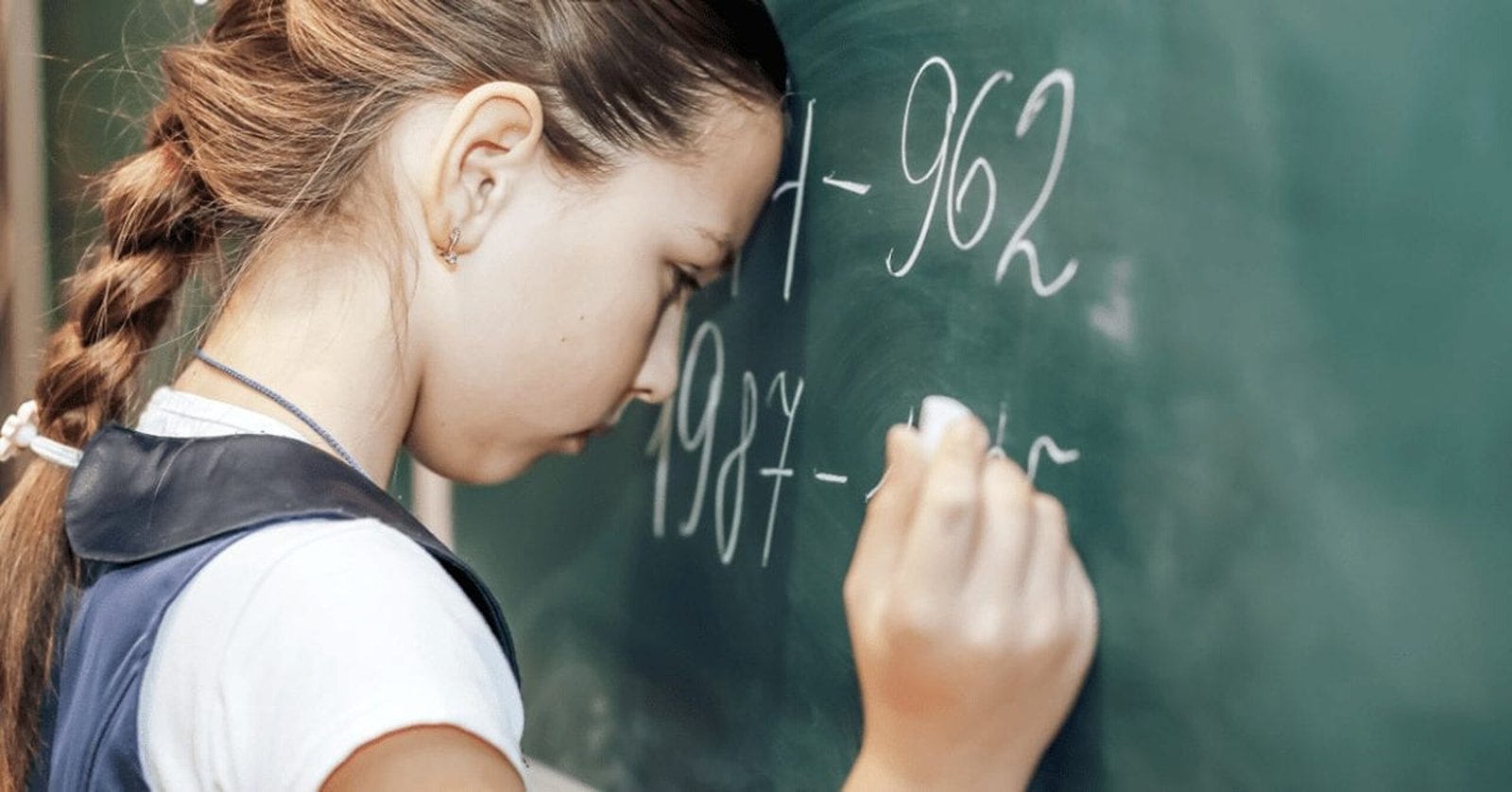
“She was just an unlucky person who had Dyscalculia in the society that she belonged to”. In a co-educational school in Lahore, a hardworking student, Ameenah, discreetly struggles with mathematics every day. Her confidence withers away slowly with each new mistake. Ameenah’s teachers would never forget to remark, calling her careless, while her classmates just considered her ‘lesser’ in terms of intelligence and would quietly move on.
Each day would pass with her dreading math lecture, the criticism she would get due to underperformance in math further deteriorating her overall grade in other subjects. To sweet and witty Ameenah, math was suffocating. She was expected to solve the complex equations in her tests when the 2 kept merging with 7, and she could never know how much time was left for the exam on the clock.
Ameenah wonders why her home isn’t a haven for her when it is for other people. Why did her parents take the unsolicited opinions of her relatives seriously? Relatives think that her being a girl is the reason behind her inability to understand numbers. “Girls simply aren’t made for tough subjects; her place is in homemaking,” they would whisper to her mother. Instilling the idea of a life of drudgery and underappreciated chores for her in her parents’ gullible minds. What these oblivious people failed to see was that Ameenah wasn’t slow-witted. She was just an unlucky person who had Dyscalculia in the society that she belonged to.
What is Dyscalculia?
Dyscalculia is a neurodevelopmental learning disorder that affects the brain’s ability to process numerical information. Much like dyslexia affects reading, dyscalculia disrupts the regions of the brain responsible for basic numeracy, time estimation, and mathematical application.
For all individuals like Ameenah, the struggle against math extends into daily life. Time Estimation, considering how important time estimation is, a blindness for it creates difficulties when it comes to reading clocks, and knowing how long a task will take. Remembering phone numbers, pin codes, and steps to any task, and being able to calculate change at a shop, is almost impossible.
A Gendered View Of Dyscalculia
There is a disproportionate occurrence of this disease in girls, almost 2% more than boys, while among individuals with any learning disability, 45% have dyscalculia along with it. These statistics are quoted from recent epidemiological research conducted in Lahore.
Many people feel that when a boy faces some difficulty with math, he will be reassured and tutored. However, when a girl faces the same situation, it’s taken as an opportunity to rid her of her studies and hand over domestic chores to her. Even if Pakistan is actively combating sexism, society misuses the circumstances of girls like Ameenah to prove their stereotypes right; many will put forward baseless claims, such as being a girl makes you inferior to men when it comes to intelligence. Before such blatantly ignorant ideas of people crush the confidence and integrity of women, drastic steps have to be taken.
After much pleading by Ameenah, her parents arranged for her a private teacher, Sarah. A couple of weeks in, the teacher noticed inconsistencies and unusual patterns in Ameenah’s learning. Ameenah easily understood concepts when they were explained verbally, yet somehow forgot the foundations of math the next hour. The teacher, taken aback by such a case, began researching multiple learning disorders. It was only when she discovered dyscalculia that Ameenah saw hope for her otherwise darkening future.
What is the next step?
We must ensure that no more cases like Ameenah’s occur and then get swept under the rug. It is a failure of the policy makers that dyscalculia is neglected to such an extent. To make a more inclusive and educated population, we must take steps for Teacher Training and parents’ understanding. The education departments of Pakistan must commence programs and workshops that help teachers detect such a condition in students early on, so that a treatment for them can be started when the chances of better treatment are higher.
Parents must understand that their child isn’t defective, and instead of using such derogatory terms, they ought to facilitate them with not just clinical help but words of affirmation and motivation. It is high time that dyscalculia gets voiced and the right people, such as policy makers and mental health experts, flag this issue. Students like Ameenah deserve to feel equal and live normal lives, and not feel like outcasts simply because their brains understand numbers differently.
References:
- https://www.the74million.org/article/teachers-join-forces-to-understand-dyscalculia-a-math-related-learning-disorder/
- https://hospitals.aku.edu/pakistan/diseases-and-conditions/Pages/dyscalculia.aspx
- https://pjms.org.pk/index.php/pjms/article/view/2486/689
- https://my.clevelandclinic.org/health/diseases/23949-dyscalculia
Similar Articles: Cognitive Blessings, Emotional Burdens: Psychological intricacies of high IQ individuals

Tazeen Rehman, an A-level student at Lahore Grammar School, Lahore, is deeply passionate about STEM, especially mathematics, and actively promotes numerical literacy in Pakistan.

