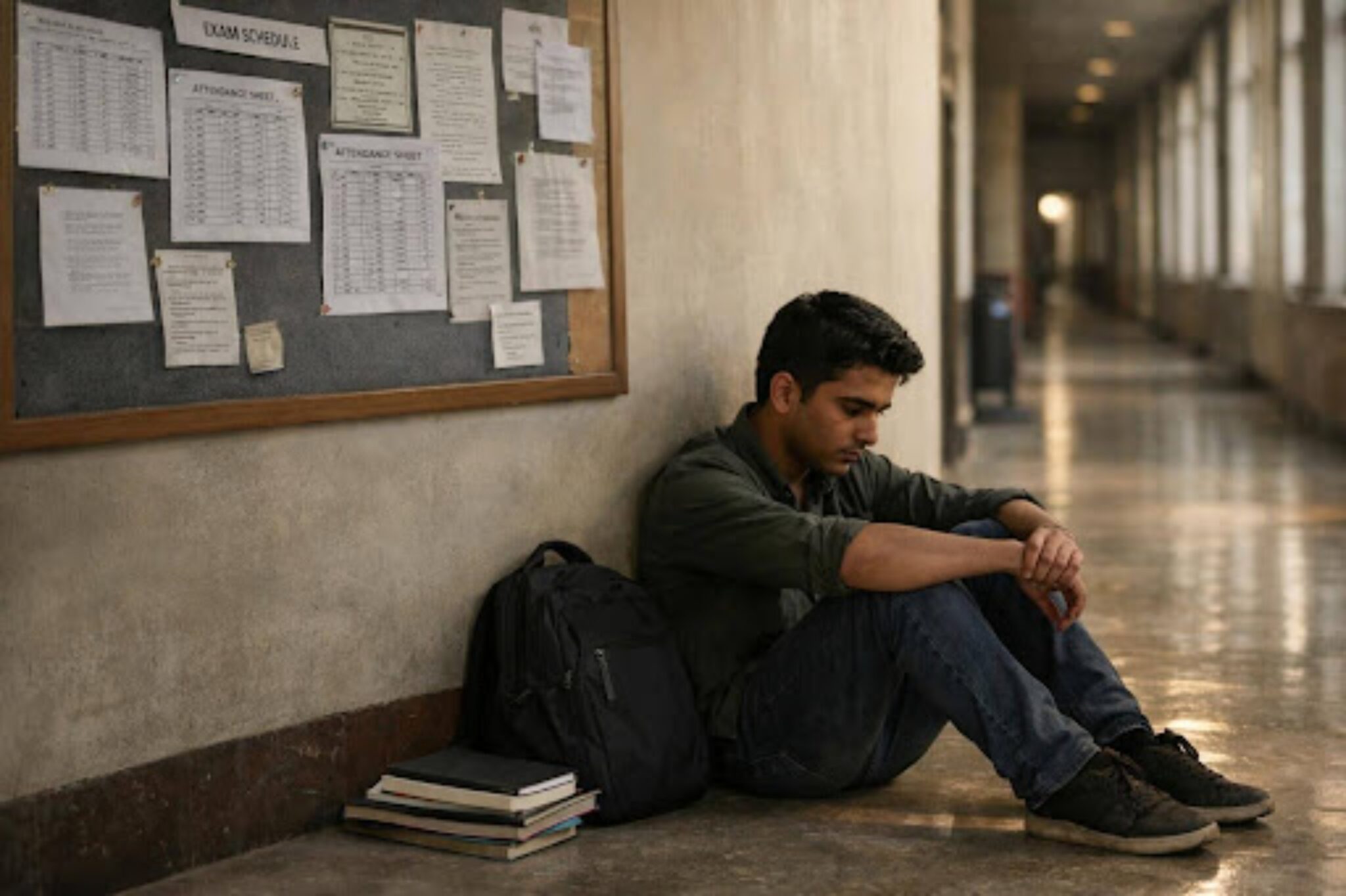
Pakistan has reached a point where student distress is harder to ignore. In Lahore, recent cases involving university students have brought this issue to public attention. A 22-year-old boy gave up on his life by jumping from the fourth floor of a university building. This case led to protests over alleged humiliation linked to attendance rules [1]. Another involved a first-semester student who survived with serious injuries after jumping from second floor of university building [2]. A third case involved a hostel student at a public medical university who jumped from the fourth floor and died [3].
Each case triggered inquiry committees and public debate. Each case also raised the same hard question. Why do so many students break down in silence before anyone steps in?
This piece of writing does not treat those reports as spectacle. Suicide is rarely the result of one event. The World Health Organization stated in a report about suicide published on 25th March, 2025, that suicide grows from multiple social, psychological, cultural, biological, and environmental factors [4]. The World Health Organization, in a report about preventing suicide published on 12th September 2023, warns against simple explanations and sensational reporting because both distort public understanding and weaken prevention [5].
Why do students reach this point?
A student rarely wakes up one morning and moves from stable to suicidal. The path is often slow. Pressure builds. Shame grows. Sleep gets worse. Fear becomes constant. Hope shrinks.
For many students in Pakistan, university life carries more than study pressure. It entails family sacrifices, financial burdens, professional competition, hostel adjustment, and the fear of wasting years of effort. One failed exam feels like a public collapse. One warning feels like a verdict. One harsh interaction feels final.
In 2017, the Journal of Ayub Medical College Abbottabad published this research by the Institute of Clinical Psychology, University of Karachi, Pakistan. This study supports the view that college students found suicidal ideation was linked with depression, anxiety, stress, and lower life satisfaction [6].

In 2023, a study was conducted among students at four major Pakistani universities and was published in the Psychology, Health & Medicine journal. Research found that around 32% of Pakistani university students reported thoughts of death or self-harm in the prior two weeks, with higher rates among those facing stronger anxiety and depression symptoms [7].
In 2021, Frontiers in Public Health Journal published an online systematic review and meta-analysis about the overall prevalence of depressive symptoms among university students in Pakistan. This review found depressive symptoms among university students in Pakistan at 42.66% overall, while also calling for stronger national data and better support systems [8].
These numbers do not prove that every distressed student is suicidal. They do show one clear fact. Student mental health strain is common, and ignoring it carries a cost.
The role of shame!
Academic pressure matters. Shame matters too!
There is a difference between academic accountability and humiliation. When a student already feels fragile, a public scolding, a rigid warning, or a threat to an entire semester may hit harder than teachers or administrators expect. The student does not hear the policy. The student hears failure. The student hears, “You are finished.” This matters because shame is not a small emotion.
In 2024, the PLOS ONE Journal published a systematic review on the impact of the lived experience of humiliation and shame on self-harm and suicidality in adolescents and young people. It found links between humiliation, shame, self-harm, suicidal ideation, and suicide among adolescents and young adults [9].
Older evidence, a review study published in 2019 published by Clinical Psychology Review Journal, points in the same direction as results of this review support the link between shame and self-harm [10].
When a student feels exposed, trapped, and disgraced, their thinking narrows. Temporary problems start to look permanent. One bad result starts to feel like a ruined identity. This does not mean every disciplinary action leads to a crisis. It does mean institutions need to consider the emotional impact, not just policy compliance.
Why do students stay silent?
Students often hide distress until the risk becomes acute. They hide it because they do not want to look weak. They hide it because they fear gossip. They hide it because they think parents will panic, blame them, or pull them out of university. They hide it because they believe everyone else is coping better.
In Pakistan, stigma around mental health still shapes help-seeking. In 2024, the Journal of the Pakistan Medical Association published a cross-sectional study by Zafar et al., which included a total of 316 medical university students. Research reported that social stigma remains a major issue in attitudes toward professional mental health care [11]. When help feels socially costly, students delay support. By the time they speak, the crisis is deeper.
This is why public advice such as “be strong” often fails. Strength is not the issue. Safety is.
Better way to understand suicidal thinking!
Suicidal thinking often grows from a sense of entrapment. The student feels stuck between options that all look unbearable:
- Fail the course, disappoint the family.
- Speak up, risk shame.
- Stay silent, keep drowning.
- Take a break, fear of being left behind.
This is why outsiders often misread the warning signs. The student may still attend class. The student may still laugh with friends. The student may still post online. A crisis does not always look dramatic from the outside.
A report about suicide published on 25th March, 2025, by The World Health Organization stated that suicide is the third leading cause of death among 15 to 29-year-olds worldwide and that more than 720,000 people die due to suicide every year [4]. Young people are at real risk. Student mental health is not a side issue. It is a public health issue. The response needs to become more practical and more solution-oriented.
What students need right now
Students need clear support, not slogans.
If your thoughts are turning toward self-harm or suicide, treat that as an emergency. Tell one trusted person today. Stay with people. Leave unsafe places. Ask someone to sit with you. Go to a hospital or emergency service if the risk feels immediate.
Pakistan does have support points. Umang describes itself as a 24/7 mental health helpline run by clinical psychologists, psychiatrists, and active listeners [12]. The HEC and UNFPA National Youth Helpline, a toll-free number 0800-69457, offers psychosocial first aid, counselling, guidance, and referrals [13,14,15].
A student in crisis does not need a lecture on gratitude. A student in crisis needs fast contact, practical protection, and calm human presence.
What should families do?
Families also need a clearer role. Fear-based pressure does not produce resilience. It often produces secrecy. If your child sounds withdrawn, hopeless, ashamed, or trapped, do not start with blame. Start with questions:
Are you safe right now? Have you had thoughts of hurting yourself? Who have you told, and what do you need in the next hour? Listen first. Remove access to obvious means of self-harm. Stay close. Seek urgent professional help if the risk is high. Do not reduce the problem to faith, laziness, or “overthinking.” Those responses push students deeper into silence.
What universities should change?
Universities need to move from an inquiry culture to a prevention culture. An inquiry after a death is not enough. A fence after a crisis is not enough. A condolence notice is not enough.
A serious prevention plan should include confidential counselling units with trained staff, clear crisis referral protocols, mental health screening and check-ins for high-pressure programs, faculty training on how to address struggling students without shame, academic appeal systems before students lose a semester, hostel wardens trained to respond to distress, and peer support systems with referral pathways.
WHO, in a report about 2000-2021 Suicide data, states that evidence-based suicide prevention works at the population, group, and individual levels [16]. WHO media guidance, in a report about preventing suicide published on 12th September 2023, also urges communication that focuses on support, recovery, and help-seeking, rather than graphic detail or romanticized loss [5]. Universities should follow the same principle in their own response after a crisis.
What do teachers need to hear?
Teachers need to hear this, too. They do not need to become therapists. They do need to understand risk. A student who is missing classes, submitting poor work, or reacting emotionally to academic pressure is not always lazy or unserious. The student may be overwhelmed, depressed, sleep-deprived, bullied, or in a family crisis.
Language matters. Tone matters. Timing matters. A hard conversation delivered with dignity protects students better than a hard conversation delivered with contempt. Rules still matter. Standards still matter. Respect matters too.
What must the public conversation stop doing?
Pakistan also needs to stop treating student suicide as gossip for a few days and then move on. Video clips, rumor threads, and assigning blame don’t help students. They feed panic and shame. WHO, in a report about preventing suicide published on 12th September 2023, states that widely shared suicide stories shape public behavior and that reports focused on people who survive crises and seek help support prevention better [5].
A better public response asks harder questions: Did the campus have counseling? Did students trust it? Did teachers know how to respond? Did the institution have a safety plan? Did the student know where to turn before the crisis peaked?
Those questions save more lives than outrage alone. Students are more than attendance sheets, GPAs, warnings, and one bad semester. Your current pain is serious. It deserves action. It does not deserve silence.
References:
- Dawn. (2025, December 27). Minister forms committee to probe the death of a university student. (https://www.dawn.com/news/1963447)
- Dawn. (2026, January 5). A University of Lahore student was injured after jumping from the second floor. (https://www.dawn.com/news/1965255)
- Dawn. (2026, February 18). Another female student dies by suicide. (https://www.dawn.com/news/1974003)
- World Health Organization. (2025, March 25). Suicide. (https://www.who.int/news-room/fact-sheets/detail/suicid)
- World Health Organization. (2023, September 12). Preventing suicide: A resource for media professionals. (https://www.who.int/publications/i/item/9789240076846)
- Naseem, S., Munaf, S., & Bano, R. (2017). Suicidal ideation, depression, anxiety, stress, and life satisfaction of medical, engineering, and social sciences students. Journal of Ayub Medical College, Abbottabad, 29(3), 422 to 427.
(https://jamc.ayubmed.edu.pk/index.php/jamc/article/view/1553/1057) - Salman, M., Mustafa, Z. U., Asif, N., et al. (2023). Self-harm and suicidal ideation in Pakistani youth amid the COVID-19 pandemic. Psychology Research and Behavior Management, 16, 679 to 690. (https://doi.org/10.1080/13548506.2022.2119483)
- Khan, M. N., Akhtar, P., Ijaz, S., & Waqas, A. (2021). Prevalence of depressive symptoms among university students in Pakistan. Frontiers in Public Health, 8. (https://doi.org/10.3389/fpubh.2020.603357)
- Sadath, A., McLoughlin, A., Sheehy, K., et al. (2024). Associations between humiliation, shame, self-harm, and suicidality in adolescents and young adults: A systematic review. Psychological Medicine. (https://doi.org/10.1371/journal.pone.0292691)
- Sheehy, K., Noureen, A., Khaliq, A., et al. (2019). An examination of the relationship between shame, guilt, and self-harm: A systematic review and meta-analysis. Clinical Psychology Review, 73, 101779. (https://doi.org/10.1016/j.cpr.2019.101779)
- Zafar, M., Atiq, H., Mubashir, H., et al. (2024). Attitude towards seeking professional help for mental health issues among medical students of Rawalpindi Medical University, Pakistan. Journal of the Pakistan Medical Association. (https://doi.org/10.2144/fsoa-2023-0114)
- Umang. (n.d.). Umang, a mental health helpline. (https://www.umang.com.pk/)
- Higher Education Commission, Pakistan. (n.d.). National Youth Helpline launched at HEC Secretariat.
- United Nations Population Fund Pakistan. (2024, May 30). National Youth Helpline: Help is but a phone call away. (https://pakistan.unfpa.org/en/news/national-youth-helpline-help-phone-call-away)
- Umang. (n.d.). Contact us. (https://www.umang.com.pk/contact-us/)
- World Health Organization. (n.d.). Mental health and substance use, suicide data. (https://www.who.int/teams/mental-health-and-substance-use/data-research/suicide-data)
More from the author: Gul Plaza Fire- Key Takeaways for Building Fires and Safety

Anam Ilyas holds an MS Forensic Chemistry from Government College University, Lahore. She is a science enthusiast with a great love for explaining complex topics in simpler ways. She aims to bridge the gap between scientific research and the general public through her writing. When she is not writing or talking, you can find her lost in a book or making ideas come alive through her drawings.

