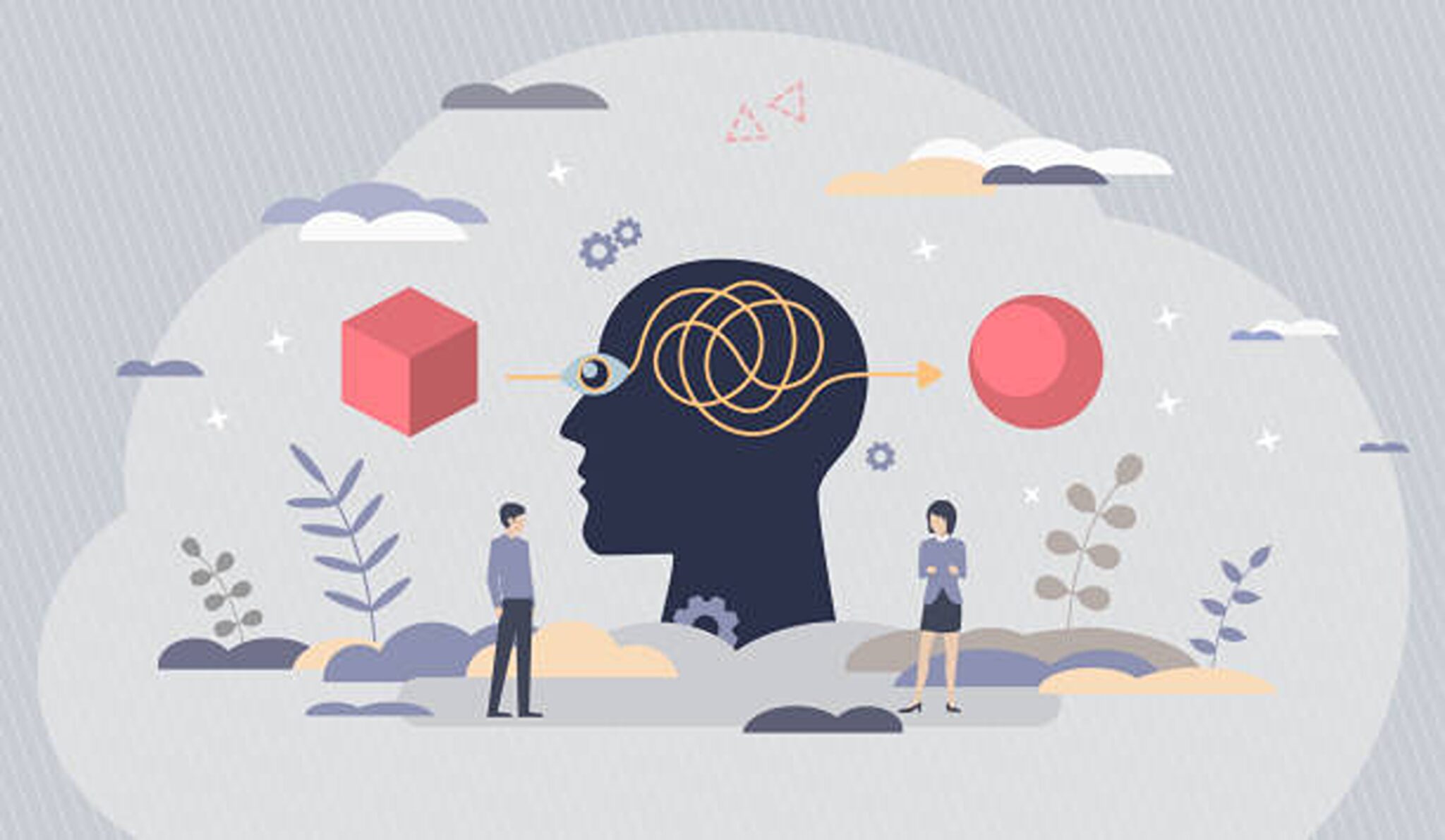
Before even starting to read this article, your mind would have made a couple of choices about the neuroscientific and psychological views of the topic. Free will is considered the capacity to choose among various options, to exercise control over one’s actions as a moral responsibility, and to be the originator of one’s own actions.
Many observed discoveries in psychology and neuroscience support disagreements about the illusion of free will. Benjamin Libet’s experiments demonstrated that the brain’s readiness potential precedes an individual’s conscious decision to act. It suggests that neural procedures may precede conscious intention.
According to Libet, there is a visible lag between brain preparation and conscious will since the readiness potential starts around 550 milliseconds before movement and conscious awareness of the intention only manifests 200 milliseconds before action. Research on split-brain patients by Michael Gazzaniga also revealed that when actions start outside of conscious awareness, people subsequently provide enthralling justifications, specifying that the mind works as an interpreter rather than the decision-maker.
The belief that more choice means greater freedom is negated by Sheena Iyengar’s jam experiment, which shows that having more options can actually make decisions harder. Everyday environments systematically shaped them without anyone observing. Moreover, subtle cues, like exposure to specific words, can unconsciously change behaviour.
Free will is one of the most treasured ideas in human thought. It suggests that we author our actions and are morally responsible for them because we control our lives. This presumption permeates every system, including the legal system, educational institutions, religious institutions, and casual conversations.
We are in the habit of praising effort, blaming wrongdoing, and appreciating courage because we believe people have different options. Over the decades, however, the idea has emerged that many of our choices are determined long before we become consciously aware of them.
The question then is: “If the brain decides first and consciousness only finds out, then what role does free will actually play?” Psychology adds another layer to this question. When humans explain their own behaviour, they often prove to be skilled storytellers. Research shows that these explanations are frequently post hoc rationalizations rather than true reasons.
In classic experiments, people are influenced by the framing of options, the order in which choices are presented, emotional states, and many other factors. Their justifications for a given decision frequently don’t relate to the real factors at play.
In actuality, a lot of what we do is automatic, despite the fact that we frequently believe we have deliberate control over our choices. Habits, feelings, prejudices, and prior experiences all influence how we behave. The brain makes quick decisions in the background without our knowledge, which leads to this mostly undetectable process.
The part that strongly feels like “us” is the conscious mind, but it comes in later. Like a storyteller giving reasons for what has already happened, it elaborates the action after it has occurred. Conscious thought is not the commander of decisions; it is more like the narrator of a story.
It is believed that many factors, including genes, brain chemistry, childhood experiences, culture, customs, and surroundings, shape our reactions and decisions in different situations. Free will is therefore argued to be less real than it feels. From this perspective, humans are complex biological systems that respond to situations according to biological and physical laws. We may compare them to machines, although humans are far more advanced.
This view is known as hard determinism, which explains that every action has its basis in previous reasons. In light of this, the idea that one could have acted differently is considered a fiction. Since there is currently no conclusive experimental evidence that neural laws determine our conscious wills, Libet warned that both strict determinism and non-determinism are still theoretical stances.
If we completely abandon the concept of free will, it becomes difficult to justify moral responsibility and concepts such as guilt, justice, blame, praise, and personal growth. Not everyone believes that neuroscience abolishes free will, and many philosophers state that the issue lies in how we define it.
According to compatibilism, free will means acting according to one’s reasons without external force. Even if shaped by biology and prior experiences, the reasons are still ours. Hence, neuroscience does not eliminate free will; it simply shows that it works within limits.
According to Libet, consciousness has a veto power, even though unconscious processes initiate actions. In this viewpoint, free will is not about initiating actions but about monitoring and perhaps hampering them. This idea matches with daily activities and experiences. We often feel the need to express aggression but choose to refrain. The impulse arises unconsciously, and the capacity to suppress it also stays within us.
The idea of control associated with free will influences motivation, ethical behaviour, and mental health. The experience of choosing is powerful, whether free will is entirely real or not. Research suggests that when belief in free will is weakened, it is associated with greater cheating, aggression, and fatalism.
Free will has a limited capacity, and it grows with education and self-reflection. A deeper understanding of our experiences creates greater room for meaningful choice. We should not think of ourselves as puppets whose decisions are entirely out of our control. There is a significant space between impulse and action where reflection, values, and responsibility can emerge.
Free will, even if it is not absolute freedom, is not a complete illusion either. We can rightly call it a constrained freedom that is real enough to hold meaning. If we are not in full control, we are not powerless either.
Libet suggested that the existence of genuine free will is “at least as good, if not a better, scientific option than its denial.”
References:
- Libet, B. (1985). Unconscious cerebral initiative and the role of conscious will in voluntary action in Behavioral and Brain Sciences, 8(4), 529-539.
- Gazzaniga, M. S. (1998). The split-brain revisited. Scientific American, 279(1), 50-55.
- Iyengar, S. S., & Lepper, M. R. (2000). When choice is demotivating: Can one desire too much of a good thing?. Journal of personality and social psychology, 79(6), 995.
- Soon, C. S., Brass, M., Heinze, H. J., & Haynes, J. D. (2008). Unconscious determinants of free decisions in the human brain. Nature Neuroscience, 11(5), 543-545.
- Haggard, P. (2008). Human volition: towards a neuroscience of will. Nature Reviews Neuroscience, 9(12), 934-946.
- Baer, J., Kaufman, J. C., & Baumeister, R. F. (Eds.). (2008). Are we free? Psychology and free will. Oxford University Press.
- Mele, A. R. (2009). Effective intentions: The power of conscious will. Oxford University Press.
- Vohs, K. D., & Schooler, J. W. (2008). The value of believing in free will: Encouraging a belief in determinism increases cheating. Psychological Science, 19(1), 49-54.
- Harris, S. (2012). Free will. Continuum Companion to Hume, London, Continuum, 214-226.
More from the author: AI and Machines: There is No such thing as Conscious Artificial Intelligence!

Syeda Khair-ul-Bariyah has been associated with teaching since 2007. She is a synthetic organic chemist and a science and fiction writer. She has publications in both national and international journals in the field of Chemistry. Moreover, she is the author of a stage playbook, “Peregrination of the Soul,” and has a couple of articles and poems published on various websites.

