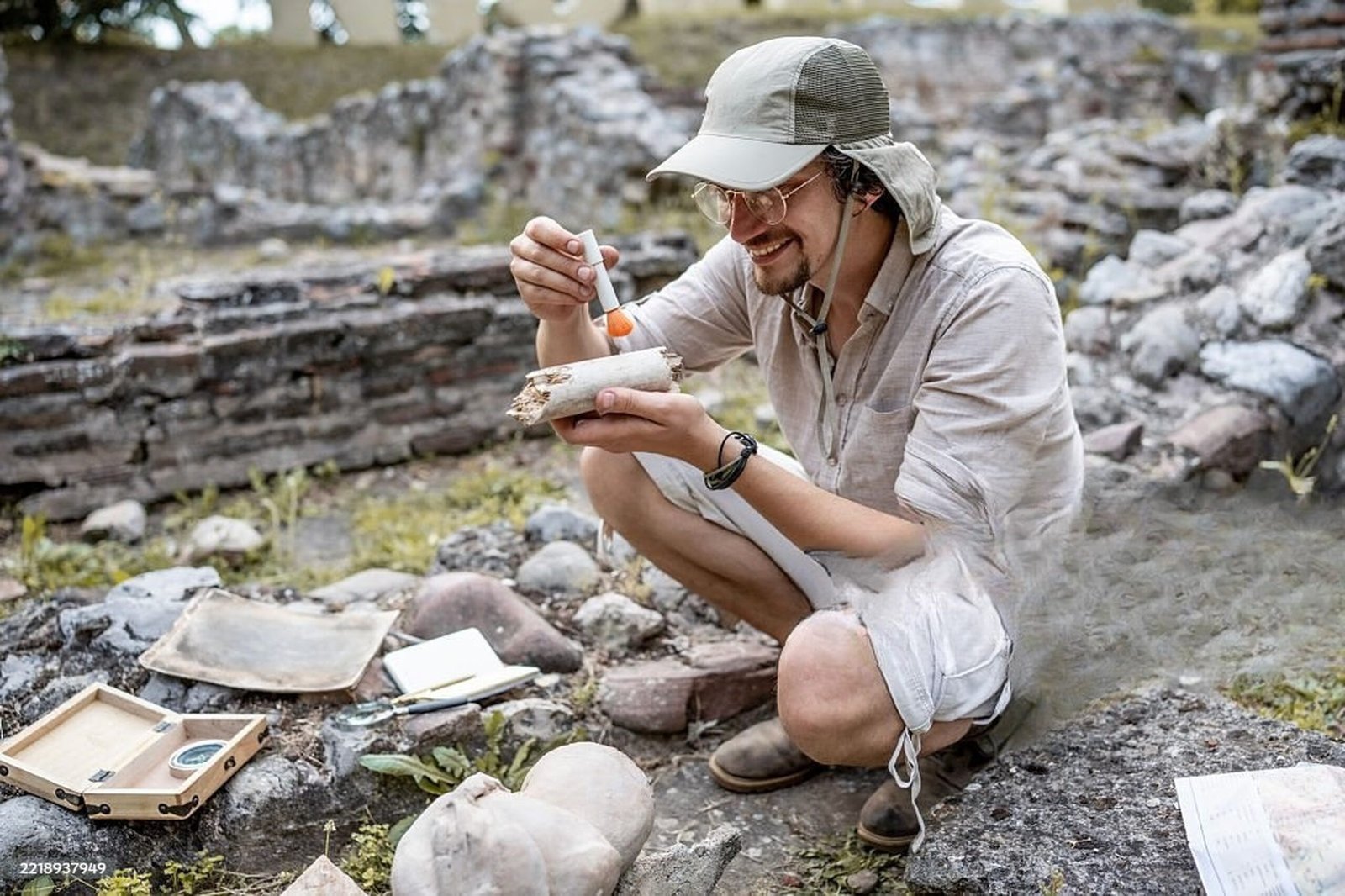
‘A burial opens slowly. Soil comes away in thin layers. A brush touches bone, then a skull, then a fracture line across the surface. The person has no name beside the grave. No witness remains. Yet the body still carries evidence. Forensic archaeology studies death through bones, teeth, soil, and objects in context to locate and recover human remains and evidence.
The field joins archaeological recovery with forensic questions about identity, injury, time since death, and treatment after death. Archaeologist Dr. William describes the forensic value of excavation, context documentation, stratigraphy, soils, artifact conservation, and taphonomy, the study of changes after death. These skills matter because ancient deaths arrive broken, buried, disturbed, and incomplete [1].
What Forensic Archaeology Does?
Forensic archaeology treats the burial place as evidence. A modern crime scene loses value if a body is moved before it is recorded. An ancient burial faces the same risk. Once bones, tools, textiles, or grave goods shift from position, part of the record disappears. In Forensic archaeology, researchers record depth, orientation, soil color, bone position, objects, roots, stones, and signs of disturbance. A skeleton found face down raises different questions from a skeleton placed with grave goods. A mass burial raises questions about conflict, disease, punishment, disaster, or crisis.
Forensic taphonomy is the study of what happens to a body after death, and gives archaeologists’ work its caution. Heat, water, animals, plant roots, soil pressure, excavation tools, and later construction all damage remains. Some marks look violent, but come from the environment. Some violent injuries disappear because bone decays. Dirkmaat and colleagues describe forensic recovery as a multidisciplinary process linking the scene, skeletal analysis, and postmortem change, which helps researchers separate injury from damage after burial [2].
The Body as Evidence
Bones and teeth form a biological archive. They do not tell a full biography, yet they preserve selected facts about life and death. A healed fracture shows that a person survived an earlier injury. A fresh break near death suggests violence, accident, or collapse. A cut mark on bone records contact with a sharp edge. A depressed skull fracture points toward blunt force, although the full pattern still needs context.
Teeth add another record as enamel forms during childhood and often survives when other tissues disappear. Chemical signals in teeth and bones help researchers study diet and movement. Strontium and oxygen isotopes support studies of childhood residence and mobility. Carbon and nitrogen isotopes support broad dietary reconstruction. These methods do not give a street address or a menu. They give patterns, and patterns need careful reading.
Ancient DNA adds another layer. Researchers use genetic data to study biological sex, ancestry, kinship, and population history. This evidence has value, but extraction damages small portions of rare remains. Good research needs legal permission, a clear plan, minimal damage, transparency, and stakeholder engagement. The 2021 Nature guidance on ancient DNA ethics sets out five global principles for responsible work with human remains [3].
Violence Written in Bone
Violent death leaves patterns, not simple labels. A hole in a skull does not automatically mean murder. A broken arm does not always mean defense. A cut across a rib does not prove execution unless the mark, angle, timing, weapon pattern, body position, and burial context agree.
Forensic specialists ask precise questions. Did the bone show healing? Did the fracture behave like fresh bone? Did the injury occur around death or long after burial? Did the mark match a blade, club, projectile, fall, animal tooth, or tool damage?
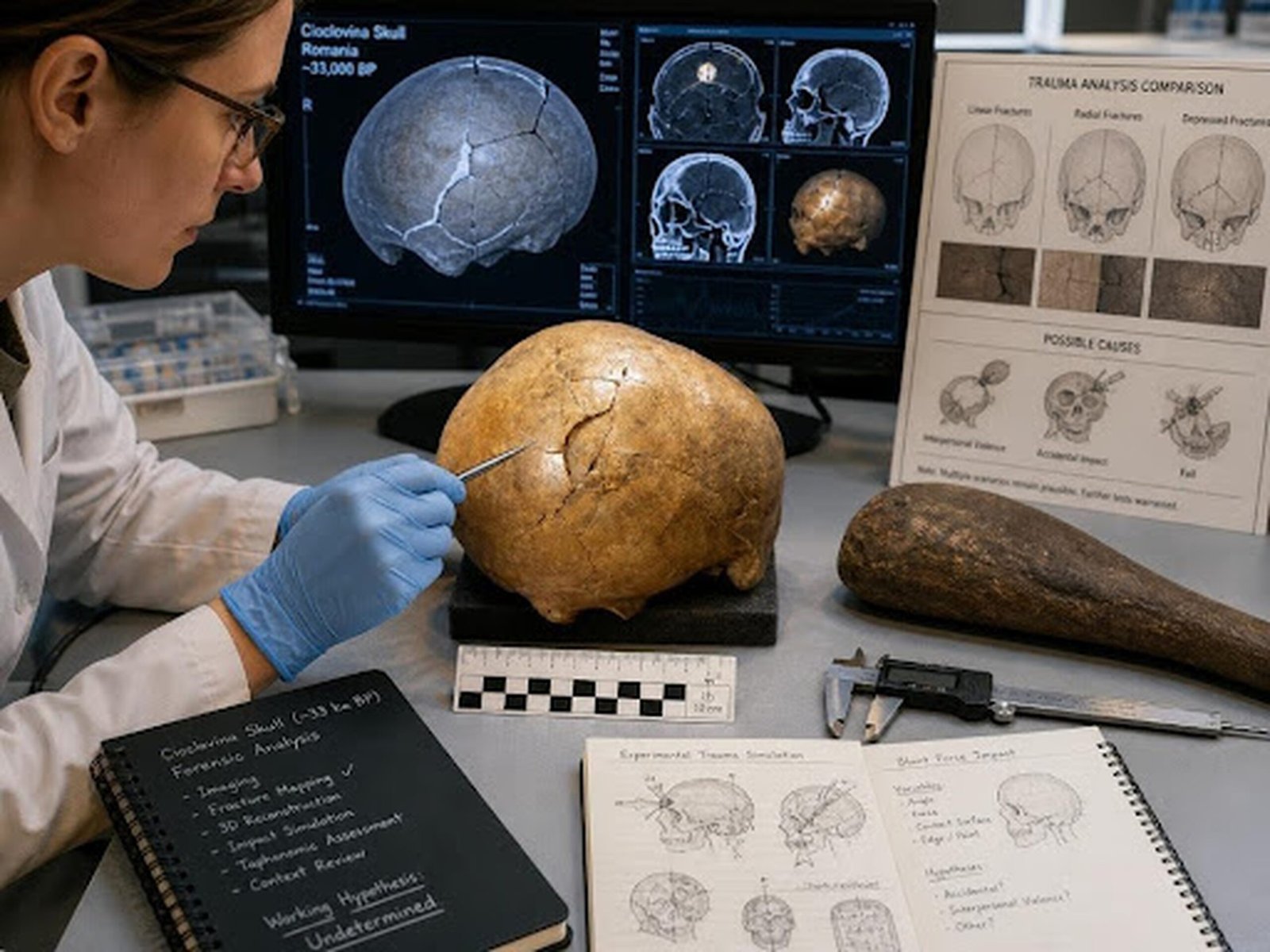
The Cioclovina skull from Romania shows this method well. Researchers reassessed a skull dated to about 33,000 years ago through visual study, CT imaging, and experimental trauma simulations. The study argued the fractures represented fatal interpersonal violence, with impact patterns consistent with blows from a club-like object. The strength of the work lies in the testing of alternatives before any dramatic claim [4].
Case file: A Medieval Assassination Reopened
A very interesting and strong example comes from medieval Hungary. A skeleton found in 1915 at a Dominican monastery on Margaret Island in Budapest entered scientific focus again through bioarchaeology, genetics, isotope study, radiocarbon dating, and trauma analysis. Researchers identified the remains as Béla, Duke of Macsó, a 13th-century nobleman connected with royal lineages. Forensic Science International: Genetics published the study in its February 2026 issue [5].
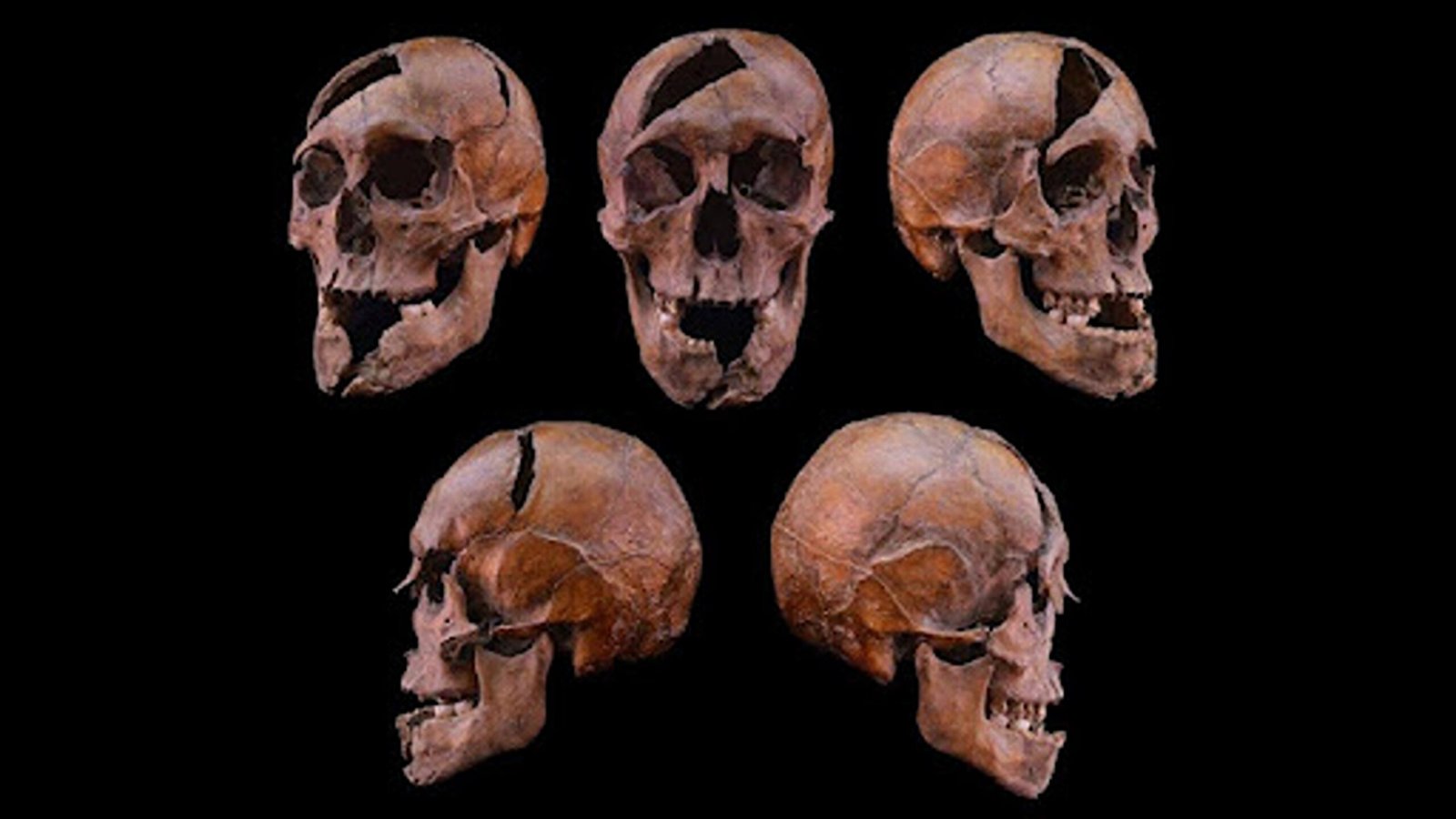
The case reads like a historical cold case because modern tools revisited an old find. The skeleton showed many sharp-force injuries from around the time of death. Reporting on the study described 26 injuries, including wounds to the skull and body, with a pattern consistent with a coordinated attack by several assailants using more than one weapon. The research team linked skeletal evidence with historical accounts of the duke’s violent death around 1272 [6].
The Béla case also shows why dating evidence needs caution. Radiocarbon results created tension with the historical timeline, and researchers considered diet-related reservoir effects as one explanation. High-status diets with more aquatic food sources sometimes shift radiocarbon readings. Here, forensic interpretation did not rest on one test. The team used DNA, dental clues, skeletal trauma, and history together [6].
The Grave as a Scene
A burial has more evidence than the bones alone. Body position, grave depth, stone lining, bindings, clothing traces, grave goods, cut marks, burning, and nearby objects all shape interpretation. A person buried with care in a formal grave tells a different social story from a body placed hurriedly in a pit.
Context also protects researchers from cultural bias. A modern reader might see unusual burial treatment and label the death cruel, criminal, or strange. An archaeologist must ask what the practice meant in its own setting. Decapitation, cremation, multiple burial, face-down placement, or removal of body parts have different meanings across periods and communities. Evidence must guide interpretation before modern emotion fills the gaps.
When Time Damages the Evidence
Forensic archaeology faces hard limits. Soil acidity destroys bone. Water moves fragments. Roots cut through skeletons. Animals scatter remains. Pressure cracks skulls and long bones. Later burials, roads, buildings, or looting disturb the scene.
Missing evidence reduces certainty. If the skull is absent, head trauma disappears from the record. If hands are missing, defense injuries become harder to assess. If the grave loses associated objects, social status and burial practice become harder to interpret. A researcher must say what the evidence supports, what the evidence rejects, and what stays unknown. A partial skeleton should not carry a full story. A single fracture should not carry a full accusation. A useful forensic report grades confidence, compares explanations, and avoids stronger language.
Ethics: The Dead are not Data Points
Human remains need respectful treatment. Every skeleton once belonged to a person with a body, relationships, fears, and social meaning. Ethical work includes legal permission, careful sampling, respectful storage, community consultation, and plain public communication.
Ancient DNA research makes this concern sharper because sampling removes material from bones or teeth. The 2021 global guidance asks researchers to follow local rules, prepare a study plan before sampling, minimize damage, share data for review after publication, and work with stakeholders from the start. These principles protect both science and dignity [7].
Why Old Cold Cases Matter Now?
Ancient death investigations help you read human history with evidence. Trauma patterns reveal conflict, interpersonal violence, punishment, warfare, and social control. Dietary study reflects access to resources. Isotope analysis traces movement. DNA research shows kinship and population links. Burial treatment shows how communities responded to death.
These studies also improve modern forensic practice. Methods tested across difficult ancient contexts strengthen recovery, documentation, trauma analysis, and taphonomic interpretation in present investigations. A burial from the past trains scientists to think carefully about scene context, missing evidence, contamination, and competing explanations.
Listening to Evidence Beneath the Surface
A 1000-year-old cold case rarely ends with a neat verdict. Some deaths gain strong explanations. Some keep their uncertainty. This does not weaken forensic archaeology. The field stays honest when researchers show both evidence and limits.
Bones record trauma, teeth preserve childhood signals, DNA links people to families and populations. Soil layers protect the sequence. Grave goods reveal cultural action. Together, they move the story from speculation toward evidence. The past does not speak in full sentences. Forensic archaeology gives you a method for listening with care. In old burials, science does not restore every name or every motive. The work returns measured truths to people whose history is almost erased.
References:
- Dr. William, Archaeology and forensic death investigations. Hist Arch 35, 26–34 (2001). https://doi.org/10.1007/BF03374524
- Dirkmaat DC, Cabo LL. Forensic Archaeology and Forensic Taphonomy: Basic Considerations on how to Properly Process and Interpret the Outdoor Forensic Scene. Acad Forensic Pathol. 2016 Sep;6(3):439-454. doi: 10.23907/2016.045 Epub 2016 Sep 1. PMID: 31239919; PMCID: PMC6474560.
- Alpaslan-Roodenberg, S., Anthony, D., Babiker, H. et al. Ethics of DNA research on human remains: five globally applicable guidelines. Nature 599, 41–46 (2021). https://doi.org/10.1038/s41586-021-04008-x
- Kranioti EF, Grigorescu D, Harvati K (2019) State of the art forensic techniques reveal evidence of interpersonal violence ca. 30,000 years ago. PLOS ONE 14(7): e0216718. https://doi.org/10.1371/journal.pone.0216718
- Hajdu T, Borbély N, Bernert Z, Murder in cold blood? Forensic and bioarchaeological identification of the skeletal remains of Béla, Duke of Macsó (c. 1245–1272), Forensic Science International: Genetics, 2025; 81
- https://www.livescience.com/archaeology/medieval-hungarian-duke-was-murdered-in-a-brutal-and-coordinated-attack-forensic-analysis-reveals
- Alpaslan-Roodenberg, S., Anthony, D., Babiker, H. et al. Ethics of DNA research on human remains: five globally applicable guidelines. Nature 599, 41–46 (2021). https://doi.org/10.1038/s41586-021-04008-x
More from the author:
- Growing Suicide Rate in Students: When a Bad Semester Starts to Feel Like a Ruined Life
- Crime Scene Investigation, Clickbait, and Screens: How Media Reshapes Forensic Reality

Anam Ilyas holds an MS Forensic Chemistry from Government College University, Lahore. She is a science enthusiast with a great love for explaining complex topics in simpler ways. She aims to bridge the gap between scientific research and the general public through her writing. When she is not writing or talking, you can find her lost in a book or making ideas come alive through her drawings.

