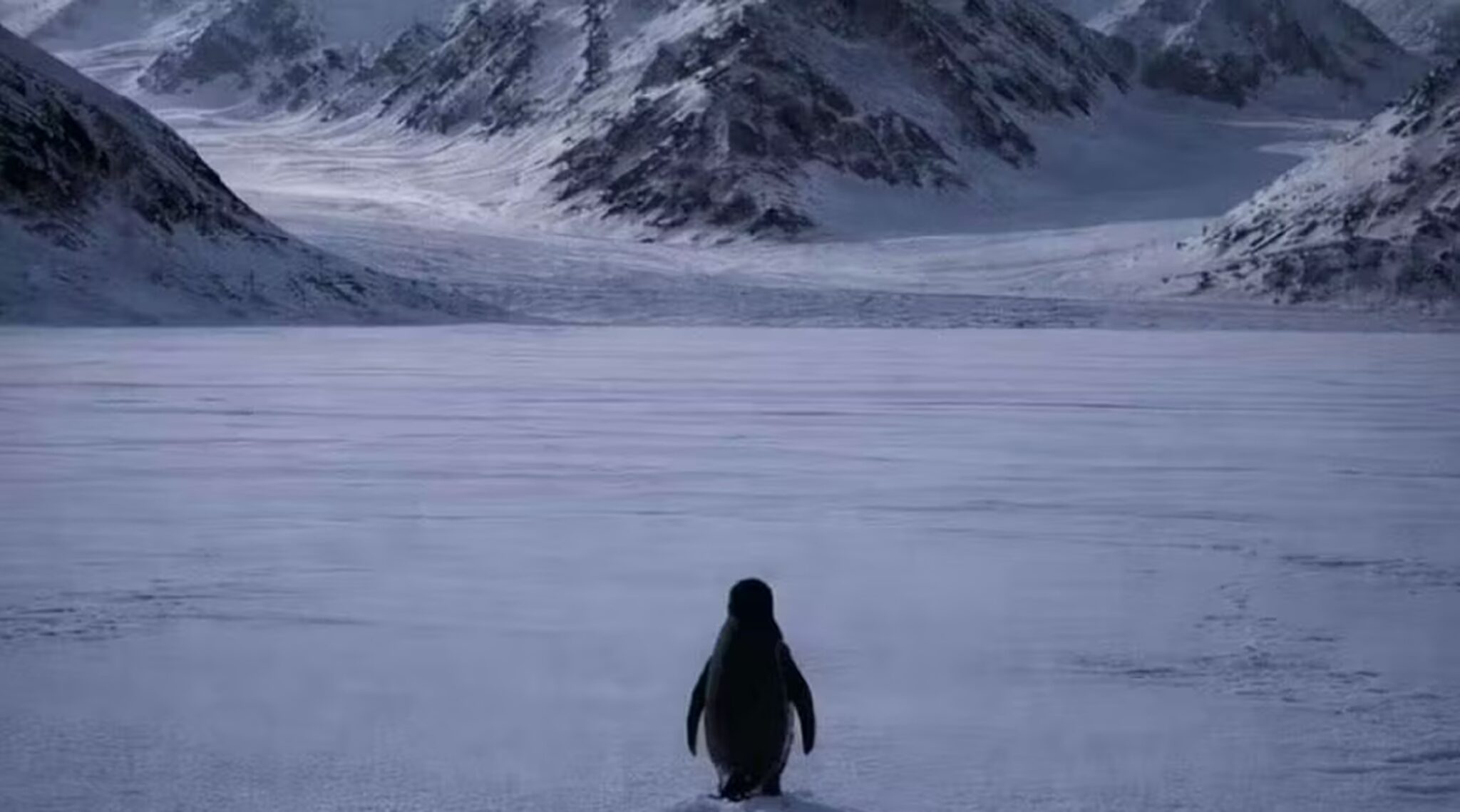
Clips of an Adélie penguin, often refered “Nihist Penguin” from a video, are gaining significant traction online. Filmmaker Werner Herzog took to Instagram to share the context behind a scene from his 2007 documentary, “Encounters at the End of the World”. This particular scene has reemerged as the popular “lonely penguin“ or “nihilist penguin“ meme circulating widely across social media.
Herzog offered insights into how the scene was captured and why it continues to resonate with audiences. The viral trend centers on an image of a penguin wandering away from its colony towards Antarctica‘s desolate interior. Users have widely shared this clip across various platforms, pairing it with captions that explore themes like isolation, existential reflection, and detachment.
The original footage shows a single Adélie penguin breaking away from its group and wierdly heads inland, instead of remaining along the Antarctic coastline. Penguins are usually found in large colonies, and they travel in groups. Humans never disturb them while living or traveling in Antarctica.
Surprisingly, this disoriented penguin appeared at New Harbor, around 80 kilometres away from where it should have been. He was heading deep into the continent’s interior, with nearly 5,000 kilometres ahead, a journey that would most certainly end in his death.
The filmmaker Werner Herzog had spoken to scientists who study penguins’ unusual behaviours. He actually drew inspiration from the ominous tone of the crime television series ‘Unsolved Mysteries’.
Why do they behave weirdly?
The viral footage shows a rare behavior where a penguin stops trying to survive. Dr. David Ainley, a scientist in the the docuemntary, explained that even if the penguin is brought back to the water, it will immediately turn around and walk back toward the mountains. This is scientifically called “death march behavior” among adelie penguins.
According to David Ainley, the penguin was disoriented and was facing a neural error. Since penguins rely on sun and magnetic field cues to navigate, a “biological error” or disruption in their internal compass can cause them to become disoriented, forcing them to misinterpret the barren inland as the sea. Changes in sea ice, such as deep cracks, can disorient penguins and force them to make unnatural decisions.
Behavioral responses of Adélie Penguin
A research was published in Science Direct in September 2022, in which the researchers from the Korea Polar Research Institute analysed the weird behaviours of Adélie penguins while confronting a giant ice floe.
Climate change is contributing to the more extreme events worldwide, due to which animals are facing rapid and extreme changes in their natural habitats. Adélie penguins are generally a sea ice-dependent diving seabird, and have been an important study species for investigating the effects of ice conditions on ecological responses in Antarctica.
Penguins are categorized as krill-dependent species, which are animals that rely on Antarctic krill as a primary food source for their survival, reproduction, and growth within the Southern Ocean Ecosystem. These species rely on a specific, concentrated food source that they are highly vulnerable to fluctuations in krill populations caused by climate change, such as sea-ice loss or commercial fishing.
These species are considered key indicator species in the CCAMLR Ecosystem Monitoring Program (CEMP) because significant habitat changes have appeared in response to changes in the sea ice environment. This program was initiated in 1984 to study the long-term changes in arctic marine ecosystem.
According to this study, recent extreme cases of sea ice extents have affected the Adélie penguin population, which suffered from total breeding failures twice in 2014 and 2017 in the Dumont d’Urville Sea.
These cases result in major reproductive failures. It is crucial to understand how extreme sea ice conditions alter the foraging strategies of seabirds. Studies conducted earlier show that the Adélie penguins have a long foraging trip in extensive sea ice, such as fast ice or extreme events like icebergs. They face major problems in food delivery to their chicks. As a result, sea ice showed a complex relationship with the reproductive performance of Adélie penguins.
This research suggests that the giant ice floe could alter the foraging paths, and penguins bypassed or crossed the ice to reach their foraging areas by spending more energy and time.
References:
- (Desprez et al., 2018; Ropert-Coudert et al., 2018)
- https://www.sciencedirect.com/science/article/abs/pii/S0967064522001370
- (Kokubun et al., 2021; Le Guen et al., 2018)
- (Lescroël et al., 2014).
Similar articles: How Climate Change is Endangering the Iconic Wildlife Species

Saadeqa Khan is the founder, CEO, & Editor-in-Chief of Scientia Pakistan. She’s a member of the Oxford Climate Journalism Network (Second Cohort) and NASW. Saadeqa is a fellow of NPF Washington, The Falling Walls Foundation, and the Science Journalism Forum. Saadeqa has won several international journalism grants and awards for her reports.


i enjoy reading your articles, it is simply amazing, you are doing great work, do you post often? i will be checking you out again for your next post. you can check out webdesignagenturnürnberg.de the best webdesign agency in nuremberg Germany
Comments are closed.