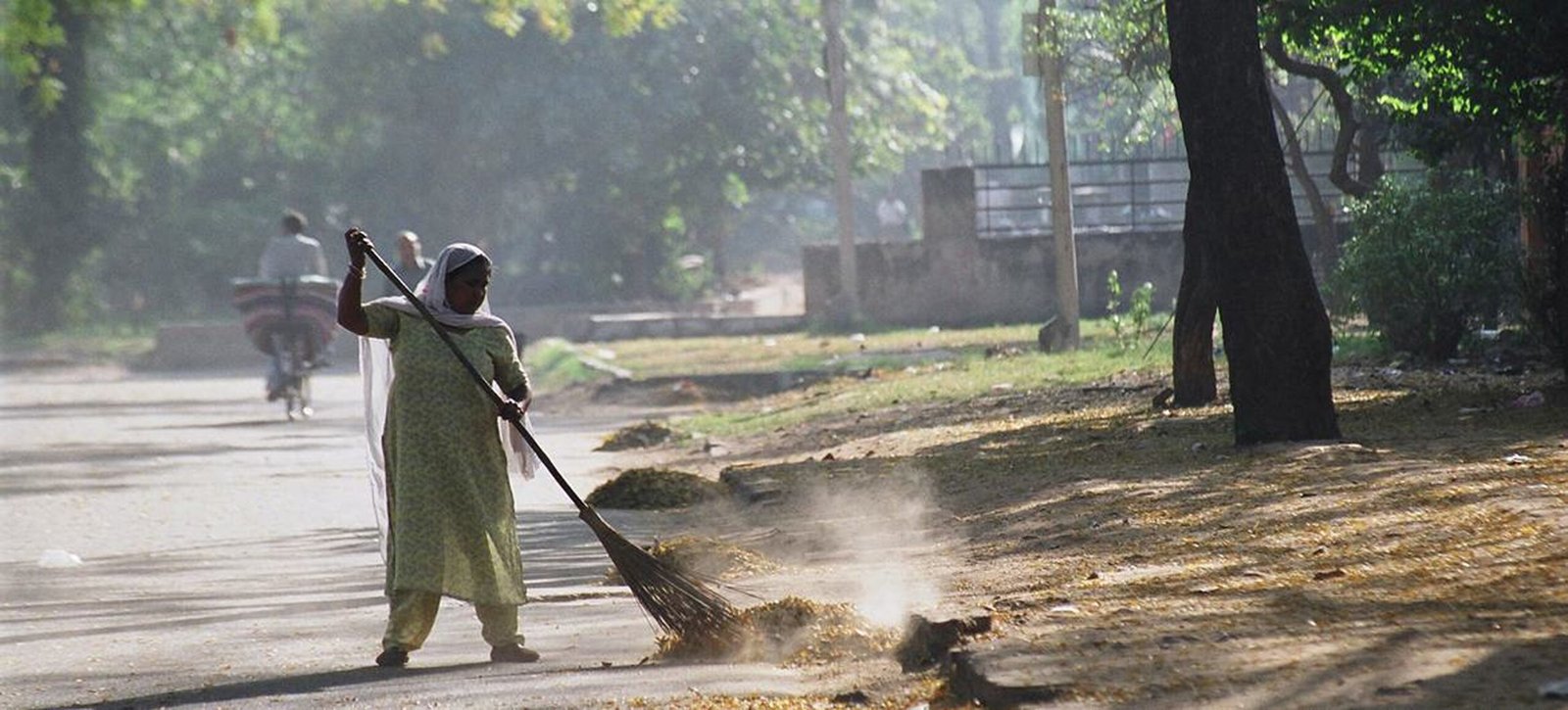
The barely swinging fan in Hamida’s* home brought her no relief from the suffocating heat enveloping the two-roomed apartment she lived in with her family. With temperatures rising to 45° C, citizens were advised to diligently follow SOPs set by health experts, namely to stay indoors, drink plenty of fluids, and wear fully covering, light clothing to minimize the risk of heat-related health problems.
But Hamida struggled to understand how staying indoors could be of any help at all; her apartment seemed to swell with heat, the otherwise regular water supply to her home had been late for the past week, and she had spent most of her mornings parched. The migraines and dizziness brought on by the intensifying heat kept worsening day by day, despite the medication she took to stop them. According to Hamida, staying inside in her house “felt even worse. The heat inside seemed to cling to me, and my family couldn’t even sleep at night because of how hot it was”.
At her own home after her shift’s end, she had another list of chores to attend to. Her family’s dinner had to be made, their clothes had to be washed, and the house had to be set in order. By the time her head hit the pillow, the pounding and dizziness had increased to such a level that it was almost blinding. According to Hamida, the migraines and dizziness never stopped throughout the day and only got worse at night, as she described she “felt so dizzy and parched in the heat, and almost collapsed because of it”.
But still another day’s wages had to be earned, even if it meant venturing out in the relentless heat day after day. So, donning her black abaya and chappals, she went out on the unpaved road, hopping over sunlit patches more than manholes because, as she described, “it felt like being cooked inside when standing in the sun for even a few seconds”.
Hamida’s plight was one of several workers who face a similar situation every year during the intense heatwaves in Karachi. Sanam* another domestic worker employed in Gulshan e Iqbal town, an area that is extremely hot during summer, also struggled for her family’s daily wage. Her children’s mounting school fees and her husband’s physiotherapy for his paralysis had to be paid. So it fell on Sanam to take up the job of providing for her family.
Her skin marked with visible blisters and feet reddened in her fraying chappals, she had to take the packed public buses and stand amidst the sweating crowd every day to reach her employer’s house. Cloaked in her burqa, standing packed among strangers with little air coming in, she felt sick and nauseous on the way to work. The heat seemed to be buried inside her. Describing her everyday condition, “it felt like death.”
It was no easy task for Hamida and Sanam to earn their daily wages in this extreme heat. Even the regular hustle of various chores – laundry, sweeping, and cleaning – did not seem to exhaust as much as the sweltering, suffocating heat that was ever present. The air conditioning in their respective employers’ homes was not enough despite their cooling, and the myriad of health issues from migraines and frequent dizziness to skin rashes were increasing.
The link between heatwaves and women’s physiological health
In a 2023 article published by the Atlantic Council’s Climate Resilience Center on the effects of extreme heat on women’s health and income in India, Nigeria, and the US, it was reported that women are more prone to heat-related illnesses than men, as thermoregulation works differently in both genders. Notably for women, especially pregnant women, the risk to health from heatwaves is much higher, especially as they work in the kitchen heat indoors.
Women have lower metabolic activity than men, leading to colder body temperatures overall. Men are also able to thermoregulate faster than women, hence women are more at risk. Moreover, women, particularly from low-income families, also carry the dual burden of caring for their families and earning their livelihoods, in addition to carrying unpaid emotional labour in their families, so poverty worsens heatwave effects on women.
According to the 2023 UN Women report, around 340 million women and girls will be living in extreme poverty by 2030. An estimated 20.9% in just Central and Southeast Asia alone. In poverty-stricken circumstances where few resources for adequate protection and support for women exist, female domestic workers like Hamida and Sanam are more prone to health risks caused by heatwaves, such as anemia, hypertension, stress, and dehydration.
Poverty and unpaid labour further push women into stress-related issues, reproductive problems, and hypertension. Karachi is a heavily populated city whose uncoordinated urban planning is a clear physical mark of inequality in social classes. High-density, often industrial areas like Landhi and Korangi seem to bear the brunt of the heatwaves and the dangerous effects of heatwaves more than those with structured planning and greener spaces.
Sustainable Energy for All (SEforALL) in 2021 reported how a lack of proper ventilation systems in residences and a lack of access to safe spaces during heatwaves further exacerbate the problems and burdens on poor women. As poverty-stricken areas in Karachi also suffer more loadshedding, these cooling appliances, such as ceiling fans that are also more often than not of low quality or not even working well, face constant interruption in their usage. Compared to the air-conditioned homes of urban areas, where people can afford to have better cooling facilities and use energy-saving equipment to combat loadshedding.
But why Karachi?
Karachi’s high temperatures during the summer are more than just due to climate change. Due to a phenomenon called the Urban Heat Island effect (UHI), the rising temperatures occur as a result of a combination of factors. The evident lack of greenery to absorb heat and provide shade, the hard materials of asphalt and concrete used in the city’s infrastructure that retain the day’s heat and radiate it at night, and the “urban canyons”, the poorly ventilated and congested streets, thanks to high-rise buildings. All of these cause heat to circulate in the city, essentially creating a hot, dense bubble that entraps Karachi and makes the weather feel hotter than it is.
In a densely populated city like Karachi, whose population reaches an astounding 20.3 million, city temperatures and heatwaves intensify with the growth of urbanization. The heat-absorbing materials like concrete and asphalt used to make the city’s infrastructure, combined with incredibly compact structures and little room for any open and green spaces, worsen the UHI. So Karachi homes emanate heat every summer. And combined with the heat radiation from machinery, vehicles, and industrial processes, you have an entire city cooking up during the summer.
The Necessity of a Heat Plan!
With the lack of proper heat-relieving spaces and equipment in most Karachi areas and the absence of greenery to absorb it, the extreme heat affected the health of citizens, particularly labourers and domestic workers earning their living wages, suffering more as most work under the direct sun without proper protective equipment. According to a report published by the World Health Organization (WHO) in 2024, severe heat waves can cause illnesses and worsen already existing ones, ranging from respiratory distress, fainting, skin allergies, heart diseases, and even deaths.
The Climate and Development Knowledge Network (CDKN) and the Commissioner of Karachi worked on the Karachi Heatwave Management Plan in 2016-17, a project made to swiftly tackle the heatwave and its effects and prevent casualties, instead of the deadly heatwave of 2015, which affected up to 65,000 people and resulted in around 1,200 deaths. But while it focuses on increasing knowledge of effects in heatwaves in citizens, individual action, and lays out a long-term response including restoration, it does not adequately address the on-ground inequality in the city with regard to support being reached in certain areas.
It appears that without a consistent plan and action, the effects of heat strokes and the high temperatures have been persistent. Published in the Journal of the Pakistan Medical Association in 2025, it was reported that an alarming number of 500 people alone died in less than a week in the 2024 heatwaves of Karachi. With the lack of structural planning and proper implementation in Karachi to address the disastrous impact of heatwaves on the people, the problem worsens annually.
References:
- https://www.who.int/news-room/fact-sheets/detail/climate-change-heat-and-health#:~:text=The%20body’s%20inability%20to%20regulate,with%20hazardous%20air%20pollution%20events
- https://scientiamag.org/cooling-karachi-combating-urban-heat-with-green-spaces/
- https://jpma.org.pk/index.php/public_html/article/view/21662/4183
- https://www.jpma.org.pk/index.php/public_html/article/view/21662
- https://pdma.gos.pk/Documents/Heatwave/Heatwave_2025/Heatwave_Sitrep_2025/Sitrep%20on%20Heatwave%2029%20May.pdf
- https://heathealth.info/resources/karachi-heatwave-management-plan-a-guide-to-planning-and-response/
- https://www.seforall.org/chilling-prospects-special-gender/factors#22
- https://www.seforall.org/system/files/2021-03/Gender-Cooling-SEforALL.pdf
- https://data.unwomen.org/features/poverty-deepens-women-and-girls-according-latest-projections#:~:text=New%20projections%20of%20global%20poverty,372%20million%20men%20and%20boys
- https://heathealth.info/wp-content/uploads/HeatwaveManagementPlan.pdf
- https://www.ndma.gov.pk/public/storage/publications/July2024/5iGkexopohXQIQckzuSh.pdf
- https://www.ijurr.org/spotlight-on/extreme-heat/heat-inaction-the-thermopolitics-of-extreme-urban-heat-in-karachi/
- https://onebillionresilient.org/extreme-heat-inflames-gender-inequalities/
- https://pubmed.ncbi.nlm.nih.gov/28291489/
- https://www.unwomen.org/sites/default/files/2023-09/progress-on-the-sustainable-development-goals-the-gender-snapshot-2023-en.pdf
Similar Articles:
Healthcare: Let’s talk about female workers
How Waste Burning in Karachi Neighborhoods Is Fueling a Toxic Pollution Crisis

Amna Rizwan is a writer based in Karachi, Pakistan. She is a recent graduate of BS English from Bahria University, where she majored in English Literature. With a passion for books and culture, she seeks to shed light on social issues in society.

