Good space movies are a rare treat. But when they do grace the silver screen, we can’t stop marveling at the beauty and magnificence of such features. Here are my five picks for some of the best space films of all time.
Gravity (2013)
Sandra Bullock stars in this space thriller
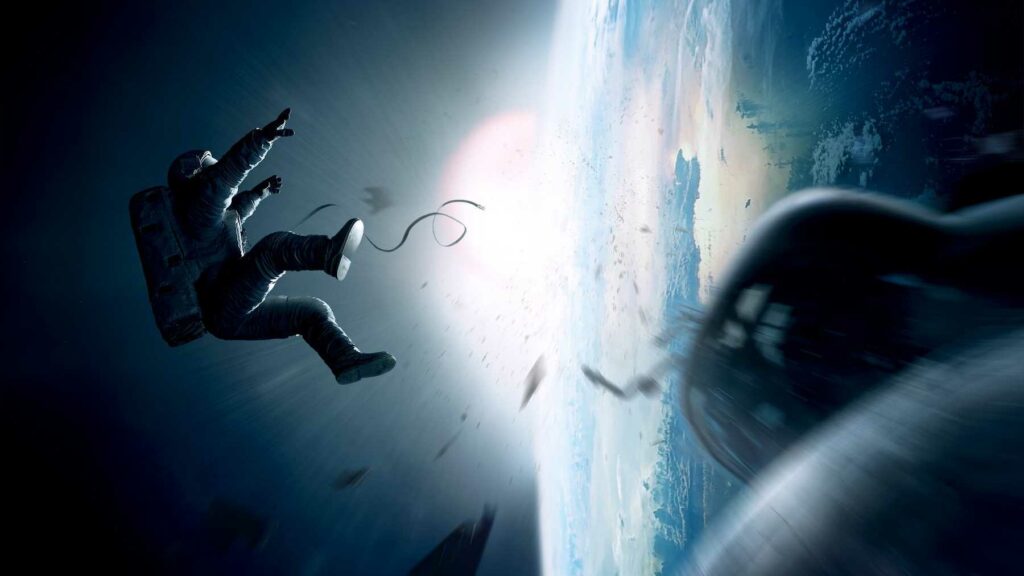
Directed by Academy Award winner Alfonso Cuaron, Gravity tells the tale of Dr. Ryan Stone (played by Sandra Bullock) who is a medical engineer on a space shuttle. She is joined by other astronauts on the mission including Matt Kowalsky (George Clooney) who is on his last flight before retiring from the profession. Within the first few minutes of the film, a disaster shakes them apart and the team is left stranded in space. What follows is a stunning story of human grit and survival. Finding a way home back to earth from deep space is as hard as it sounds, and the movie perfectly captures the emotion one can expect to flow through a person during such a moment. The haunting soundtrack adds the thrill and electricity in the tranquil environment of space. It was a film that won the hearts of every movie lover and landed the director an Oscar following other accolades. Neil deGrasse Tyson did disagree with some of the physics in the movie but hey! We can surely forgive a few mistakes for such a splendid piece.
Interstellar (2014)
Interstellar is loved by the audience and physicists alike
While
Gravity missed the proper physics, Interstellar was a masterpiece that duly
stuck to it. Coming from the mind of the admirable Christopher Nolan, it tells
the Saga of a former pilot (played by Mathew McConaughey) who is selected by
researchers at NASA to go to space along with fellow scientists in the search for
a new planet. Earth is shown as an uninhabitable place for humans and there appears
to be a dire need for searching a new home across the galaxies. A stellar cast
giving the best emotional performances in years makes it even more spectacular
and the cinematography is literally out of this world. It reimages what our
future could be if we continue our attitudes towards the mother earth and what
it might take to save it. Real-life scientists and physicists worked on the
project and most of the theories and work, shown in the film, are real. The
intense and striking soundtrack by Hans Zimmer fills it with new life and it is
guaranteed that one cannot make it to the end without shedding a few tears.
Also, you will be surprised to know that the black hole shown in Interstellar
was the closest adaption ever and it was proven almost correct when the first
black hole image was released this year. What a coincidence!
First Man (2018)
Ryan Gosling stars as Neil Armstrong in this biopic
Just last month, we were celebrating the 50th anniversary of the first moon landing. And last year, the first biographical movie on the First Man to walk on the moon, that is Neil Armstrong, was released, in which Ryan Gosling played the lead role. The enchanting picture shows us the life of a celebrated hero who had to go through a lot to achieve the historic feat. Oscar-winning director Damien Chazelle was a part of the film and Claire Foy was the female lead. Based on the book of the same name by James R. Hansen, it explores the ups and downs and the sacrifices the Apollo mission team and crew made and how much effort it took to put humans to the moon. Aspects of Neil’s life were also shown along with true events and the spirit of his humble character. Justin Hurwitz managed to put even more emotions through the hauntingly beautiful soundtrack and the key moments of the mission felt personal through that. The giant leap for mankind actually took a lot of steps and efforts, all shown in this epic.
The Martian (2015)
The Martian is based on the book of the same name by Andy Weir
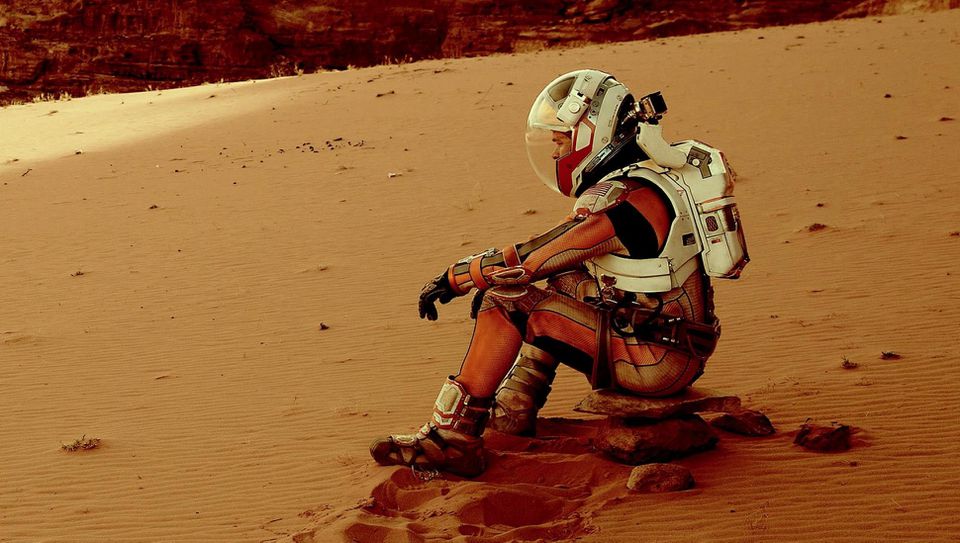
Ridley Scott is the genius behind some of the greatest sci-fi films of all time such as Alien, Blade Runner, Prometheus, etc. In 2015, he directed ‘The Martian’ starring Matt Damon. The drama explores a frightening theme i.e. being left behind on a strange planet. Believe it or not, it is a scary concept that is surely hidden somewhere in the back of our minds. But fear not, as this movie tells you exactly how to survive in space, Mars to be exact. Astronaut Mark Watney (Damon) is left stranded on Mars during a mission and it is all up to him to figure out how to connect the crew on Earth and go back. It is a feature of hope and ambition showing that there is no limit to human strength and determination and that nothing is impossible. The movie was shot in the deserts of Jordan which beautifully mimic the environment on the red planet resulting in exceptional shots and cinematography. The star-studded cast gave brilliant performances and the film undoubtedly kindles a desire for space exploration in the hearts of the audience.
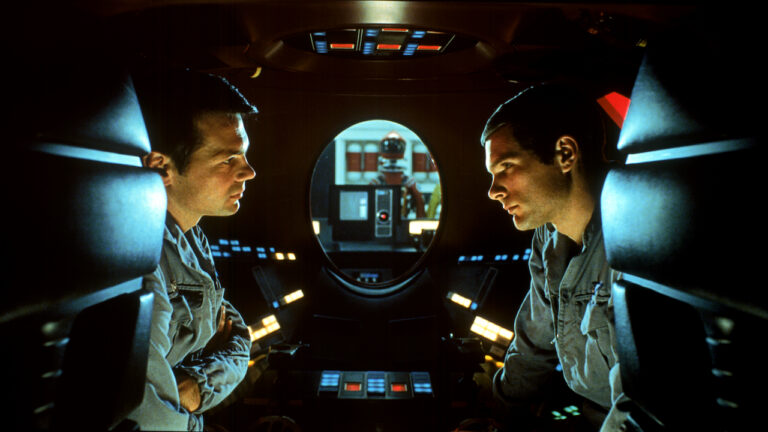
2001: A Space Odyssey (1968)
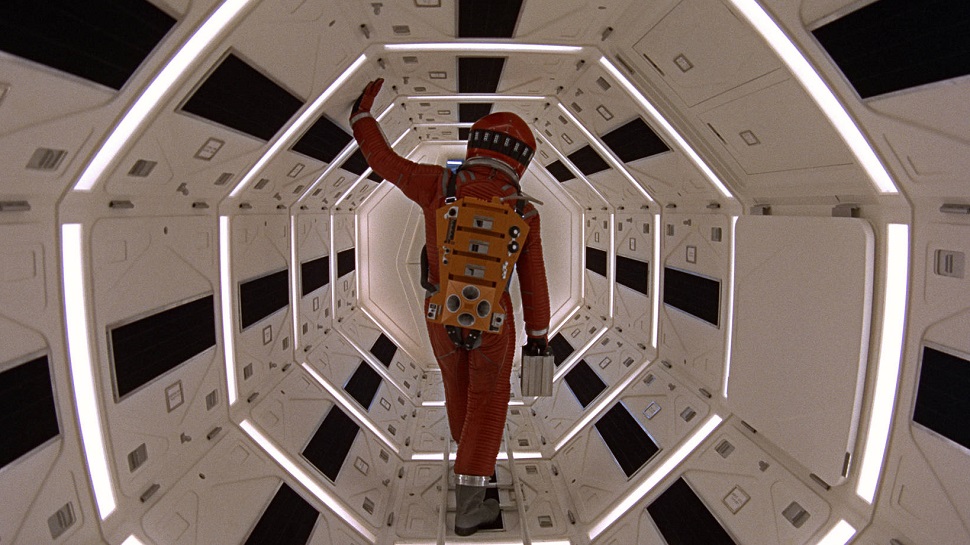
2001: A Space Odyssey is lauded for its strikingly beautiful cinematography
Stanley
Kubrick is known as one of the greatest visionary directors of all time. And he
came through with that title in his sci-fi masterpiece 2001: A Space Odyssey.
This is one of those movies that always makes its way into the lists of the
best movies of all time and does it fittingly so. It is a great film where we
see astronauts sent to a mysterious mission to space along with a computer HAL
that ultimately leads to what we fear… Robots turning against humans. Even
though it was released in the 1960s it predicted some amazing future gear which
was surprising. Such as, in the very beginning, we see characters talking to a
computer screen in space and now that we have the technology of video calling
or Acritical Intelligence, it is still bewildering how it managed to show us a
peek of the future in such an era. Kubrick used brilliant techniques to shoot
the film and created a stupefying space and future for us to get bewitched.
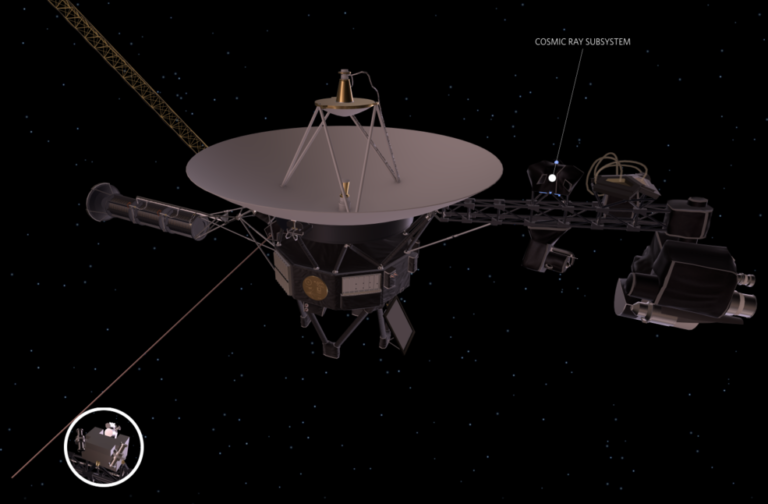
This artist’s concept depicts one of NAS’s voyager spacecraft, including the location of the cosmic ray subsystem (CRS) instrument. Both voyagers launched with operating CRS instruments. Credits: NASA/JPL-Caltech
This artist’s conceptdepicts one of NAS’s voyager spacecraft, including the location of the cosmic ray subsystem (CRS) instrument. Both voyagers launched with operating CRS instruments. Credits: NASA/JPL-Caltech
Launched in 1977, twin spacecraft, 11 billion miles away from home, Voyager 1 and 2 are exploring where nothing from Earth has flown before. Each spacecraft has ten instruments with a goal to explore the outer solar system and send back priceless information to Earth. Voyager 1 visited Jupiter and Saturn, while Voyager 2 visited Uranus and Neptune. Three radioisotope thermoelectric generators (RTGs) are used to provide the power which produces heat via the natural decay of plutonium-238 radioisotopes and convert that heat into electrical power.
The major problem is that both the voyagers have fewer available power resources over time and the spacecraft has started to flag. To ensure that these vintage probes continue to return the best scientific data, engineers implemented a plan to manage and made some tough decisions. Recently a heater for the cosmic ray subsystem (CRS) instrument turned off on voyager 2.
Even after the removal of heating system, voyager’s 2 cosmic ray subsystem is still functional and sending back data despite functioning at a chilly minus 74 degrees Fahrenheit which is less than the temperature it was tested for; hence Voyagers’ instruments proved to be very hard.
“Incredibly, Voyagers’ instruments have proved so hardy,” said Voyager Project Manager Suzanne Dodd, who is based at NASA’s Jet Propulsion Laboratory in Pasadena, California. “We’re proud they’ve withstood the test of time. The long lifetimes of the spacecraft mean we’re dealing with scenarios we never thought we’d encounter. We will continue to explore every option we have to keep the Voyagers doing the best science possible.”
Voyager spacecraft achieved far more than the science could have ever expected, they are the farthest human-made object in the universe and the first that entered to interstellar space. For now, the mission planners are experimenting with alternative techniques to conserve power and operate them for a longer time.
Yesterday, Pakistan’s federal minister of Science and Tech, Mr. Fawad Chaudhry claimed on twitter that Pakistan will send its first manned mission into space by 2022 and the recruitment will be open up by Feb 2022. Initially, fifty people will be selected which will later drop down to 25 only. Later talking to media over his tweet, he explained that the procedure and the selection of Pilots will be made under Pakistan Air Force and SUPARCO. However, neither Pakistan Air force nor SUPARCO supported Mr. Minister’s claim so far.
Proud to announce that selection process for the first Pakistani to be sent to Space shall begin from Feb 2020,fifty people will be shortlisted — list will then come down to 25 and in 2022 we will send our first person to space,this will be the biggest space event of our history
The news got viral through social media within an hour and a couple of confusion aroused in science communities regarding his Claim. Initially, in October 2018, Fawad Chaudhry the [Then] Information minister announced “Pakistan first manned mission to space by 2022” with the technical coordination of China, however, after a successful official visit of Prime Minister Imran Khan to China in the same month, no further details of this mission were disclosed. Now, after a wide gap of more than nine months, Fawad made another announcement about Pakistan’s manned mission to space and the timing is enough to tell the “truth behind the curtains”.
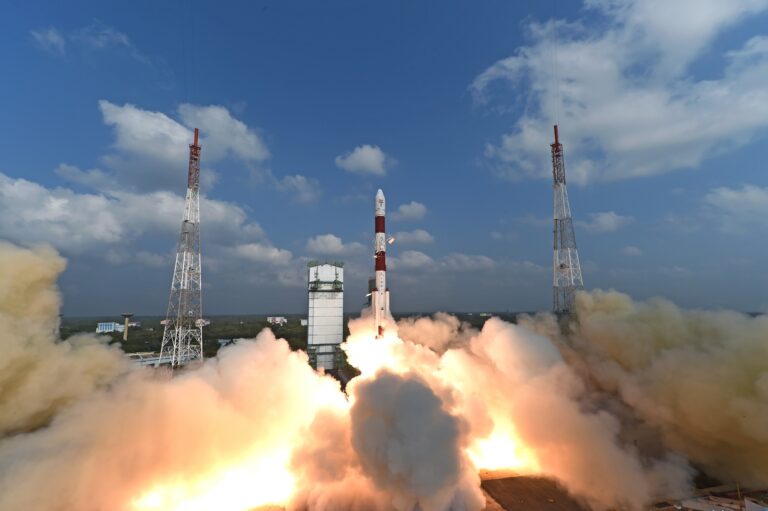
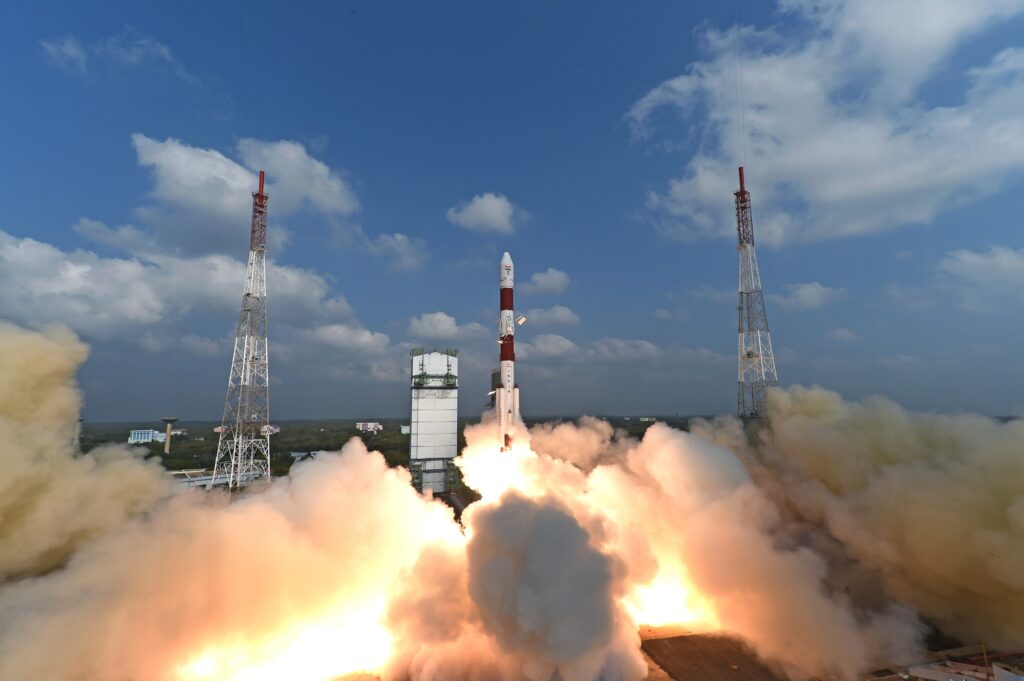
Mr. Chaudhry made this announcement just three days after when India successfully launched its second mission to the moon, Chndrayaan-2, which was locally made by Indian scientists and engineers. It is oblivious that Pakistan is far behind in technical and financial basis to India, and to individually support such a huge mission is nearly impossible for Pakistan. It will have to depend on China for technical and strategic assistance to send his first man into space.
India’s launched its second mission to the moon, Chdrayaa-2
A couple of confusions have already been there due to multiple untangled, more often than not lame statements made by our federal minister of Science & Tech regarding Pakistan’s space mission. Like, what will be missions’ objectives and why it is necessary to travel to space when our countryman are confronting with widespread drought, climate changes, and global warming? These questions need to address fairly and with clarity, for our general public, it will take a little too long time to fully believe that space exploration is a much inspiring effort. Though it is not such an easy task as our Minister of Science and technology claimed.
Spending space frontier is the need of the hour. We are having enjoyed its suspected profits in our daily lives. We have a communication satellite that is fairly maintaining Television, cell phones, and internet signals and connected us with global communities. Consequently, future space missions by different nations would result out in more discoveries those lead to the development of more sophisticated infrastructure beyond space frontiers.
India and Pakistan have fought two wars in the 1965 and 1971, historically they were never friendly. The current situation between the two countries is quite identical to that of a cold space war between USA and USSR. The Space Race started as a war of words when the US announced it intends to launch the first artificial satellite into outer space. In response, the USSR claimed that it is going to launch a satellite “shortly”. The two country’s political enmity started to play out in a battle for spaceflight supremacy, watched by the global audiences.
Later on, when the Soviet economy was no longer be able to deal with it abandoned the useless space effort since the Soviet Government’s priority had to feed and clothe its people.
One cannot deny the importance of space technology in the modern era we are living in but space missions, specifically of a growing state like Pakistan should be dealt & planned wisely and the government officials should be of careful about their statements. A space war of the words will result in nothing other than tension and humiliation, keeping the fact in mind that Pakistan is far behind to India in technical and financial aspects, at least for now.
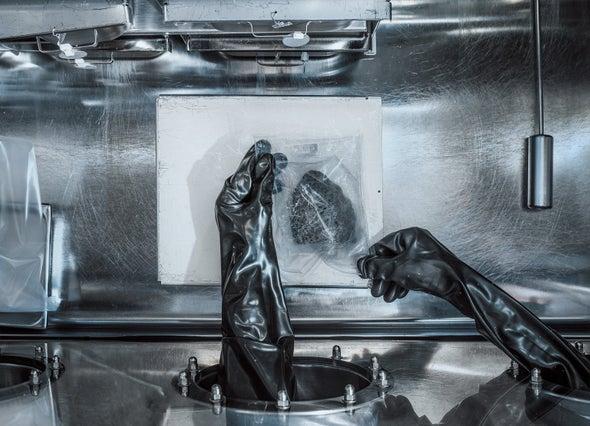
Over the course of the six moon landings between 1969 and 1972, astronauts brought back 842 pounds (382 kilograms) of lunar rocks, pebbles, and soil. The lunar lab is a reservoir of hundreds of pounds of moon rocks collected by Apollo astronauts close to a half a century ago. Some of the rocks were vacuum-packed or frozen or stored in gaseous helium preventing them from chemical radiations.
The largest remaining piece of the Apollo 15 moon rock sample 15556 at the Apollo Sample Vault at NASA’s Johnson Space Center. Credit: Chris Gunn
Inside a locked vault at Johnson Space Center is a treasure few have seen and fewer have touched. Buried within the Apollo samples that came back to Earth, are the clues of lunar origins. Apollo rocks unlock secrets of the universe and help transform our understanding of the cosmos.
“Many of the discoveries that we’ve made in planetary science, not just on the Moon, but on Mercury, on Mars, on some of the asteroids, directly relate to some of the results that we obtained during the Apollo missions.” Lawrence, who works at the Johnson Space Center in Houston, said in an interview with AFP.
Apollo rocks are a gateway to a new world of information, revealing mysteries, opening a window into lunar geology. It has basically revolutionized our understanding of three major concepts: the origin of the moon, nature of the lunar surface and lifelessness of Moon. It took years to correctly interpret these samples using advanced technology but they offered a deeper understanding of the evolutionary history of the universe.
Lunar Samples Are A Time Capsule:
“The Earth is a gigantic recycling machine,” said Juliane Gross, a planetary scientist at Rutgers University. “We have wind, we have rain, we have ice and weather, and so all the rocks weather away.”
The surfaces of the Earth and the moon are very different and dynamic because it is changing continuously. The combination of these factors means that the Earth’s surface is very young and is modified by the presence of life; hence erasing its geologic record.
However, Moon is geologically “dead” with negligible activity. There is no life on the moon and the only factor that changes its surface slowly is the crater’s formation. While life evolved on Earth, “the Moon is lifeless”, preserving the traces of history; making it a time capsule, an archive for the history of our solar system.
Lunar Rocks Are The First Direct Evidence of The
Collision That Formed Moon
Before the Apollo mission, scientists were confused regarding the formation of the moon. Some scientists thought that it was an independent object captured by Earth gravity, some considered it a blob of Earth that flung away due to the fast spin of our planet. Others considered that both Earth and moon may have formed from the “protoplanetary disk”.
After the Apollo mission, scientists gained a whole new perspective about the origin of the moon and only “Giant impact hypothesis” seemed to fit in.
Giant Impact Hypothesis-An evolving legacy of Apollo
Around 4.5 billion years ago, according to the prevailing theory of the scientific community, the solar system was a violent place. Around that time, a Mars-sized body known as Theia slammed into an Earth predecessor, forming the earth. The violent reaction results in an ejection of material from both colliding bodies. Debris merges in an earth orbit for next several hundred million years, into what we call today moon. The early moon was covered in an ocean of magma with the heavy minerals forming the core and the lightest ones forming the crust. In this way, the Earth and the moon were formed.
But how does the Apollo rock support this hypothesis? Giant impact hypothesis has been supported by many observations from the Apollo samples which include the following:
Magma Ocean
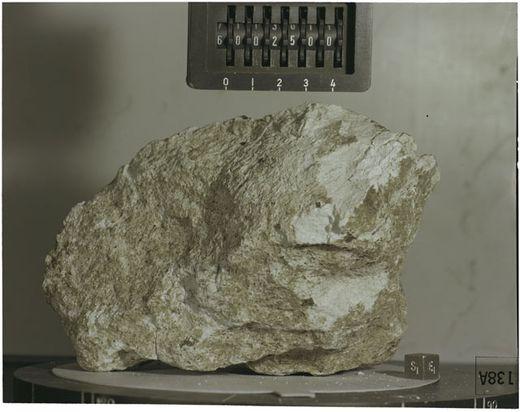
Moon Rock collected from Apollo 16
The above picture is of a moon rock collected from Apollo’16 made of plagioclase, a rock formed out of molten magma. Plagioclase feldspar mineral (made of sodium and calcium) is a light mineral that floats to the surface of the ocean where it crystallizes forming the crust when molten magma cools down. The presence of the same plagioclase in an Apollo rock is proof of the violent beginning of the moon.
Iron
Apollo rocks revealed that the moon’s core has little iron compared to Earth-just 25% of its total radius. The relative deficiency of iron is an evidence for the giant impact hypothesis that after collision heavy metals like iron sank into the Earth leaving behind lighter elements that were propelled away into what we call moon today.
Volatile Elements
Lunar samples collected from Apollo missions were dry and
lacked volatile elements. After the collision, the theory goes, immense heat
and energy were generated that may have blown away volatiles from the moon.
According to NASA, “When the young Earth and this
rogue body collided, the energy involved was 100 million times larger than the
much later event believed to have wiped out the dinosaurs.”
How do Apollo rocks reveal the similarity between the earth and the moon?
Moon rocks collected from the Apollo program have the same chemical fingerprints as earth rocks in terms of oxygen isotopes. Interior structure of the Earth and the moon is also similar i.e. it has a crust, a mantle, and a core. The similarity between the moon and Earth rocks is also a shred of evidence that supports the giant impact hypothesis. The similarity between both is evidence that they share a common evolutionary history and are formed from the same swirl of the exploded rock.
Moon craters provide a key for unraveling time scales for
the geologic evolution
Some of the scientists have used the Apollo rocks to “see beyond the moon”, like a Rosetta stone and unlock the secrets of other planets. Lunar crust “craters” proved to play a vital role in revealing the geologic history of the whole solar system.
Since, Earth’s geologic history has been constantly erased by erosion, tectonics, and volcanism but moon bears the impact of every meteor or asteroid ever crashed into it. Craters are one of the most interesting features in the solar system. And by age-dating lunar craters, we can age-date craters on other planets.
Moon craters can be used as a standard and by comparing
the crater of other planets with the lunar crater, we can estimate the age of
other planet’s crater. The bigger the craters, the longer they were made.
About 4.5-3.8 billion years ago, asteroids smashed into the larger world, increasing the impact on their surfaces, known as the period of “Late Heavy Bombardment”. Lunar samples provide evidence for this bombardment as they also contain pockmarks due to the hitting of asteroids. By using “crater counting method”, scientists have estimated the age of craters and calculated the time frame for materials smashing into their surface. Analysis of all the data proved the increased impact activity about 3.8-3.9 billion years ago, during the period of Late Heavy Bombardment, which is thought to have lasted between 20 million to 200 million years.
NASA is planning to put boots on the lunar surface by 2024. For now, the astronauts will visit the lunar south pole at a crater called the south pole -Aitken Basin. It is one of the oldest and the deepest moon crater. Lunar exploration plan known as the Artemis program is a two-phased approach: first is to focus on speed, landing astronauts in five years and the second is to establish sustainable human presence over the moon by 2028.
Sustainable human presence over the moon will be the next big thing to uncover new scientific discoveries, demonstrate new technological advancements and will be a good launching ground for the mission to Mars.
Over the course of six Moon landings, planetary
scientists have dug a ton of information from the exploration of a small area of Moon. And
this information has given scientists a detailed look into the geology of
another world.
“The (Apollo) astronauts only directly explored an area that’s roughly the size of a large suburban shopping mall,” Lawrence, who works at the Johnson Space Center in Houston, said in an interview with AFP. “There’s a lot of places on the Moon that we haven’t yet explored.”
Now, Going back and collecting more samples from the areas that are far away and not explored before will help scientists to dig out more mysteries and will give them crucial insight into geologic processes. It is not possible to directly study Earth’s mantle, so Moon is the next big target for the scientists.
“It’s exciting to open up something new”, said Barbara Cohen, a planetary scientist at NASA’s Goddard Space Flight Center who will lead the gas analysis. “We don’t know what we’ll find.”
To fully answer lingering questions, “we need a
better global representation of lunar rock types,” Cohen said. And for
that, “we need to go back.“
Before the Apollo mission, our knowledge was restricted to the limited observations made from the Earth but lunar samples reshaped our understanding of the solar system and gave planetary scientists a whole new perspective. Now scientists are hungry for more and gathering more of them is the foremost reason to go back.
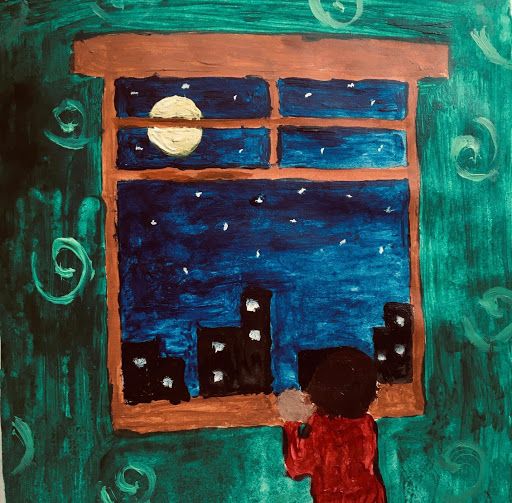
While the rest of the world slept peacefully after a long hectic day, young Saud sat perched in his window scrutinizing the sky. The sky, what a mesmerizing miracle of nature; vast, deep, calm and mysterious. And highlighting it, the pearl-white moon.
Every day, so many people worried about academics, impressions, careers, standards, resources, politics, gossip, and the sort, but Saud was only interested in the sky and its wonders.
He turned to his table, where a pair of binoculars sat atop some astronomy magazines and books. He held his binoculars lovingly as he recalled the time, he had purchased them. He was in sixth grade when his science teacher had asked the students what they wished to choose as a career in future. Among the typical chants of doctors, engineers and businessmen, his loud ‘Astronaut’ had caught his teacher’s attention.
“Well Saud, I hope you will be able to make your dream a reality. We haven’t had an astronaut from Pakistan yet, but let’s hope you become the first one!”
These words had ever since been stuck
in Saud’s mind. He imagined himself passing the test and being the first
Pakistani to reach the moon. He imagined how it would feel like to have newspapers
with his picture on the front cover receiving surprised comments on every
breakfast table. And every news channel mentioning him in the headlines;
He imagined himself passing the test and being the first Pakistani to reach the moon
“Saud Tariq, first Pakistani to
reach the moon. A milestone for Pakistan! It is proud of such stars which
struggle to fulfill their dreams and inspire the rest of the youth.”
Years later, his passion for space travel hadn’t got any less and an example of this was his bookshelf which was overburdened with profuse books on the solar system, space, physical aspects of astronomy, space fiction and rocket science. As a child, his favorite movie had been the animated ‘Toy Story’ because of Buzz Lightyear. He even had his mom make him a similar costume for one of his school parties. His biggest inspirations were Alan Shepard, John Glenn, Kalpana Chawla, and Sally Ride, to name a few.
After 7th grade, Saud had
managed to make it to Military College Murree. It was very close to Rawalpindi,
and an hour from Islamabad, where his home was. He had been ecstatic to finally
start working for his dream, but part of him was aching as he bade his mother
and younger siblings goodbye.
Life at Cadet College was far from Saud’s expectations. First, he had found it awkward to be called a cadet instead of a student. Cadet sounded like some sort of a robot’s name to him. Secondly, he had to follow an extremely strict routine with an even strict diet. Thirdly, he had to juggle his studies with his training program. He had to get up at the crack of dawn for his physical drills, then later attend his classes and labs. Then it was time for the evening sports activities like football, running, hockey, gymnastics, and karate. Saud soon lost a lot of weight and missed his mother’s cooking badly. He missed his old normal school and friends who would now be at the local high school.
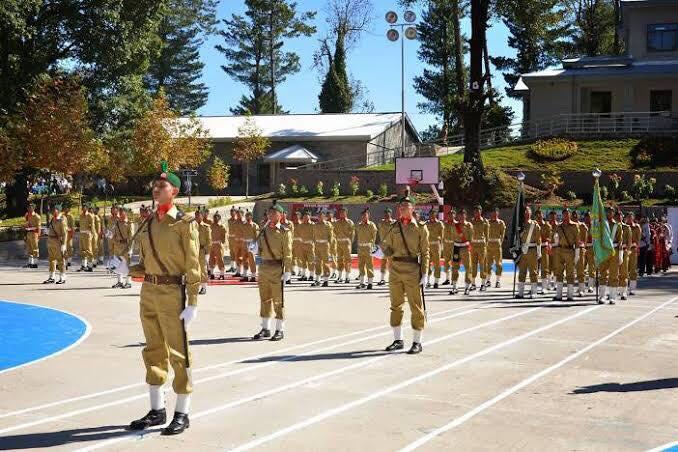
The day he graduated from Cadet College had been a proud moment for him
During his four years at MCM, he thought of
quitting his stressful routine many times, but then he would remind himself why
he was there in the first place. One look at the moon from his hostel window was
all it would take to reincarnate his passion for aeronautics, and it would
strengthen him to endure the hardships all over again.
The day he graduated from Cadet
College had been a proud moment for him. He would never forget the beaming
faces of his parents and the many congratulations that flooded his way from all
directions as he held his degree with the utmost pride.
That summer Saud got himself enrolled in Space Summer School at the Institute of Space Technology. Those few weeks of his life had been like his dream come true. The workshops, the technical projects, and the astronomy night were all some of the best moments of his summer. Saud got to relish some good career advice as well. He wanted badly to become an astronaut and visit the moon.
He started BS in Mechanical and
Aeronautical Engineering at UET Taxila. Every day he spent hours in the library
reading literature on space science and astronomy and brooding about his
future. He applied for the training program for International students at NASA
as soon as he saw the advertisement. He also applied at SUPARCO, Pakistan Space
and Upper Atmosphere Research Commission for the Space research program and had
his fingers crossed. He hoped he would be shortlisted for the interviews and
pass his written test as well.
Saud saw himself perfect for the job.
He was 6 feet tall and well built. He had a good night vision and did not wear
glasses, although they were acceptable for astronauts and space scientists. He
had no history of any severe diseases. He was active and worked out every
morning. He was young, ambitious and ready to take risks. He had developed all these
habits since college and had a healthy 140/80 blood pressure. He did not suffer
from nausea or vomiting, and training had made him strong-minded and swift.
Weeks passed but nothing happened.
Then, one fine evening, another door opened for Saud. He was at his window with
his newly purchased telescope observing the surface of the moon. His father
came into his room, clutching the paper in his hands.
“Saud. Have you read today’s paper, boy?
’he asked, a spark in his eyes.
“No, dad.”
“Well then, you should have!” he
passed the newspaper to him, smiling. Saud read the column his father had
encircled with bright red. His mouth grew wide open and he couldn’t believe his
eyes as he read further. Collaborating with China National Space Administration
and NASA, the Pakistani government was offering BS students in several
Engineering programs an extensive four weeks course on Space Science and
Travel, and they would choose 10 lucky students to go to the moon by the end of
this year.
At T-minus zero seconds, the liftoff began
‘Saud counted down to one in his head
along with the countdown as he sat nervously in the Space shuttle with all
these experienced men. At T-minus 6 seconds, the main engines roared to life.
Saud could feel his intestines tying into the tightest knots. The man in front
of him grinned at him and gave him the thumbs up.
At T-minus 0 seconds, the liftoff began! Saud felt as though his insides were left behind on the Earth and he felt as light as a feather as the Spaceship rose higher and higher. In a while, Saud would land on the moon. The Moon! That little dot he so vividly remembered seeing from his window….’
“Son. Son?”
Saud was brought back to earth by his father’s voice.
“Yes?” he asked, still looking dazed.
“Well, what are you waiting for? Go, apply. Now!”
Saud gave his father a quick hug and incandescent,
sauntered gleefully towards his PC.
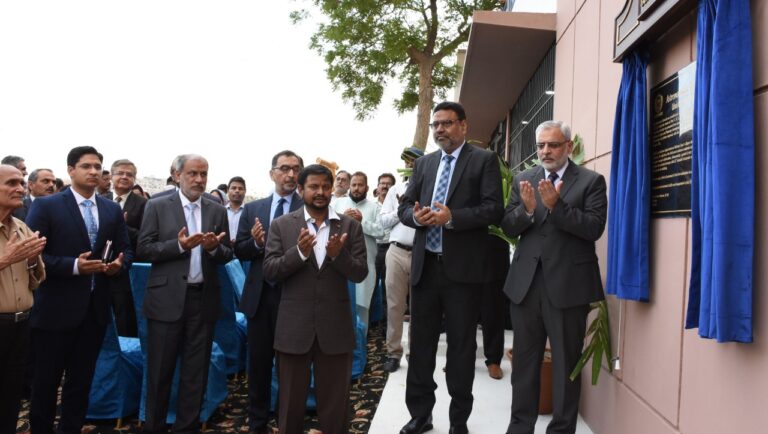
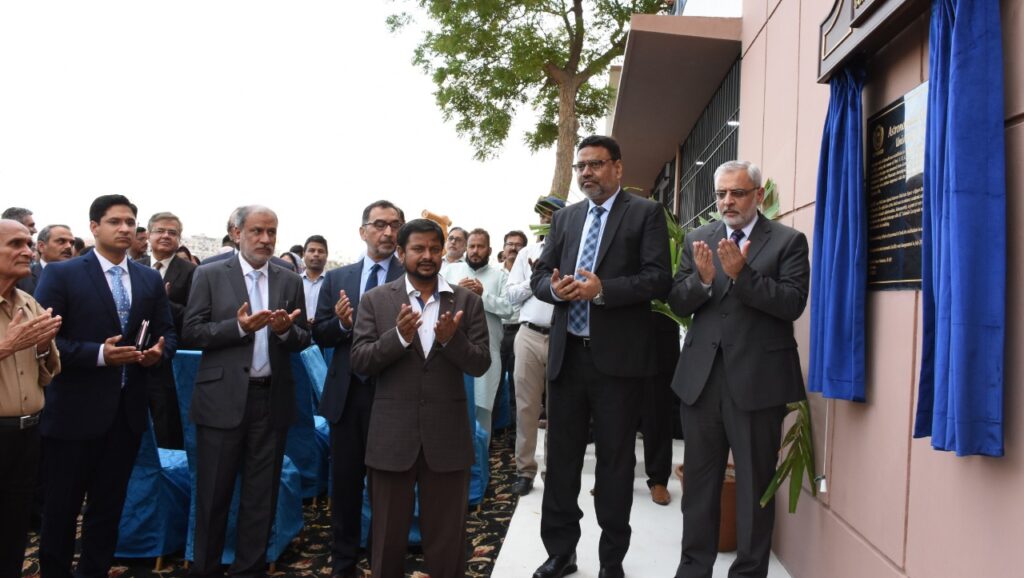
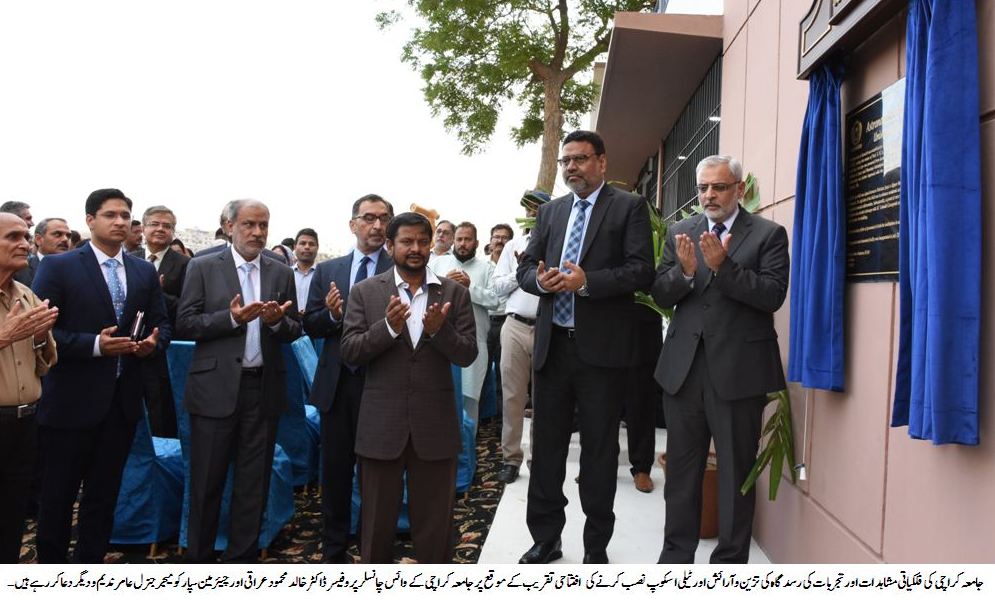
The Institute of Space and Planetary Astrophysics (ISPA), University of Karachi, on Monday installed a new 16-inch telescope at ISPA Observatory. The Chairman, Pakistan Space and Upper Atmosphere Research Commission (Suparco), Major General Amer Nadeem and the KU Vice-Chancellor Professor Dr. Khalid Mahmood Iraqi jointly inaugurate the project.
Inaugural Ceremony
An inaugural ceremony was also attended by the members SUPARCO and ISPA, Dean Faculty Sciences Professor Dr. Tabassum Mehboob, Dean Faculty Pharmacy Professor Dr. Raheela Ikram, faculty members of various departments, the Founding Director ISPA Professor Dr. Javed Qamar, students and field experts.
The up-gradation work, automation of dome and fixation of 16-inch diameter computerized Meade telescope, and renovation of the observatory building have been completed by SUPARCO. The project was completed with Rs6 million and it has the ability to keep records of 65, 000 astronomical objects while with the help of its ‘go-to technology’ certain astronomic object could be focus immediately.
The Chairman, Suparco, Maj General Amer Nadeem, said that once he took over the charge last year, this was one of the projects, which he thought needed to be done on priority. “We took up several steps and eventually we completed the task and now jointly inaugurated the project.”
An inaugural ceremony was also attended by the members SUPARCO and ISPA, Dean Faculty Sciences Professor Dr. Tabassum Mehboob, Dean Faculty Pharmacy Professor Dr. Raheela Ikram, faculty members of various departments, and the Founding Director ISPA Professor Dr. Javed Qamar
Maj General Amer Nadeem shared that in his opinion, the research work would be as good as the equipment which is available for students and faculty and therefore with the installation and commissioning of this telescope quality of research at ISPA would further increase.
“Suparco will continue to assist ISPA and other departments of the University of Karachi. We can further support research work in the domain in space sciences and other fields which then eventually contributes to the space program.”
Meanwhile,
the KU VC Professor Dr Khalid Iraqi, while expressing his gratitude to the
Chairman of Suparco, Major General Amer Nadeem, member of Suparco Amir Iqbal
for participating in the inauguration ceremony of the installation of this new
telescope at ISPA observatory, said that he was grateful to Suparco for their
financial support to upgrade the existing ISPA Observatory.
“I am pleased to know that ISPA and SUPARCO are collaborating for promoting space science education. We would like to see ISPA reaching new heights in the upcoming future.”
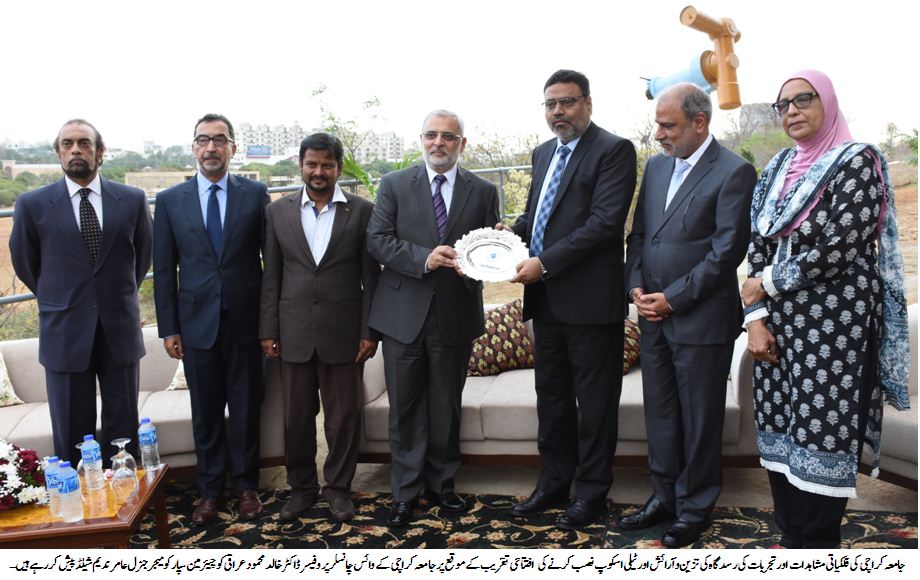
Chairman SUPARCO Maj Gen Amir Nadeem presenting a shield to Pro Dr. Khalid Mehmood in inaugural ceremony
He expressed that development in space research during the past decades has been responsible to bring about revolutionary concepts and advances in long-distance reliable communications, remote sensing of earth’s resources and environment, planetary science, astronomy, and cosmology.
He
shared that ISPA is providing education of space science to undergraduate
students and conducting research programs for the graduates.
The KU VC Professor Dr. Khalid Iraqi mentioned that up-gradation of the Observatory is a notable achievement of ISPA. This new telescope having 16-inch diameter will provide an excellent opportunity for our students and faculty members for observing astronomical events and carrying out research in the field of Observational Astronomy.
Earlier, the Director ISPA Professor Dr. Muhammad Jawed Iqbal informed the audience that SUPARCO and ISPA signed the MOU for upgrading the existing astronomical observatory with a larger modern telescope in comparison with the existing one.
“We can observe planets of our solar system including Mars, Saturn, moons of Jupiter and astronomical events like the transit of Venus, eclipse Nebula like ring nebula, Orion nebula nearby Galaxies Andromeda Large Magellanic Cloud and Small Magellanic Cloud.”
He said that the main objective of this project is to undertake collaborative research studies and students projects between Suparco and ISPA. The upgraded astronomical observatory would also support space awareness and education programs for students, the general public and media.
He expressed that the automation of dome, fixation of 16 inch Meade telescope and renovation of the observatory building has been completed successfully while all costs associated with this project was provided by SUPARCO.
Professor Dr. Muhammad Jawed Iqbal mentioned that the former Chairman Suparco Maj Gen Bilal Ahmed had played a significant role in this project. We have signed MoU during his tenure and it was Maj General Bilal who had initiated collaboration of Suparco with ISPA.
The Director ISPA Dr. Jawed said that Maj General Bilal had appreciated the efforts of ISPA for promoting education and research in the fields of space science. He termed that the installation of this 16-inch telescope is a milestone for the University of Karachi.
He
told the participants that it is an optical telescope which is used to observe
light wave portion of the spectrum coming from the astronomical objects, while
a radio telescope studies portion of the electromagnetic spectrum emitted by
astronomical objects.
He added that ISPA is also planning to install a small radio telescope as Higher Education Commission release the grant of our approved project. He informed that one of his Ph.D. students is doing research on dark matter and ISPA has recently published an article on accelerated expansion of the universe in European journal of physics.
Later, the chief guest, Chairman Suparco Maj General Amer Nadeem and KU VC Professor Dr. Khalid Iraqi unveil the plaque and planted a sapling at the ISPA Observatory.
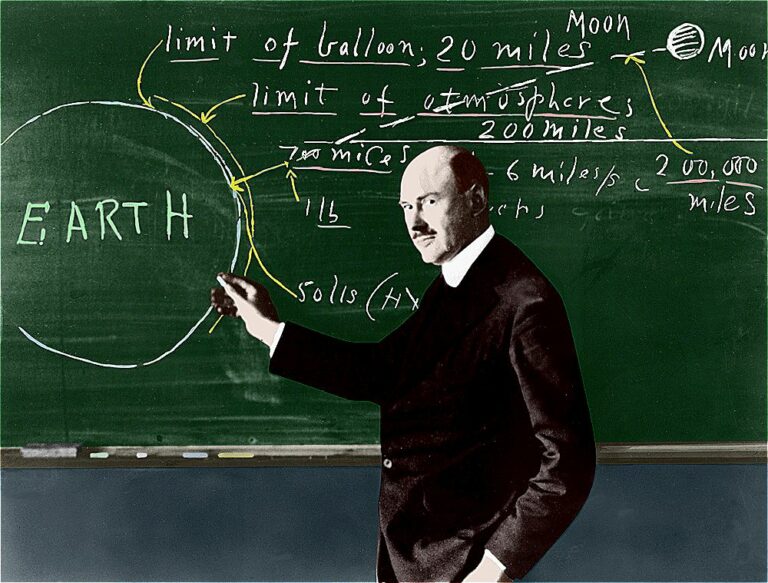
In 1921, The New York Times discredited a discovery made by the father of modern rocketry, Robert H Goddard. This is a tale of how an innovator was lambasted, shunned and embarrassed … only to be proven right 24 years after his death
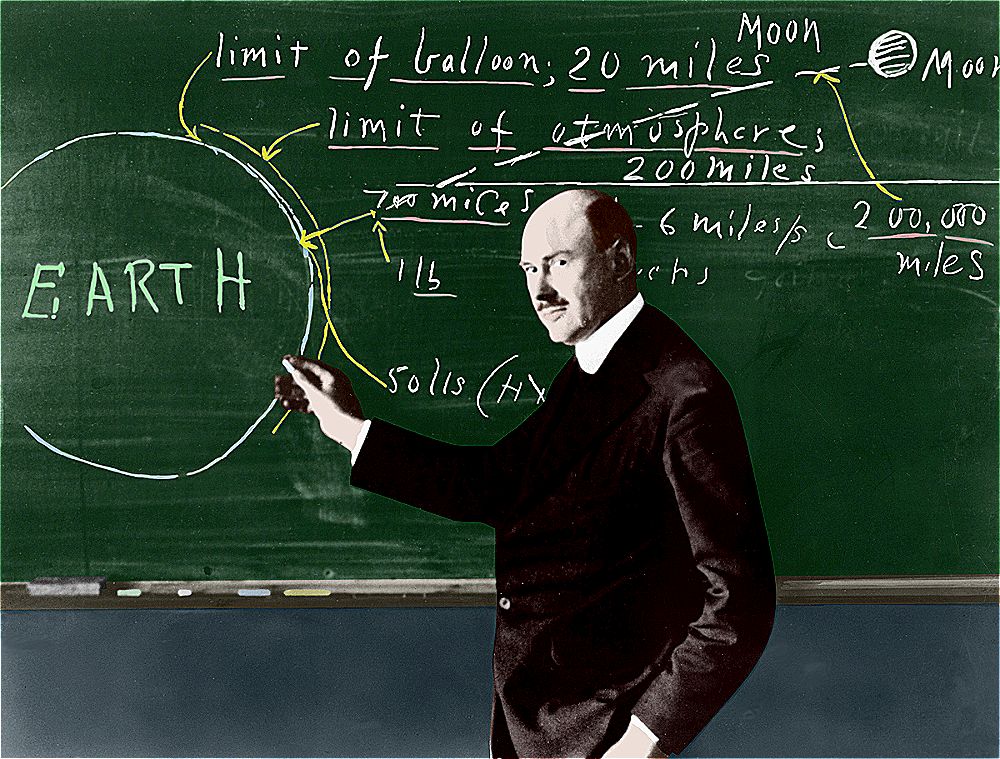
Robert H Goddard
In the early 20th century, American physicist Robert H Goddard came across the idea of liquid fuel propellant while he was conducting a series of practical experiments in rocketry. Goddard, at least figuratively, was over the moon.
Goddard’s fascination with space flight tracked back to his college days at Worcester Polytechnic Institute. He was actually interested in achieving higher altitude but it was a daunting task to build a liquid fuel rocket than solid –propellant rockets. Despite a lack of resources and sufficient funding, Goddard was able to build a liquid-propellant rocket by 1926. This was game-changing.
But the euphoria of Goddard’s discovery did not leave everyone in awe.
Some thought he was a charlatan, others believed science could not have such a leap of discovery in the 1920s. Such was the disbelief in Goddard’s work that the New York Times in an editorial not just ridiculed Goddard’s intellect and integrity but, also accused him of not understanding Newton’s third law of motion.
“Professor Goddard with his chair at Clark College and countenancing of Smithsonian Institution [from where he held the grant to continue his research independently] does not know Newton’s third law of motion,” read the editorial, “and the relationship between action and reaction, and of a need of something better than a vacuum against which to react. Of course, he only seems to lack the knowledge ladled out daily in high schools.”
In the same year, a similar campaign simultaneously sparked out another controversy when Goddard published one of his research works in Scientific American that intensified the prevailing wave of harsh criticism. This propelled other science outlets also arguing that space travel is nearly impossible. Some even claimed that rocketry can be traced back to more than 2,000 years and never had anyone been able to do the unthinkable: travel to space.
But Goddard was a scientist and such criticism by non-scientists was mere noise to him.
Perhaps the greatest influence and the lifelong gift of Goddard to humanity was his deep understanding of rocketry, inspiration, and celebration that space travel would be a reality in a few decades or so later. It was actually Goddard who initially outlined an uncrewed mission to the moon. Little did he realize that this work would become instrumental in American foreign and defense policy. Goddard’s legacy has arguably quietly been absorbed by engineers and scientists at NASA and the Russian space agency, Roscosmos, who worked frantically on Vostok, Gemini, and Apollo space programs.
According to Goddard’s works, a rocket should essentially be a heat engine that can able to convert the heat energy or chemical energy of fuel into mechanical energy. The critical component in this energy conversation was the nozzle from which the jet blew onto the wheels. Goddard along with his counterpart De Laval found that the best conversation takes place when the nozzle initially narrowed and eventually gives rise in the speed of jet to the speed of sound. Using a De Laval nozzle, Goddard was succeeded to attain the real jet velocities between 7000 and 800ft/sec. Later with a specially designated compact device, he showed that rocket can work in a vacuum as well.
By then, NASA and several other space agencies were also working on the same principle of rocket propulsion but the only way they followed to learn was projecting heavy objects into the other planets of our solar system. At that time, it was widely assumed that when rockets acquired a certain escape velocity they are still in a thin layer of earth’s atmosphere and it’s almost impossible to survive for a rocket from the heat of reentry. Goddard was ahead of them in some ways and one of his rockets with explosive payload would successfully crash into the moon.
In 1919, Goddard published his research work entitled “A method of reaching high extreme altitude”, condensation February 1920, Scientific American and Nature August 1920. The paper thoroughly explained the method of attaining high altitude around 20 miles, beyond the range for surrounding balloons and developed a theory of rocket propulsion taking into account the air resistance and gravity.
Goddard concluded with the statement that if most of the mass of the rocket consists of propellant, its superiority will increase enormously.
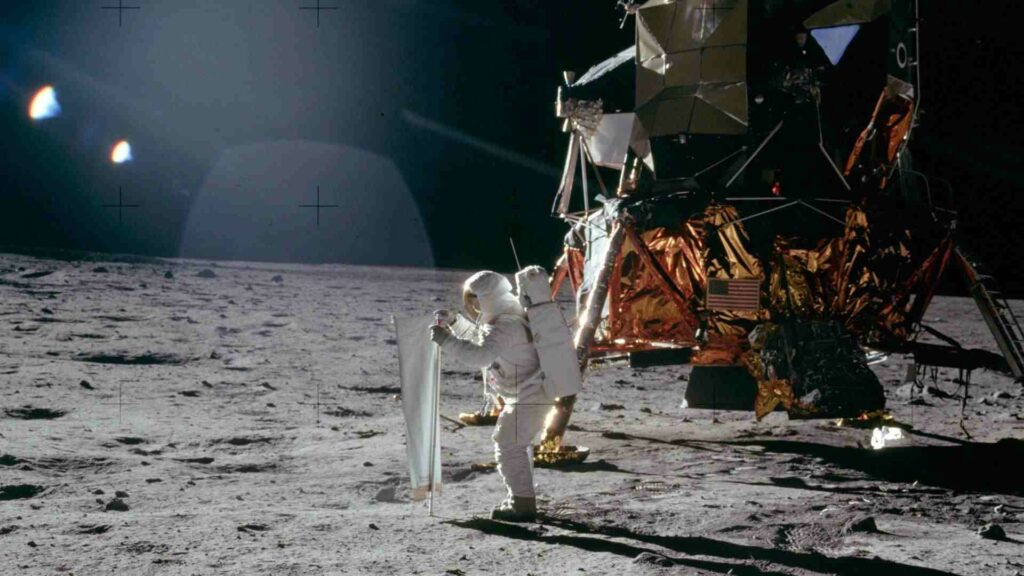
Fifty years after, when NASA’s mission “Apollo 11” successfully landed on the moon with Neil Armstrong, Buzz Aldrin, and Michael Collins on July 1969, those who doubted that space travel was a possibility were left stunned. Those in scientific communities who had belligerently opposed the idea of a small capsule being able to land on the moon could not believe the images.
But it was the New York Times who first came to realize its biggest mistake — dismissing the notion of rocket propulsion and the scientist behind it.
“Further investigation and experimentation have confirmed the findings of Isaac Newton in the 17th century and it is now definitely established that a rocket can function in a vacuum as well as in an atmosphere. The Times regrets the error.”
Though this correction was made 24 years after Goddard’s death, history absolved him.
Mansoor “Moonie” Ahmed, was brought up in Peshawar, Pakistan in the northwest region on the fringe with Afghanistan. He retired from NASA where he worked as an Associate Director of Astrophysics. He anticipated Division and Program Manager for the Physics of Cosmos and Cosmic Origin Programs.
Mansoor Ahmad
Mansoor has a B.S degree from the University of Maryland and M.S. from George Washington University, both in the mechanical building. He received a couple of prestigious awards like NASA Exceptional Service Medal. Mansoor has worked as a part of the US government Senior Executive Service (SES) in 2007.
Mansoor is at present filling in as the Associate Director of the Astrophysics Projects Division just as the Program Manager for the Physics of the Cosmos program and the Cosmic Origins program at NASA Goddard Space Flight Center.
Mansoor Ahmed has spent the majority of his vocation in serving the Hubble Space Telescope (HST) program in various limits, including the Flight Operations Manager and the Project Manager for HST tasks. He has taken an interest in everything except one Hubble adjusting missions. During a short spell far from HST, Mansoor has filled in as the Mission Manager for the Compton Gamma Ray Observatory Orbit mission and afterward as the appointee venture administrator for the James Web Space Telescope.
Here are some excerpts of his conversation with Team Scientia.
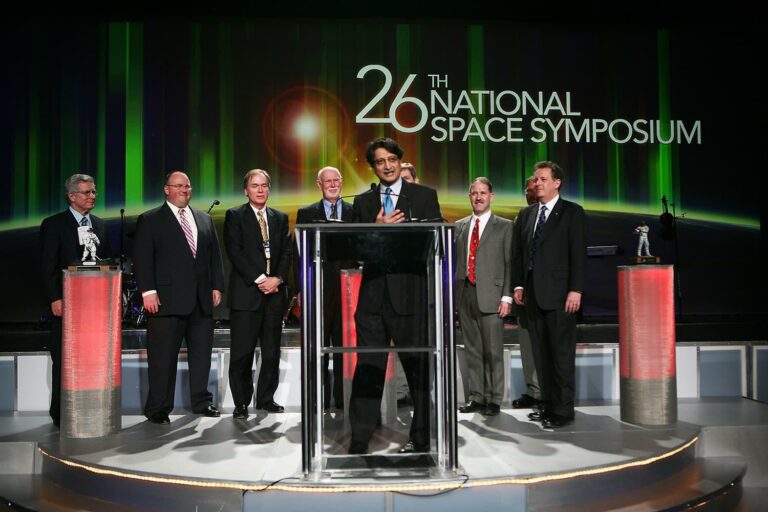
While addressing the national space symposim
You were born and grew up in Peshawar, let us know about your family background? Do you recall any interesting story regarding your childhood/teenage or by any of your elder relatives that you think worth talking?
My father was a Subedar-Major in the army. We lived in Peshawar city, near Fort Balahisar. For the first 5 years of education, I went to a Christian mission school and from sixth grade onwards, I went to the Government High School # 1in Peshawar city. Our house was across the street from Naaz cinema, the only cinema in the city that played English language films. This is where I got my very first exposure to films. My father took me to see the film “The Vikings” and I was hooked from then on.
Even though I didn’t really understand any English. My answer to the question “what do you want to be when you grow up?” was; I want to become the ticket collector for Naaz cinema so that I can see every film playing there. After watching a film, I would tell the story, scene by scene, in detail to my cousins. I guess that is where I picked up the art of storytelling that is coming in handy now in my filmmaking endeavor.
Then one day, I was visiting some relatives who lived right next to the Pakistan Airforce base in Peshawar and I witnessed an F-86 land on its runway. As the plane taxied right by me, I could see that the cockpit was open and the pilot in it. The pilot waved at me as he passed by and right then my career goals changed. I wanted to be a fighter pilot.
In the Government, High School, a close friend of mine, Ayub told me about the Airforce cadet academy in Lower Topa, a tiny town near Murree. A boarding school that selects 60 children each year as pre-cadets to prepare to enter the air force flying academy after FSc. Ayub said he was applying for it and encouraged me to apply as well. Fortunately, both of us got selected and we entered Lower Topa in May of 1966, at the age of 13.
Who was the most influential person to you as a child? Is there a teacher that you remember having been particularly influential?
I attended the air force pre-cadet academy in Lower Topa from 8th grade to FSc first year. These were the most impressionable years of my life. The academy taught us discipline, comradery, leadership, and sportsmanship together with an excellent education. The best part about this academy was the teachers. They really cared about the students, did everything to engage us directly in the lessons instead of just giving lectures.
They made us interested in science and math as well as literature and poetry. Even though I have been away from Pakistan for more than 40 years, my interest and taste in good poetry go back to the good old days of Lower Topa. We all made a very close bond with a lot of our teachers. Even though most of us have dispersed all across the world, we still keep in touch with a lot of our teachers.
In an experiment
You had been a BS from the University of Maryland & MS George Washington University in mechanical engineering, If you could do it again, would you take a different academic path or you satisfied with the route you followed?
This is a very interesting question to answer. First, I must admit, there is no direct path connecting my current career at NASA to my educational goals when I was a student. As I mentioned earlier, my career goal was to become a fighter pilot. I was happily pursuing it in Lower Topa when I became unfit for flying due to my eyesight. My parents had already migrated to America while I was still in Lower Topa, and once unfit to fly, I was given the option to join my parents in the US. I exercised this option.
When deciding my educational path, I was still driven by the love of flying and figured I should study aeronautical engineering so that I can still work with jet planes. As I started my BS degree, it became apparent that job opportunities in aeronautical and aerospace engineering were diminishing. The Apollo program was coming to an end and there was no real vision NASA was pursuing. So, my advisor advised me to change my major to mechanical engineering. Out of all my courses, I enjoyed thermodynamics and heat transfer the best.
America was entering the energy crisis era and the government was focusing on commercializing alternate, renewable energy resources, such as solar and wind energy. These needs were in line with my BS training and I was encouraged to continue my master’s degree in the area of energy resources. It is by chance that NASA was in need of someone with heat transfer experience, which opened the door for me into NASA.
The point I am trying to make is that where I am today is because of the circumstances that ended up in my favor. There were several opportunities where I could have gone astray, making wrong friends, making wrong choices and pursuing a course of studies resulting in a different career. Who knows if that career would have been as exciting as the one I have now. So personally, I would not want to go back to my student’s days with the risk of making a wrong choice and not end up where I am today.
In Pakistan, only specific mindset have interest in Astronomy and commonly parents do not support their kids in astronomy as a profession, let us know how much you had been encouraged by your family during the early years of your career? Would you encourage your own child if he/she do prefer astronomy/astrophysics as a profession?
I think there are two aspects to this question. Parents are concerned about the livelihood of their children when they grow up. They are concerned whether their children will be able to earn a living and support a family. So, their tendency is to push their kids towards careers that are known to provide a good living. Unfortunately, most often their preferences are also tainted by the apparent status of certain careers in our society and ignore the interest and aptitudes of the children in areas that may not rank high in the status hierarchy in Pakistan.
It is very likely that if allowed to pursue their own interests, the children would really thrive in any careers, whether it be engineering, medicine, music, business, sports, etc. Taking astronomy as an example, even though there may not be too many job opportunities in astronomy in Pakistan, if a child is genuinely interested and has the right aptitude in the subject, encouraging him/her to pursue their passion may result in an illustrious career that might answer the most profound mysteries of the universe, possibly getting worldwide recognition. I recognize it is a tough choice for a parent. Especially in Pakistan where there is a stigma attached to certain careers and are discouraged by parents.
In my situation, I am not sure if my parents would have encouraged me to become the ticket collector for Naaz cinema but they definitely did not discourage me in pursuing my career in the air force. In the case of my children, I believe in allowing them to pursue their passion, be it astronomy, plumbing or driving a taxi. It is easy for me to say because in the US, there is generally no stigma attached to any career and a person can make a decent living in any job, as long as they are willing to work hard at it. And if one is in a career following their passion, it is easy to work hard at it.
With colleagues
Do you think science could be made more popular and accessible in Pakistan if more scientific literature was available to the masses in Urdu?
I’m not sure if that will help any but it’s worth a try. In my opinion, the first step required is to create an environment where the population is trained to question everything before believing anything. My experience has been that our folks are very quick to accept any rumors, tales and conspiracy theories without logically analyzing it. In the current situation, unless you control scientific knowledge that is disseminated to the public, anyone can post erroneous scientific information and folks will believe it. Having an Urdu based outlet of science information would have to be carefully controlled to avoid misinformation.
JWT is infrared while Hubble is an optical telescope. What do you feel about the future of Hubble? Is it true that JWT got more importance than Hubble?
Hubble and JWST are equally important tools for answering astrophysics questions. Just like Hubble cannot see infrared light, JWST cannot see optical and ultraviolet light. Together they can solve more mysteries than either one can by itself. Hubble continues to be in perfect health. We predict that all its systems will still be functional until 2022 and most likely beyond. JWST will be launching in early 2019. The scientific community is eagerly awaiting when both of these amazing observatories will work for hand in hand.
How our knowledge has expanded via space-based astronomy with observations like Hubble & JWT?
Hubble has made amazing discoveries up to now. It has determined the exact age of the universe, it has proved the existence of black holes that were only theoretical before Hubble, it has observed gravitational lensing as predicted by Einstein and so much more. As it has answered so many questions, it has also introduced us to so many more mysteries that we didn’t know existed.
Dark matter and dark energy for example. Being an optical telescope, Hubble’s eyes reach a limit when looking for the oldest galaxies and stars. The older the galaxies, the faster they are moving away from us so their light reaches us in infrared (due to Doppler shift) and Hubble cannot see them. With James Web, we will be able to see those galaxies and determine how and when the very first stars in the universe were born.
Let us know about your services as a project manager for LISA, the mission that was a collaborative endeavor between NASA & ESA? What do Gravitational waves tell us & how would LISA implement our knowledge about the beginning, evolution & structure of the universe?
Up to now, all of our astrophysical discoveries have been done with analyzing the electromagnetic spectrum. The visible light, which human eye can see, and Hubble is optimized to see in this wavelength, is just a small subset of this spectrum. The spectrum ranges from radio waves at one end and very energetic gamma rays on the other end. We have satellites in space observing in most of these wavelengths and together they have informed our knowledge of the universe to date. But the electromagnetic spectrum is generated by the stars when they are born and start to emit electromagnetic radiation.
There were no stars at the time of the big band. Only elementary particles that coalesced together for form electrons and protons which in turn formed hydrogen. The hydrogen atoms started to coalesce to form blobs of hydrogen, eventually forming a mass large enough to have enough gravitational force to initiate hydrogen fusion in the core of this blog, thus igniting the blob into becoming a star that started to emit electromagnetic waves. This process took hundreds of thousands of years. So, there were no electromagnetic waves during this time. We call it the dark period because there was not light and as a result, we can only predict theoretically what happened during that period.
Gravitational waves, on the other hand, were generated right at the start of the big bang because mass always existed and mass creates gravity. LISA mission is being designed so that we can see the universe with gravitational waves. A completely new way of looking at the universe. With LISA, we will be able to look at the dark period from the very beginning of the big bang. We would also be able to see deep inside black holes where electromagnetic light cannot escape from. While we are in the process of building LISA, there are several grounds based gravitational observatories now coming into action already.
How long have you been serving for NASA? What advice do you have for your countrymen regarding your type of services?
I have been with NASA for almost 35 years. NASA is a government agency so I am a civil servant, doing this work on behalf of the American public. As a civil servant, one has to always keep in mind that we serve at the pleasure our population, who have contributed their hard-earned money to the government so that the entire nation can benefit from the work of the government. As a civil servant, it is an honor to be given this responsibility and we should do our utmost to work hard and honestly to fulfill our obligations to our public.
Have you encountered obstacles during your career, what is the most interesting thing about your job at Goddard Space Flight Centre, NASA, & what is the least?
I don’t think I can imagine a single dull moment during my career at Goddard. It has been amazing to be working on so many interesting and challenging projects with so many amazing scientists and engineers who are motivated and hard-working to meet the mission objectives.
We found an apparent dichotomy in Mansoor Ahmad, besides your arduous services for NASA, you have been directed sixteen short films and a movie. Let us know about your experience as Technical Director of the television show ‘Pakistan vision’. What’s harder getting started or being able to keep going?
I don’t see it as a dichotomy. My work at NASA is my career. Filmmaking is my hobby and not intended for earning a livelihood. It is very important for one to follow one’s passion. And it is not necessary that one should have only one passion. We should pursue all our passions. It is important to do that to feel complete. Pakistan Vision was a passion of a friend of mine, Mr. Saleem who was a pharmaceutical representative during the day and in his spare time wanted to develop a news and entertainment program for the Pakistani population in the Washington DC area.
My interest in the technical side of filmmaking and figuring out the right equipment for developing, editing and airing the show went hand in hand with Mr. Saleem. It was a great learning experience for both of us. This partnership evolved into us launching into the production of our feature-length film Bhool.
Do you think that cinema has the power to influence the minds, if so what should be the role of a filmmaker in a society like Pakistan?
I believe so. Cinema remains to be the most popular form of entertainment worldwide and especially in our country. So, I do believe the filmmakers have the moral obligation to honestly expose the issues facing the country as well as create material that minimizes the divide among us, whether it is political, religious, status, and gender. The filmmakers can help eliminate all kinds of stereotypes existing in our society.
As a filmmaker, how much did you compromise because of financial restrictions, how did you & your fellows manage time during the making of BHOOL besides professional responsibilities?
As I said earlier, filmmaking is my hobby and not a money-making endeavor. We took on this venture as a learning process. Other than buying the necessary equipment, there was no other expense. All the cast and crew were volunteers, following their own passions. The locations were obtained through favors by our friends and families. And frankly, we didn’t really know enough to know if we were compromising anything. And since we are our own customers, following our own schedule, we were free to mold the storyline based upon the available resources. It was only after we finished the film that we realized all our shortcomings.
Do you think that Pakistani University students are different from any American or other country students in capabilities and core skills like mathematics, reasoning, research, and analytical approach? What would you suggest to the new generation in order to cope with the challenges of time regarding space-based astronomy?
I had the privilege of meeting young students in several institutions in Pakistan. I must say I was very impressed by their curiosity, their intelligence and their interest in astronomy and astrophysics, even with the limited resources available to them in Pakistan. I was very encouraged to see that there was almost an equal number of girls as boys attending the talks. A lot of them were enrolled in Ph.D. programs in physics, which is not an easy subject. Some of them have found their own ways to continue research in astrophysics, especially in finding planets around other stars, which is the first step in finding life elsewhere in the universe.
I have made commitments to the leadership of these institutions that I will do my best in connecting these students with the scientists and engineers at NASA who can provide guidance to these young students in pursuing careers in space-based astronomy. I have already obtained commitments from NASA scientist to give periodic lectures by skype to the interested students in Pakistan.
Note A few parts of this interview published on Dawn.com in Jan 2018.
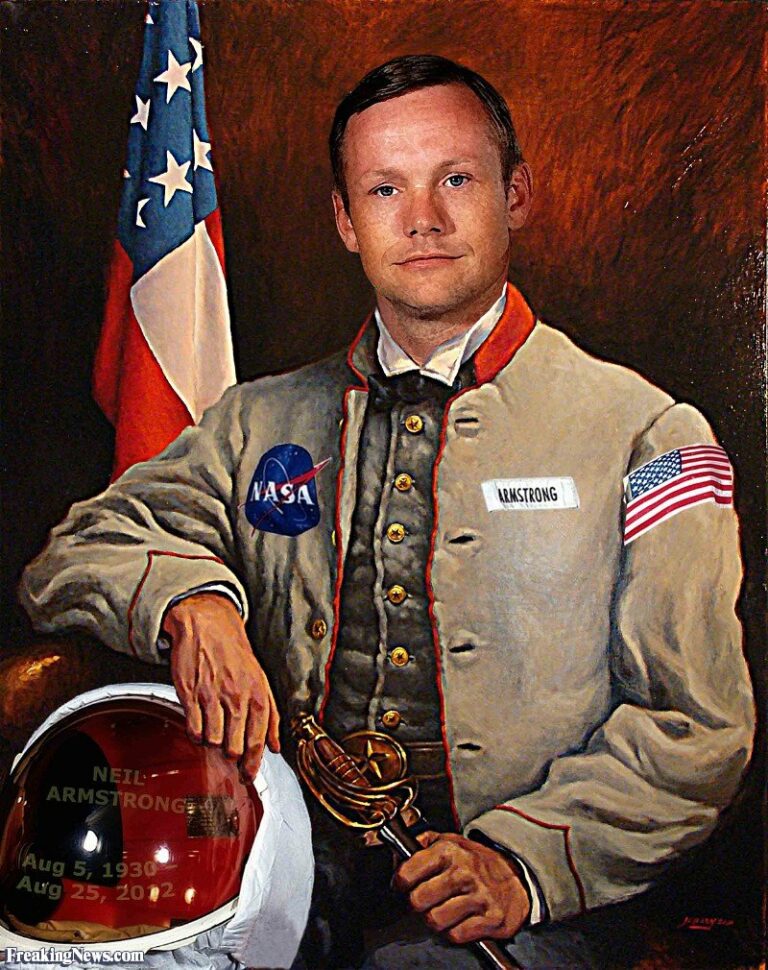
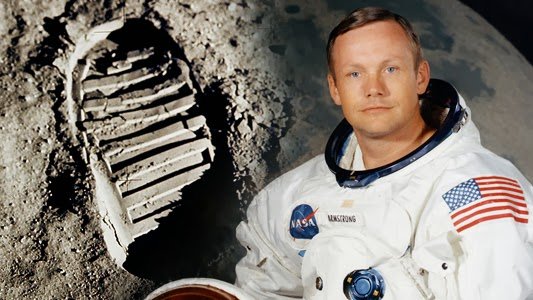
There is a moment, towards the end of First Man, Oscar-Winning director Damien Chazelle’s Neil Armstrong biopic, where the astronaut, after having immortalized himself by becoming the first human to set foot on an alien world and of course delivering the iconic lines ‘One small step…’ is poised over a crater in the Sea of Tranquility, reflecting. As private a man as Neil Armstrong was, it seems almost characteristic for him to seek solitude from the only other human on the moon, fellow astronaut Buzz Aldrin. But the moment isn’t one of seclusion; Armstrong has a burden to bear. In his gloved hands, he holds his erstwhile daughter, Karen’s bracelet, a memento of the child to whom he was so devoted. Standing there, earth’s envoy, he is not an astronaut but a grieving father. The scene ends with the bracelet committed to the deep, the moon’s gravity gently planting it in the Little West Crater.
Whether this episode is apocryphal or not is anyone’s guess – Armstrong’s enduring privateness revealed little and he remains as much of an enigma today as he was then. Shortly after the announcement that Armstrong would be the commander of Apollo 11, the press tried desperately to get to know him, to know who this man was but as writer Andrew Chaikin put it, “Armstrong was beyond their reach” a fact that friends and colleagues could testify to. For someone so lauded, so identified, it is peculiar that we know the astronaut but not the man.
Born in Ohio, 1930, Neil Alden Armstrong cut his teeth as a naval aviator and test pilot before joining NASA and the Gemini Project. A crew cut, corn-fed Boy Scout, Armstrong may have been an All American poster boy but beyond the picture-perfect look, he had ‘The Right Stuff’ – that particular quality that separated him from us mere mortals. A childhood interest in flying and a head for numbers set him on the path for a career in flight, one that reached its apogee quite literally in the heavens.
In telling his story, there are moments throughout his career that build towards the legend –trials by fire that shaped the astronaut to be but then there are also moments, anecdotes if you will, that lend to his own mystique, revealing glimpses of the man.
Soon after graduating from college, he returned to flying but instead of reenlisting in the navy, decided on a career as a test pilot. While this period of his life, the preamble that is, is most noted by ‘incidents’ such as his X-15 ‘bouncing’ off the atmosphere it is perhaps more telling of the man by where he lived.
Though assigned to Edwards Air Force Base in Southern California, Armstrong and family lived quite off the beaten path, in a remote, spartan cabin in Juniper Hills which apparently had no electricity or plumbing. This ascetic, isolated abode typified Armstrong who as time would tell came to be one of the most famous people in the world yet for all that chose obscurity and a farm.
This idyll, one that he would often fondly look back to, was soon to be irrevocably changed by events both foreign and domestic. In 1957, the Soviet Union shot Sputnik into space, announcing to the world that the Space Race had begun. The bi-polar world of the 50s had the US and the USSR locked in a game of one-upmanship and with Sputnik, this contest took to the stars. Scrambling to come to terms with the Soviet Union’s feat, the US, with all urgency, sought to do them one better. Armstrong, perhaps with some foresight, was eager to get in on the action, remarking to a colleague “Space is the frontier and I intend to go”.
Though missing out on Project Mercury, the earliest human spaceflight program by NASA because he was a civilian, Armstong later qualified for Project Gemini in late 1962. However, the year had already been ‘marked’ for the astronaut and his family, and if First Man and the biography of the same name are anything to go by, it is something that dogged him his entire life. Earlier that year, his daughter Karen, aged 2 ½, died, having been diagnosed with a brain tumor.
Armstrong playing with his daughter, a scene from First Man
Again this is the kind of Apocryphal that may never be confirmed (James Hanson, Armstrong’s biographer ‘suspected’ that the astronaut left his daughter’s bracelet on the moon) but one would like to chalk this down to creative license for the morose, somber character Ryan Gosling plays is only one side of the picture. There was a side to Armstrong that was rarely seen, only putting in brief appearances but when it did, like the sunrises that he so cherished in the Californian desert, it was warm and lasting. You can see this in pictures, particularly that megawatt smile he has posing in a spacesuit with the Apollo 11 crew – this is, after all, a man about to embark on a voyage like no other, it’s hard not to smile.
Of course, his professionalism and sangfroid never failed him as during the Gemini Project, the Gemini 8 spacecraft, performing rendezvous and docking in earth’s orbit, malfunctioned, leading to a deadly roll which was only averted thanks to Armstrong’s quick thinking. Though coined much later, Armstrong embodied the ‘Steely-eyed Missile Man’ – a quality in an astronaut to problem solve under great pressure. His landing of Eagle on the moon is a classic example. As the Lunar Module was descending to the satellite, Aldrin, and Armstrong aboard, a sudden computer error led to the LEM’s navigation system being thrown off, jeopardizing the landing. At that moment, Armstrong took manual control of Eagle and with only seconds of fuel left to spare, landed on the lunar surface – “The Eagle has landed.” And though seemingly calm during the descent, Armstrong’s EKG, being monitored back in Houston, showed that his heart rate had soared to 160 BPM.
This restraint and reserve that he exuded were felt by all, as Michael Collins said of him “He has his own barriers erected” and it was something of an ethos for him. When he was informed by NASA flight director Deke Slayton that his crew had been selected for Apollo 11, he would say later that he was ”very pleased but not wildly elated” – that signature restraint in play. When it was being discussed who was to be first to exit the LEM and thus become the first human to set foot on the moon, he remarked at the time that this was something “not based on individual desire” knowing that Aldrin was pushing for the privilege but would add years later, that he didn’t care either way. Of course, Armstrong was selected as he was a commander of the mission and the senior astronaut.
There has been much speculation, both at the time and to this day, about the words spoken at the time he first set foot on the moon. Prior to the launch, he was bombarded with suggestions, constantly being quizzed by the press but as always he kept his own counsel. Even en route to the moon, his crew asked him the same question, but he declined from answering. What was the inspiration for this epigram and when did he come up with it? Again another of those Armstrong mysteries but it is likely that it was conceived on the way, the sheer wonder of it all serving as some muse.
Armstrong’s post-Apollo 11 career was expectedly quiet, retiring from NASA to go on to teach. He remained very active advocating space flight but stayed out of the limelight as much as he could. Following complications after heart surgery, he died at the age of 82. In eulogizing his colleague and friend, Buzz Aldrin’s words are perhaps the most fitting, “My friend Neil took the small step but giant leap that changed the world and will forever be remembered as a historic moment in human history. May he Rest in Peace, and may his vision for our human destiny in space be his legacy.”
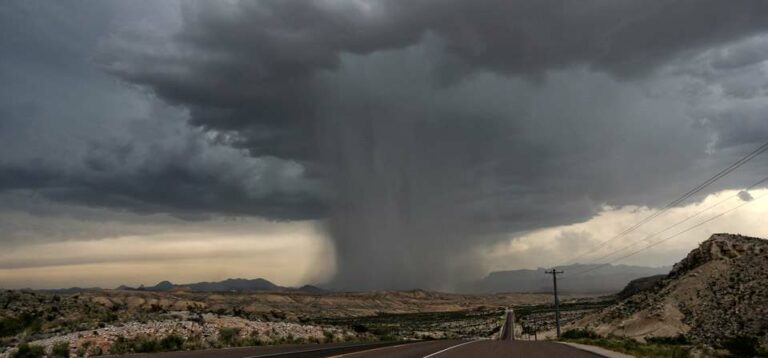
Cloud burst is a natural meteorological phenomenon, occurs when sudden extremely heavy rainfall falls within a very short interval of time. These incidents usually occur in localized areas, especially in mountainous areas, and most often are accompanied by thunderstorms.
A cloud Burst
The hottest air currents carrying large amounts of water vapor tend to rise on the mountainside while violent up rushing air currents prevent condensed raindrops from falling on the ground and thus accumulate extremely high levels of vapor which ultimately burst in the form of heavy rainfall wreaking havoc and destruction. The destructive power of nature is most visible on mountain slopes, valleys, and gullies which are instantly filled with water due to heavy downpour.
The intensity of the cloud burst in the most severe cases can only be conjectured. On 29th November 1911, a rainfall of 63mm (2.47 inches) was recorded in just three minutes in Porto Bello Panama. In other cases, excavations made into the ground by the falling water of cloud burst have indicated the extreme intensity of this powerful natural phenomenon.
Last week at least two dozen people were feared dead and several others reported missing on Monday after flash floods, due to a cloudburst, wreaked havoc within minutes in Neelum Valley, Azad Kashmir.