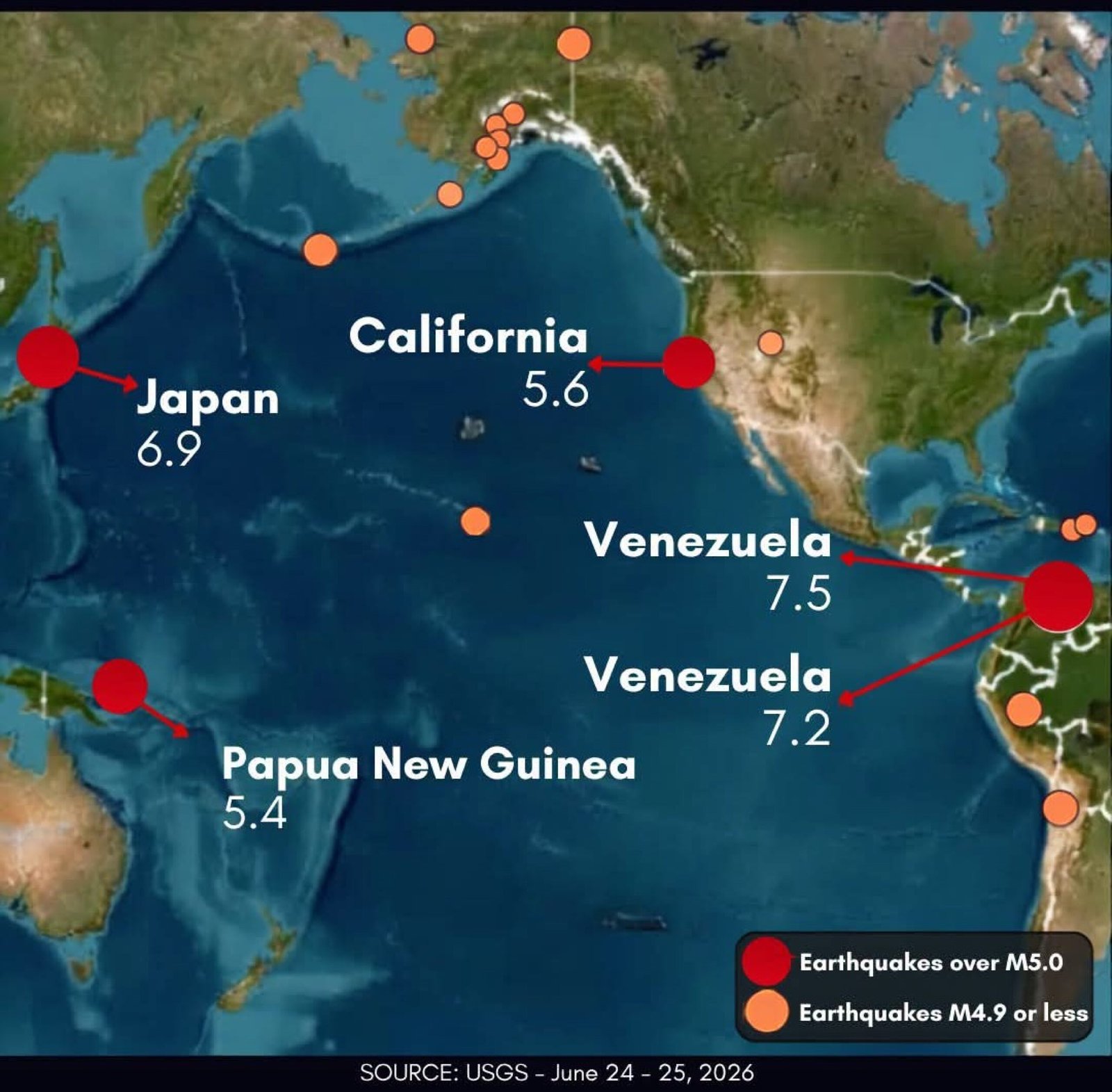
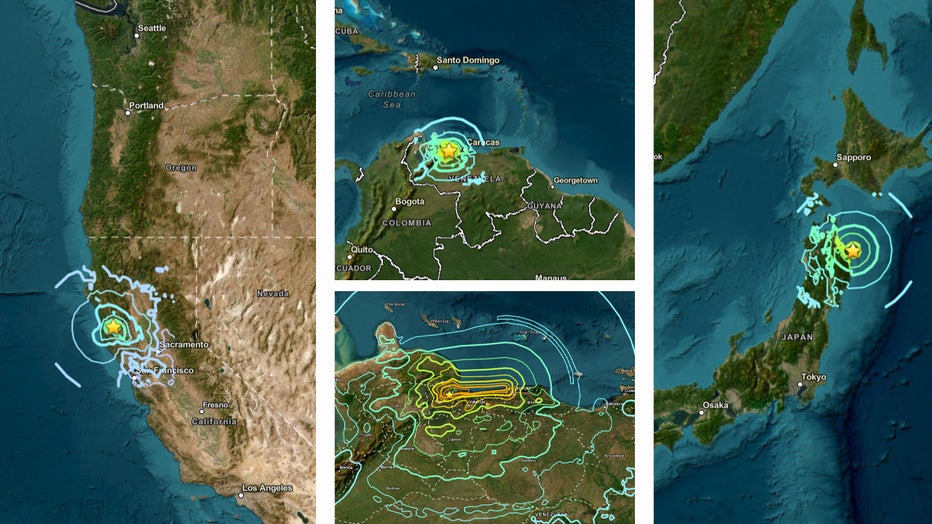
A series of powerful earthquakes erupted around the globe in the last 24 hours. On Wednesday, a sequence of powerful earthquakes rattled three continents within a mere eight-hour window, sparking global concern. In Northern California, a 5.6-magnitude tremor struck Mendocino County, knocking out power for thousands and leaving residents shaken but largely unharmed. Hours later, a massive 7.2-magnitude earthquake struck off the coast of Iwate Prefecture, Japan; fortunately, the nation’s highly resilient infrastructure and the lack of a tsunami threat prevented significant damage.
While California and Japan escaped relatively unscathed, Venezuela suffered a profound tragedy. The country experienced a rare earthquake doublet—a rapid succession of 7.2 and 7.5-magnitude quakes that collapsed buildings in Caracas and along the northern coast, claiming at least 164 lives.
According to Associated Press, four powerful earthquakes rocked different parts of the world in less than eight hours on June 25, 2026. Despite public fears that these global events might be physically linked, experts from the U.S. Geological Survey confirmed that the earthquakes occurred on entirely separate fault lines and were simply a dramatic geological coincidence.
The History of Earthquakes in Pakistan
Two earthquakes occurred just over a minute apart in two different parts of Karachi on July 16, raising the total number of low-intensity earthquakes in the city since June 1 to sixty, and making earthquake preparedness a critical concern.
According to data from the Pakistan Meteorological Department, the first earthquake of magnitude 3.4 originated at a depth of 20 km at 5:52 pm. Its epicenter – the point on the ground located directly above the earthquake’s origin – was located 14 km northwest of Malir. This earthquake was followed by a 2.7-magnitude tremor that originated at a depth of 10 km at 5.53 pm. Its epicenter was 10 km east of DHA City on the Super Highway.
Local geologists report that fault lines passing through the areas of Korangi and Malir have become active after several decades and are causing minor earthquakes in the surrounding areas.
Earlier, on March 31, an earthquake of magnitude 4.7 had also rattled Karachi. Although the tremors lasted only a few seconds, they caused widespread panic and disruption in the metropolitan area, revealing the lack of preparedness for natural disasters. This event not only shook the ground but also served as a wake-up call for residents. Also, it highlighted the critical need for disaster management in a vulnerable country like Pakistan.
What Causes Earthquakes in Karachi?
Researchers explain that Karachi lies on a passive margin, a zone where the continent meets the ocean, so the chances of a massive earthquake happening there are low. Small earthquakes do happen with intensities of 3 and 4 on the Richter scale, but they are not dangerous.
Dr. Sarosh Hashmat Lodi, the former Vice Chancellor of NED University of Engineering and Technology, spoke to Dawn about Karachi’s vulnerability to earthquakes. He stated that the city has no significant history of major earthquakes. However, if an earthquake with a magnitude of 5 or 6 were to occur, it could cause substantial destruction due to the inability of the city’s infrastructure to withstand such an event.
Natural disasters like this are, in a sense, natural. We can’t avoid them, but that doesn’t mean we can’t be better prepared when they do come. Before we explore how to prepare for an earthquake, we need to understand why this is even more important for a country like Pakistan!
Why Earthquake Preparedness in Pakistan Cannot Wait
The Earth is made up of huge chunks of rock called tectonic plates – think of these plates as ice cubes floating on the surface of your soda, except that the tectonic plates move extremely slowly: around 2 to 10 centimeters per year. It is when these plates move and collide with each other that an earthquake is born.
Pakistan is situated on the boundary between two major tectonic plates: the Eurasian and the Indian Subcontinent plates. Additionally, it lies on minor plates, such as the Iranian, Arabian, and Tibetan plates, which further increases the risk of experiencing an earthquake. That makes earthquake preparedness in Pakistan not just a precaution, but a necessity embedded in the country’s geography.
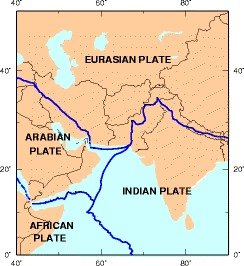
Moreover, Pakistan’s landscape is scattered with several fault lines, which are essentially fractures in the Earth’s crust and form when two pieces of land grind against each other, building up huge amounts of pressure. Karachi, in particular, contains the following faults: Karachi-Jhimpir Fault Zone, Allah Bund Fault, Kirthar Fold and Thrust Belt, and Makran Subduction Zone.
Additionally, much of Pakistan’s infrastructure has been developed without accounting for the potential impact of earthquakes. The absence of this consideration in building designs drastically increases the risk of damage associated with seismic events.
Hence, it is safe (or rather, unsafe) to say that Pakistan is not only located in a highly seismically active region in the world, but also lacks the preparations required to minimize damage caused by earthquakes, making it all the more important for us to improve our disaster management system.
Dust, Debris, and Destruction – The Kashmir 2005 Earthquake!
Let’s take the Kashmir 2005 earthquake as an example, and explore the devastating effects of the earthquake, what steps were taken to reduce damage, and evaluate the groundbreaking lessons learned from this tragic event.
The Extent of Devastation!
On October 8, 2005, one of the most devastating earthquakes hit Pakistan with a magnitude of 7.6, resulting in terrible consequences for human life and infrastructure. For comparison, this earthquake was around 800 times stronger than the one experienced in Karachi on March 31.
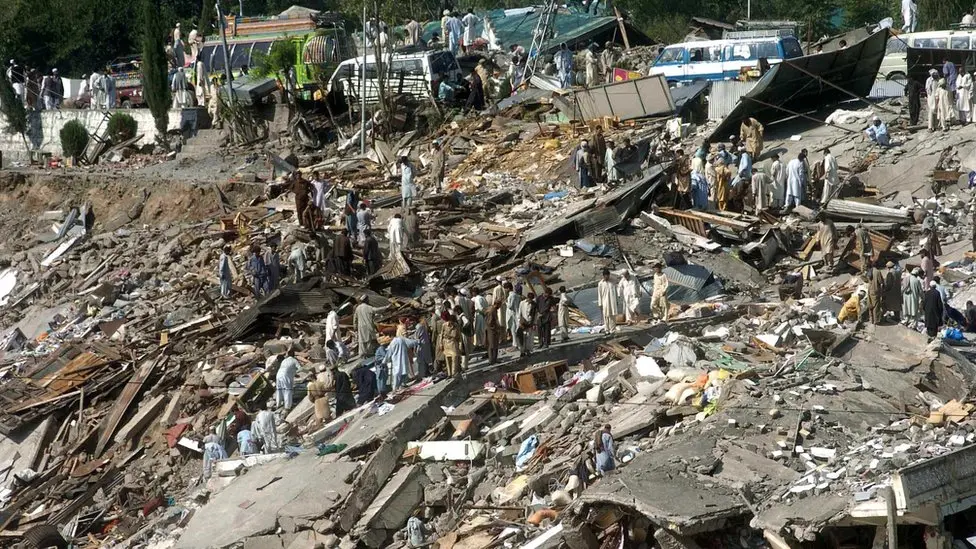
Shahzeb Jillani, a Karachi-based journalist, then reported to the BBC, “When he reached Balakot, one of the areas greatly affected by the 2005 earthquake, it was a terrible sight: around 90% of the buildings had been reduced to nothing but rock and rubble. Parents screamed their children’s names outside what was once Shaheen School, and the atmosphere was encompassed by a prevalent feeling of helplessness.”
The Aftermath
According to data in a report published by the National Disaster Management Authority (NDMA), between 3.2 million and 3.5 million people were affected by the earthquake, either directly or indirectly. The nation faced 73,000 casualties, while 79,000 people remained injured.
In terms of infrastructural damage, a staggering 400,153 homes were destroyed, leaving hundreds of thousands of people without a roof over their heads. Roads and communication lines were severely damaged, which further delayed a response from emergency teams.
The Response
The government established a Federal Relief Commission (FRC) to initiate and manage large-scale rescue and relief operations. Simultaneously, the Earthquake Rehabilitation and Reconstruction Authority (ERRA) was also formed to support medium- and long-term reconstruction projects. It was through these entities that aid and assistance from international organizations and agencies also poured in. Emergency camps and mobile hospitals were also set up.
The Faults led to more Human Toll and Infrastructure Damage
Several factors led to increased damage to human life and infrastructure as a result of the Kashmir earthquake:
Lack of Planning and Earthquake Preparedness
The absence of an early warning system meant the residents were not prepared to expect an earthquake. In countries like China, where a national early warning system has been set in place, residents can be alerted a few seconds before an earthquake strikes, prepare them before the disaster strikes.
Now you may ask: how does an early warning system exactly work? We all have one friend who stays at the entrance and tells us when the teacher is on their way to the classroom, so that we can stop our mischief! Consider this early warning system to be that friend – it alerts everyone seconds before the earthquake strikes!
Additionally, it is important for organizations like the NDMA to devise a detailed plan to put into action immediately when an earthquake strikes – even the seconds matter in crucial times like these! Survivors of the Kashmir earthquake faced many issues with mismanagement, such as uneven aid distribution and temporary shelters unable to support harsh weather conditions.
Lack of Proper Infrastructure
The Kashmir earthquake brought damage to around 780,000 buildings – but the question is why. This is because buildings in Pakistan are not designed with earthquakes in mind. Following the Kashmir earthquake, several steps were taken to change this: by revising the Building Code of Pakistan (2007) to incorporate ‘seismic provisions’; however, that being said, efforts remain limited in the implementation of this code, highlighting a major gap in earthquake preparedness in Pakistan.
Additionally, many roads and communication lines were damaged due to the earthquake, causing delays in the provision of emergency and rescue services. Remote regions like the Neelum Valley did not receive aid for several days. This issue can be avoided by establishing emergency options for which careful planning is crucial.
Lack of Earthquake Knowledge and Awareness
It has been noticed that several people in the regions affected by the Kashmir earthquake did not have adequate awareness about how to react to an earthquake. Hence, it is important for the relevant government agencies to ensure focus is placed upon earthquake drills and public awareness campaigns, specifically in schools. Community training programs can play a huge role in improving earthquake preparedness in Pakistan, especially in schools and rural areas
Lack of following the Building Code in Pakistan
Earthquakes are a prevalent issue for Pakistan primarily due to its location, as earthquake-prone regions tend to be highly populated, resulting in even greater damage.
In his interview with Dawn, a geologist explained that many buildings in Karachi are constructed with low-quality materials, have no earthquake preparedness, and the safety standards for most of these structures are questionable. Oftentimes, very inexpensive materials are used in their construction.
This makes it imperative for everyone to play their role in reducing damage from earthquakes: government organizations by investing in carefully planned initiatives and programs, schools by educating their students about earthquake management, and communities by being prepared and helping each other when the quakes strike. Strengthening earthquake preparedness in Pakistan at every level is essential to reducing future disaster impacts.
Let’s invest in rock-solid plans for shaky times!
References:
- https://ead.gov.pk/SiteImage/Misc/files/MAIN-REPORT.pdf
- https://www.britannica.com/science/earthquake-geology
- https://www.pmd.gov.pk/SeismicReport_PMD.pdf
- https://www.undrr.org/quick/9045
- https://www.youtube.com/watch?v=Is6gok2TRLk
- https://ndma.gov.pk/storage/guidelines/March2025/1AnQbXaJH0B5zL8p9Q3i.pdf
- https://www.globaltimes.cn/page/202409/1320031.shtml
- Newshttps://www.bbc.com/news/world-asia-34464815
- https://www.pec.org.pk/wp-content/uploads/2021/05/Building-Code-of-Pakistan-Seismic-Provisions-2007.zip
- https://www.dawn.com/news/1924651/two-more-quakes-jolt-parts-of-karachi
- https://www.dawn.com/news/1915067
Read also: The Bizarre Lights Over Islamabad Before the Earthquake – Here’s What Experts Say!

