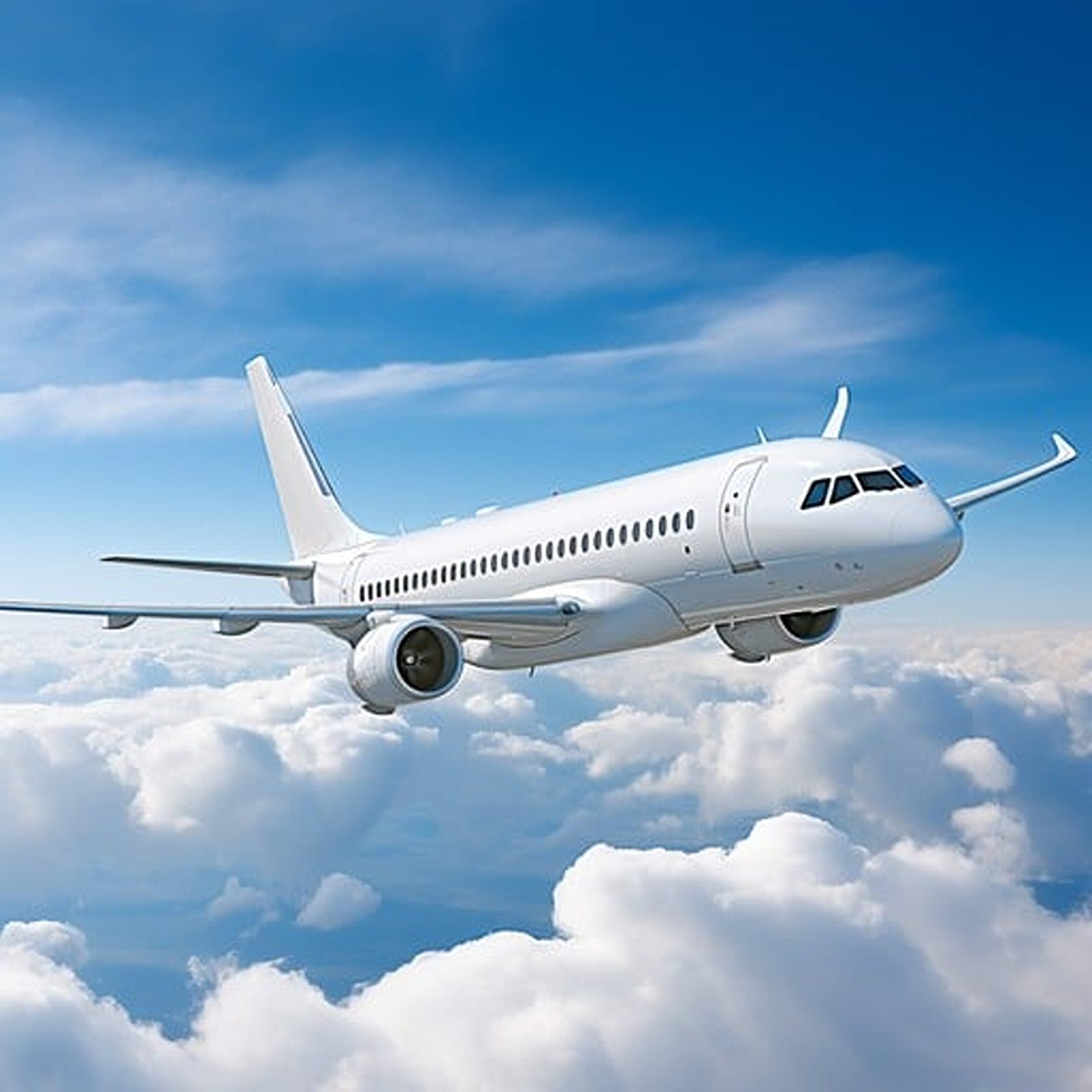
Observing an aircraft in mid-flight naturally raises a simple yet perplexing question: how can an aluminum structure weighing hundreds of tons glide effortlessly for hours at a time? This question has riddled my mind since the first time I looked out of an airplane window as a child, leading to a lifelong fascination with the science behind flight.
Human fascination with flight has existed for centuries, driven by our envious observation of natural fliers like birds. However, it was only through generations of innovation and the precise application of physics and mathematics that controlled, sustained human flight finally became a reality.
To understand how modern aircraft conquer gravity, we must look beyond the simplified diagrams found in standard school textbooks. By examining the fundamental forces of lift, motion, and fluid dynamics, we can begin to decode the elegant mathematical framework that keeps these metal giants in the sky, turning an ancient human dream into an everyday reality of aerospace engineering.
Lift, Weight, Thrust and Drag are the four fundamental forces that govern flight. Lift is the upward force that enables an aircraft to take off, remain airborne, and maneuver against the force of gravity. The aircraft’s wings primarily generate it as air flows around them during motion. Aircraft wings are designed with a specific shape known as an airfoil. This shape causes air to move faster over the upper surface of the wing and slower beneath it.
According to Bernoulli’s principle, faster-moving air has lower pressure while slower-moving air has higher pressure. As a result, a pressure difference is created between the upper and lower surfaces of the wing, producing an upward force known as lift.
Another key factor influencing lift is the angle of attack, defined as the angle between the wing and the oncoming airflow. As the angle of attack increases, lift also increases because more air is deflected downward by the wing. However, this relationship only holds up to a critical point. Beyond a certain angle, the airflow over the wing becomes disrupted, leading to a sudden reduction in lift known as a stall.
Lift can also be explained using Newton’s third law of motion. As the wing moves through the air, it pushes air downward. In response, the air exerts an equal and opposite force upward on the wing. This reaction force contributes significantly to generating lift and works alongside pressure differences to keep the aircraft airborne.
The lift force can be expressed mathematically by the lift equation:
L= ½ ρ V² SC
The lift equation was developed by the aerodynamicists of the early 20th century. It has been derived from earlier fluid dynamics and drag formulas developed by Isaac Newton and Daniel Bernoulli and was adapted into its modern form by figures like Lord Rayleigh. Within this mathematical framework,(L) represents the total lift force generated, which is determined by the fluid density of the surrounding air (ρ), the square of the aircraft’s velocity (V), the total surface area of the wings (S), and the lift coefficient (C), which is determined by the specific shape of the airfoil and its angle of attack.
From this equation, lift is affected by several factors. Understanding the mathematics behind this equilibrium reveals why flight behavior changes so drastically with altitude. In the fundamental lift equation mentioned before, lift is directly tied to air density (ρ) and the square of the aircraft’s velocity (V²).
As an airplane climbs higher into the atmosphere, the air becomes thinner and less dense. With fewer air molecules available to flow over the airfoil, the aircraft must fly exponentially faster to generate the same amount of lift. This elegant physics equation explains why commercial airliners must travel at blistering speeds when cruising in the thin air of the upper stratosphere.
The Breaking Point: Understanding the Stall
An aircraft stalls when the wings are no longer able to produce sufficient lift. This usually happens when the angle of attack becomes too large. At high angles of attack, the smooth airflow over the wing breaks away, reducing the pressure difference and causing a sudden loss of lift. Stalls commonly occur at low speeds because pilots increase the angle of attack to maintain lift, which can exceed the critical angle. Although stalls are often associated with low speed, the real cause is excessive angle of attack, not speed alone.
The Dynamic Balance: Weight, Thrust, and Drag
The Newtonian pair of lift is weight, the force exerted on the aircraft due to gravity acting on its mass. It acts vertically downward through the aircraft’s center of gravity. The weight of an aircraft depends on its total mass, including the structure, fuel, passengers, and cargo. As fuel is consumed during flight, the aircraft’s mass and therefore its weight gradually decreases. For an aircraft to climb, the lift force must be greater than its weight. In level flight, lift and weight are balanced, while during descent, weight exceeds lift.
Thrust is the force that propels an aircraft forward through the air. It is generated by the aircraft’s engines, such as jet engines or propellers, which accelerate air or exhaust gases backwards. According to Newton’s Third Law, this backward acceleration produces an equal and opposite forward force on the aircraft.
Thrust is required to overcome drag, the resistive force caused by air resistance, and to provide the forward speed necessary for the wings to generate sufficient lift. During takeoff, a large amount of thrust is needed to accelerate the aircraft along the runway until it reaches takeoff speed. In steady, level flight, thrust balances drag, allowing the aircraft to maintain a constant velocity.
Drag is the resistive force that opposes the motion of an aircraft as it moves through the air. It acts in the direction opposite to thrust and is caused by the interaction between the aircraft and the surrounding air. It is the air resistance of an aircraft. As an aircraft flies, it must continuously overcome drag to maintain its speed.
Drag arises because air is not frictionless. When an aircraft moves forward, air particles collide with its surface and are displaced, creating resistance to motion. The faster the aircraft travels, the more air it encounters each second, and therefore the greater the drag force becomes. This is why higher speeds require greater thrust. The magnitude of drag depends on several factors, including the aircraft’s speed, shape, surface area, and the density of the air.
Aircraft are designed with smooth, streamlined shapes to reduce drag as much as possible, improving fuel efficiency and performance. Even small increases in drag can significantly increase fuel consumption, especially at high speeds. At equilibrium-level flight, drag is balanced by thrust while lift is balanced by weight. If drag increases while thrust remains constant, the aircraft will slow down. Similarly, to fly faster, the engines must produce enough thrust to overcome the increased drag. Managing drag is therefore a key consideration in aircraft design and flight performance.
The Great Aerodynamic Tug-of-War
Lift is commonly explained using either Bernoulli’s principle or Newton’s Third Law, yet neither explanation alone fully accounts for how lift is generated. As stated by NASA in the article “Bernoulli and Newton” by Tom Benson, the explanations of lift are often divided into two perspectives: the Bernoulli approach, which attributes lift to a pressure difference across the wing, and the Newtonian approach, which explains lift as a reaction force resulting from the downward deflection of air.
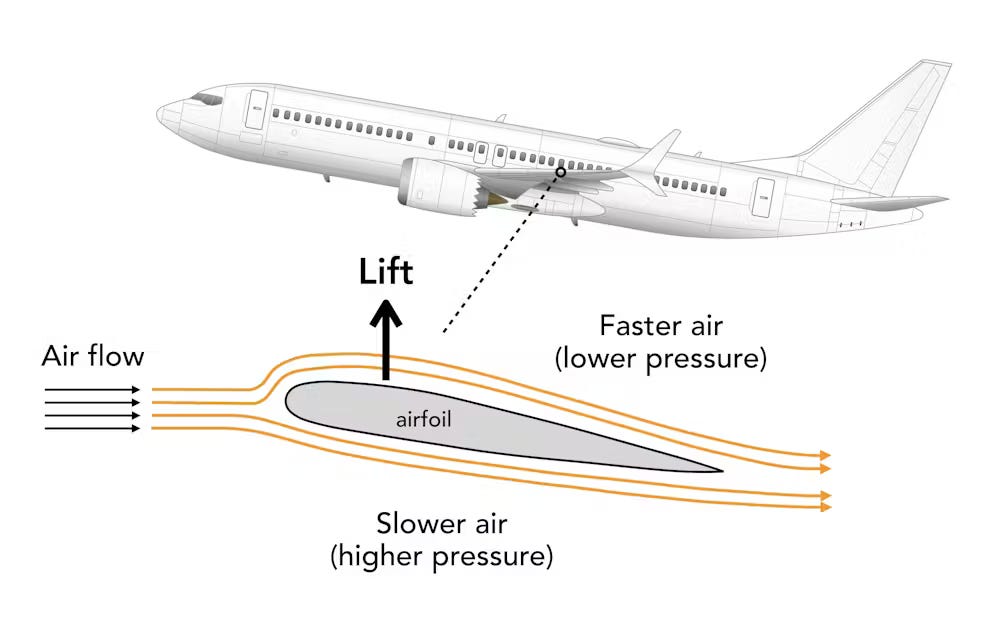
Bernoulli’s principle on its own is insufficient because it oversimplifies the cause of lift. It does not explain why air accelerates over the wing in the first place and fails to fully account for cases such as inverted flight or lift generated by flat plates. While pressure differences are essential, they are not the root cause.
The Equal Transit Time Theory is a popular but incorrect explanation for how airplane wings generate lift. It claims that air traveling over the longer top curve of a wing must move faster to meet the air going underneath at the exact same time. In simple words, Bernoulli answers the question “How,” but he fails to answer the question Why.”
Newton’s Third Law, although it correctly identifies that lift arises from the downward momentum transmitted to the air, also has limitations when used alone. It does not fully explain how the shape and orientation of the wing enable it to deflect a sufficiently large mass of air downward to sustain flight.
Pressure (Bernoulli) and momentum (Newton) are not two separate forces fighting each other; they are just two separate ways of looking at the same physical fluid system. The pressure drop above the wing is what pulls the air downward; the downward deflection of the air creates the pressure drop. They are two sides of the same coin.
To decipher the science behind lift, integrating both principles is crucial. The wing’s shape and angle of attack cause air to accelerate and change direction, leading to pressure differences described by Bernoulli’s principle and momentum changes explained by Newton’s Third Law. Together, these ideas provide a more accurate and comprehensive understanding of lift.
The lift equation incorporates both Bernoulli’s principle, through pressure differences represented by the lift coefficient, and Newton’s third law, through the momentum change of air caused by the wing.
How to Direct a Giant: Roll, Pitch, and Yaw
An aircraft is controlled using its ailerons controlling roll, elevator controlling pitch, and rudder responsible for yaw.
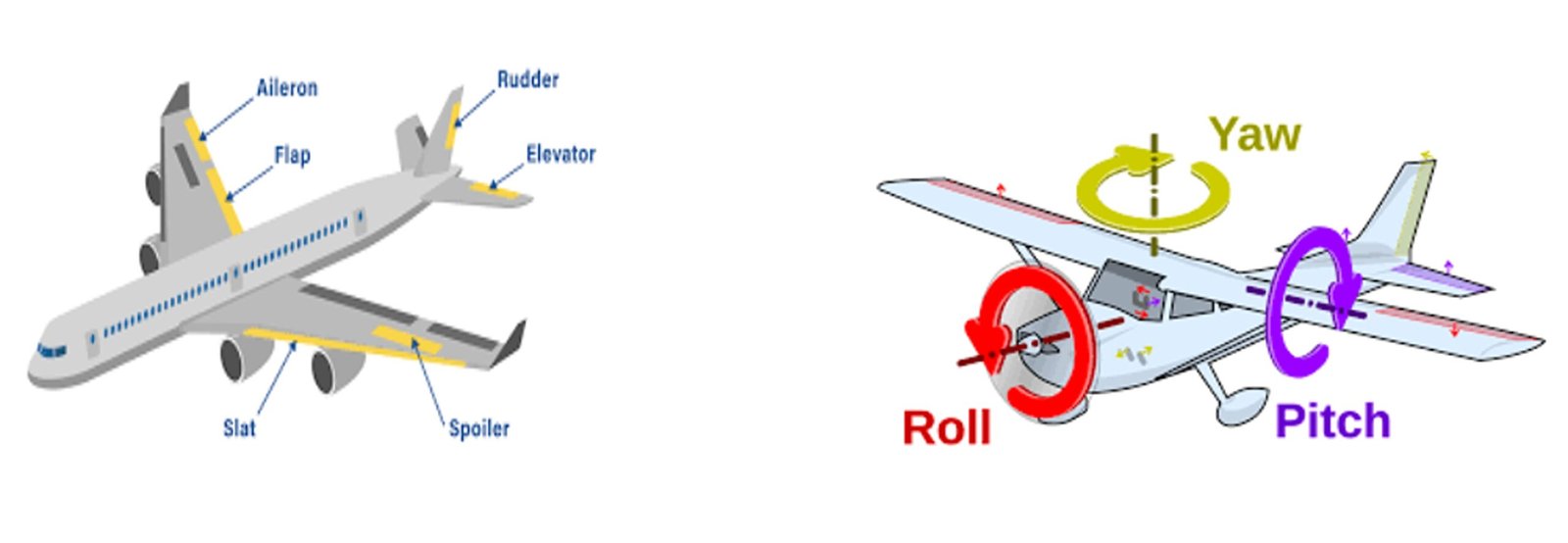
To maneuver through the sky, an aircraft relies on a brilliant system of hinged surfaces that manipulate the airflow across three imaginary axes. The first of these are the ailerons, located on the trailing edge of each wing. When a pilot wishes to bank the aircraft, turning the control wheel forces these surfaces to move in opposite directions—one deflecting up and the other down. This creates an intentional imbalance of lift between the two wings, causing the massive structure to roll smoothly into a turn.
Meanwhile, movement along the horizontal axis is governed by the elevator, located on the tail’s horizontal stabilizer. When a pilot pulls back on the controls to climb, the elevator deflects upward. The rushing air smashes against this raised surface, forcing the tail downward and pivoting the nose up toward the clouds.
Finally, the rudder, positioned vertically on the tail fin, swings left or right to manage yaw. Operating much like the rudder of a ship, it controls the sideways movement of the nose, ensuring the aircraft maintains a perfectly stable and smooth flight path.
The science behind flight is a unique combination of a plethora of physical laws supported by mathematical equations. By untangling the complex interplay of forces like thrust and drag and moving past simplified textbook myths to appreciate how Newton and Bernoulli coexist, the mechanics of aviation become accessible to everyone.
In the end, understanding these concepts is what finally answers that timeless question asked by every curious child peeking out of a cabin window: how a metal giant weighing hundreds of tons can effortlessly slice through the clouds, transforming the ancient human dream of flight into an everyday reality.
References:
- https://en.wikipedia.org/wiki/Bernoulli%27s_principle
- https://pilotinstitute.com/newtons-third-law/
- https://www.grc.nasa.gov/www/k-12/VirtualAero/BottleRocket/airplane/lifteq.html
- https://www.grc.nasa.gov/www/k-12/VirtualAero/BottleRocket/airplane/thrust1.html
- https://www.grc.nasa.gov/www/k-12/VirtualAero/BottleRocket/airplane/wrong1.html
- https://web.mit.edu/16.00/www/aec/flight.html
- https://www.grc.nasa.gov/www/k-12/UEET/StudentSite/dynamicsofflight.html
Similar Articles:
The Secrets of Guitar: How Physics Creates the Perfect Chord
The Modern Alchemy at CERN: Turning Lead into Gold is Possible Now!

Muhammad Zain ul Abdin is an A-Level student, aerospace enthusiast, and student researcher based in Pakistan. Driven by a lifelong passion for aviation, engineering, and the mechanics of flight, he actively explores the intersections of STEM, mathematics, and astronomy. When not decoding the cosmos or winning school aerospace olympiads, Zain runs an educational YouTube channel dedicated to breaking down the scientific principles behind everyday technology.

