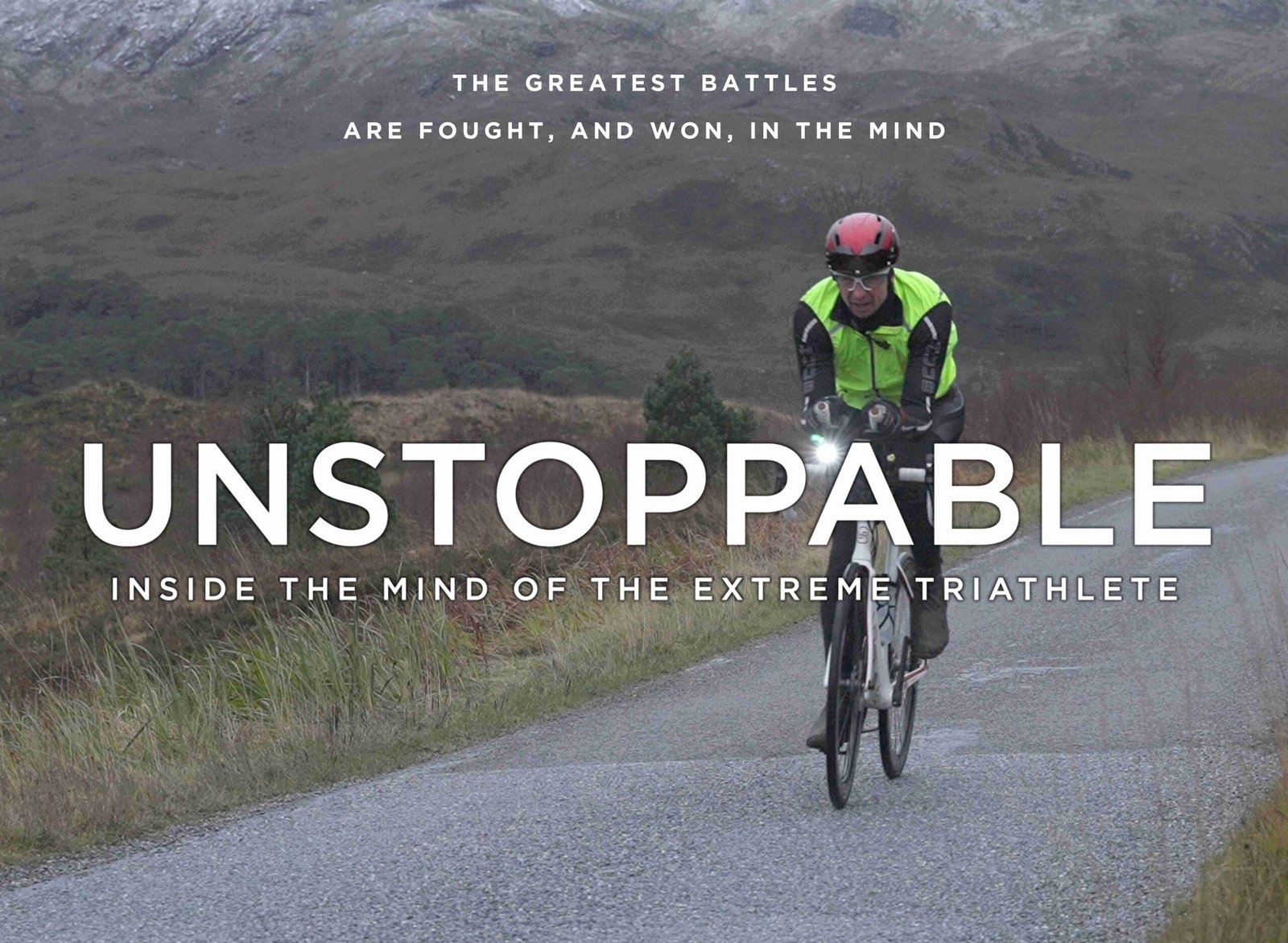
Endurance performance is won or lost in the mind long before it is won or lost on the course. Unstoppable: Inside the Mind of the Extreme Triathlete (2023) is a feature documentary directed by Ben Hull. The film follows Professor Greg Whyte OBE, a former Olympic modern pentathlete, as he takes on an extreme solo triathlon challenge. Released as the world was still emerging from the disruption of Covid-19, the film lands at a moment when the language of endurance, resilience and pushing through uncertainty had a resonance well beyond sport.
Whyte’s credentials give the film its authority, as he has an impressive research background to back his performance. Following his Olympic career, Greg graduated from Brunel University before completing an MSc in Human Performance in the USA and a PhD at St George’s Hospital Medical School, London. He is currently Professor of Applied Sport and Exercise Science at Liverpool John Moores University and Director of Performance at his own clinic, The Centre for Health and Human Performance (CHHP), on Harley Street.
Additionally, he has served as Director of Research for the British Olympic Association. Throughout the film, you can notice him testing personal experience against evidence rather than instinct alone, making his research background evident. Impressively, it is this combination- elite competitor, sport scientist, and coach that has helped him raise over £45 million for charity.

Roughly half the documentary’s runtime is devoted to preparation rather than the race itself, which, in my opinion, could’ve been edited down. The beginning of the documentary features many montages of Coach Greg working out, which take up screen time and make it redundant.
Exploring the deep mental resilience and psychological preparation
The reason for the documentary’s success could be the unusual editorial choice, where the temptation is normally to highlight the emotional and mental state of the athlete rather than their performance or achievements. The challenge is not really the swim, the bike, or the run; it is everything that happens before the athlete reaches the start line, specifically the mindset preparation
When it comes to endurance sports and events Coach Greg has multiple under his belt among them are the Marathon des Sables, the roughly 250 km, six-day self-sufficiency footrace across the Moroccan Sahara often described as the toughest footrace on earth, where competitors carry their own food and kit through daytime heat that can exceed 40°C and cold desert nights and Norseman, the Norwegian iron-distance triathlon nicknamed “the toughest triathlon on the planet.”
PATAGONMAN, the extreme-distance triathlon held in the remote, weather-exposed terrain of Chilean Patagonia, is referenced as part of the same lineage of races built to punish rather than merely test the participants and their resilience. From there, the film moves to Celtman, the extreme Scottish triathlon, as the basis for the solo winter challenge that forms the film’s spine.
Solo Celtman in the middle of winter and a national storm is where the challenge of the documentary takes place. The open-water swim leg, undertaken in winter conditions, carries risks the film does not need to overstate: cold-water shock and the involuntary gasp reflex it triggers, rapidly diminishing swim stroke and coordination as muscles cool, and the ever-present threat of hypothermia and cardiac strain in near-freezing water, all before fatigue is even a factor.
The 90 km bike leg is run under a severe weather warning, with black ice on exposed roads turning a straightforward discipline into a hazard-management exercise. The 21 km run is worse again; the film shows the weather deteriorating into a full blizzard, with sleet at night soaking through gloves until Whyte is effectively running with his hands full of water. None of these are staged obstacles; they are the reason the challenge is framed as a “battle for survival” rather than a race against a clock.
Around this narrative, the film sets out what it calls the endurance mindset as described by Coach himself, a small set of mental tools Whyte has refined across three decades of coaching Olympic athletes and untrained celebrities alike. The framework is built on the principle of preparing for the worst while hoping for the best and covers goal setting, preparation, short-term goals adding up to long-term wins, the happy bank, and knowing your enemy, meaning an honest audit of the course, the conditions, and one’s own weaknesses. The figure below sets these out visually.
Navigating Uncertainty: A Framework for Resilience
The mindset framework described by Dr. Greg Whyte is built on five pillars: Goal Setting, Preparation, Short-Term Goals, the ‘Happy Bank,’ and Knowing Your Enemy.
The film’s central claim, that this kind of training genuinely reshapes what the brain treats as its limit, is not just motivational language. A growing body of neuroscience supports the idea that endurance sport produces measurable changes in brain structure, function and molecular signalling, and the evidence spans several independent mechanisms rather than resting on one study.
In a study by Schlaffke, thirteen endurance athletes were compared with equal non-exercising controls, where significantly higher gray matter volume in the hippocampus and motor cortex among the athletes was found. These regions of the brain are tied respectively to memory and motor learning. Furthermore, Seidel et al. observed increased motor cortex activation during cycling in both trained and untrained participants, suggesting the adaptation begins before elite performance is reached.
According to Taubert et al., exercise improves motor learning and neuroplasticity at the systems, cellular, and molecular level simultaneously. The research shows some very intriguing aspects of athletic endurance and highlights the need for more research to better understand its physiology and neural anatomy.
Taken together, this research does not prove the film’s mindset framework works exactly as presented, but it does support the film’s underlying premise: the brain is not an organ being tested in endurance sports; rather, it is actively reshaped and enhanced like other body muscles.
During the actual challenge, the visuals are, at points, genuinely beautiful; the footage of Whyte running through snow in particular has a stark, cinematic quality that does more to communicate the scale of the challenge than any interview could. But the editing and framing elsewhere lean into a fairly traditional, occasionally over-dramatic sports-documentary style: swelling music under training montages, the kind of pacing that can feel more comical than gripping when set against the genuine physical risk being described.
It is a minor complaint against a film with a strong central argument, but it does occasionally undercut the scientific credibility the rest of the film works hard to establish.

Prepare your mind well!
The question the film keeps circling, directly or not, is why anyone would choose to do this to themselves. Cold-water swims, ice on the roads, gloves filled with sleet at midnight, none of it reads as fun in the moment, and the film does not pretend otherwise. The answer it offers is less about suffering for its own sake than about what structure, preparation and a trained mind can do when the body wants to stop. That is arguably the more interesting subject than the triathlon itself: not what an extreme athlete’s body can survive, but what a well-prepared mind decides is worth surviving for.
Unstoppable is a worthwhile watch for anyone interested in sport psychology, endurance performance, or the practical mechanics of resilience, less so for viewers looking purely for race footage, given how much of the runtime sits in preparation rather than competition. As a case study in applying a structured mental framework to genuine physical danger, though, it is compelling, and the endurance mindset model it sets out has clear application well beyond triathlon.
References:
- Mrówczyński, W. (2019). Health Benefits of Endurance Training: Implications of the Brain‐Derived Neurotrophic Factor—A Systematic Review. Neural plasticity, 2019(1), 5413067.
- Schlaffke, L., Lissek, S., Lenz, M., Brüne, M., Juckel, G., Hinrichs, T., … & Schmidt-Wilcke, T. (2014). Sports and brain morphology–a voxel-based morphometry study with endurance athletes and martial artists. Neuroscience, 259, 35-42.
- Taubert, M., Villringer, A., & Ragert, P. (2012). Learning-related gray and white matter changes in humans: an update. The Neuroscientist, 18(4), 320-325.
- https://www.imdb.com/title/tt34381301/?ref_=mv_close
- https://youtu.be/rKlfKDoZUw0?si=K2Qk9md2eeHbOiC5
More from the author: Reviewing “JANE” — When Science Meets Empathy and Courage

Khadija Tariq is a genetics graduate who loves understanding how diseases work at the molecular level and how we can use that knowledge to create better treatments. She was an intern at Scientia Pakistan Science Writing Internship Cohort Three.

