Have you ever used any of your electronic devices- phones, PCs, tablets- for an extended amount of time? You would notice them heating up and, in a few cases, even shutting down after continuous use over a certain period of time. This is because electronics generate heat. And extended use generates heat faster than it can be dissipated.
Heat usually behaves predictably: a hot cup of coffee cools, a laptop warms your hands, and the sun heats Earth. But at scales thousands of times smaller than a human hair, heat can behave in unusual ways that scientists are only now learning to control.
Heat precision and control are a crucial element in all electronic operation, and also a persistent concern in technological development. As smartphones, laptops, and AI chips grow smaller and more powerful, managing heat is becoming one of the biggest limits on performance.
The biggest threat to the next generation of supercomputers, AI chips, and hypersonic vehicles isn’t software or aerodynamics- it’s the inability to shed heat. At the nanoscale, thermal radiation breaks classical physics, but until now, nobody had figured out how to reliably exploit it.
A team of researchers at Carnegie Mellon University, in collaboration with Stanford University and Purdue University, published in Nature (2), has shown that carefully designed nanoscale gold metamaterials can increase heat transfer across tiny gaps by up to four times compared with similar conventional systems, offering one of the clearest experimental demonstrations yet that heat transfer at the nanoscale can be actively engineered. The findings could eventually lead to better chip cooling, more efficient energy devices, and new ways to manage thermal radiation.
So, how does it work?
At the core of the discovery is a phenomenon called near-field radiative heat transfer: Under ordinary conditions, objects lose heat by radiating it outward in all directions. That is called far-field radiation, and it follows familiar physical limits. But when two objects are separated by an extremely small distance- just a few hundred nanometres- thermal radiation can “tunnel” across the gap much more efficiently than it can in everyday conditions.
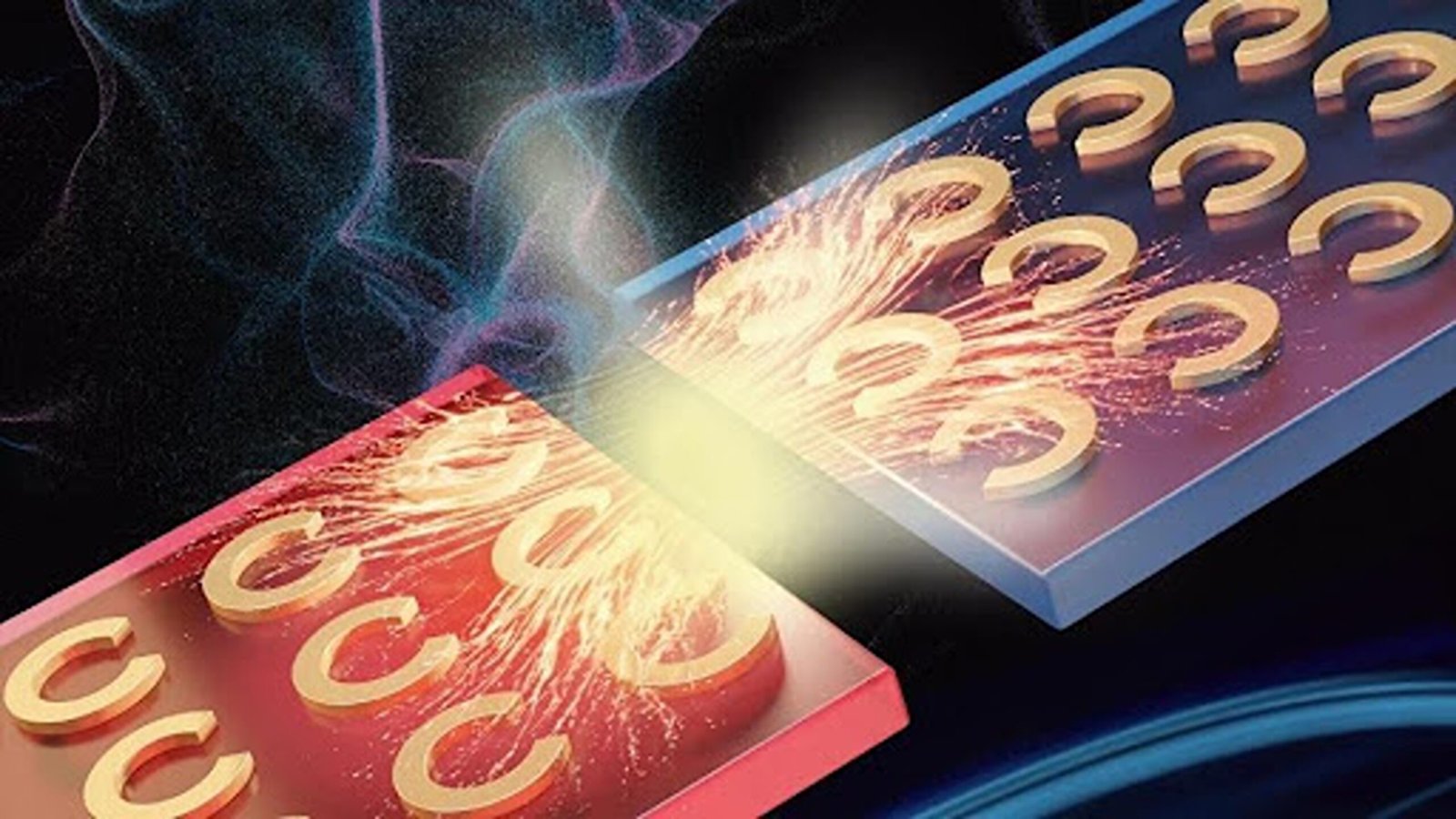
Scientists have known about this effect for years, but what this study shows is that it can be pushed further through deploying metamaterials: engineered structures built from tiny repeating patterns designed to interact with energy in precise ways. In this case, the researchers patterned microscopic gold structures onto thin membranes and placed them face-to-face across a nanoscale gap.
The gold was shaped into split-ring resonators- tiny ring-like structures with a gap that lets them act like miniature electromagnetic circuits. The key was tuning them so that their resonant frequency matched the natural vibrational frequency of the silicon nitride membranes. At that frequency, the material supports surface phonon polaritons, which are coupled waves of vibrating atoms and electromagnetic fields that travel along a surface.
“Unlike conventional materials, metamaterials are built with tiny, repeating patterns that interact with energy in precise ways,” said Sheng Shen, a professor of mechanical engineering at Carnegie Mellon University and senior author of the study. “We patterned microscopic gold structures onto thin membranes and positioned them face-to-face across a nanoscale gap. This increased heat transfer by as much as four times compared to similar setups without metamaterials, which is far beyond what traditional physics would predict at larger distances. (1)
This enhancement, however, is not simply the result of adding more pathways for heat to travel. According to the researchers, the effect emerges because the microscopic structures and the material’s natural energy waves work together.
“Rather than simply adding more pathways for heat, the gold structures interact with naturally occurring energy waves in the material, known as surface phonon polaritons, creating a resonance effect,” said Zexiao Wang, a PhD student in Professor Shen’s research group and co-first author of the study. “These coupled vibrations allow energy to move more freely and efficiently across the gap.”
“It’s a cooperative effect,” Shen said. “The structures and the material amplify each other.”
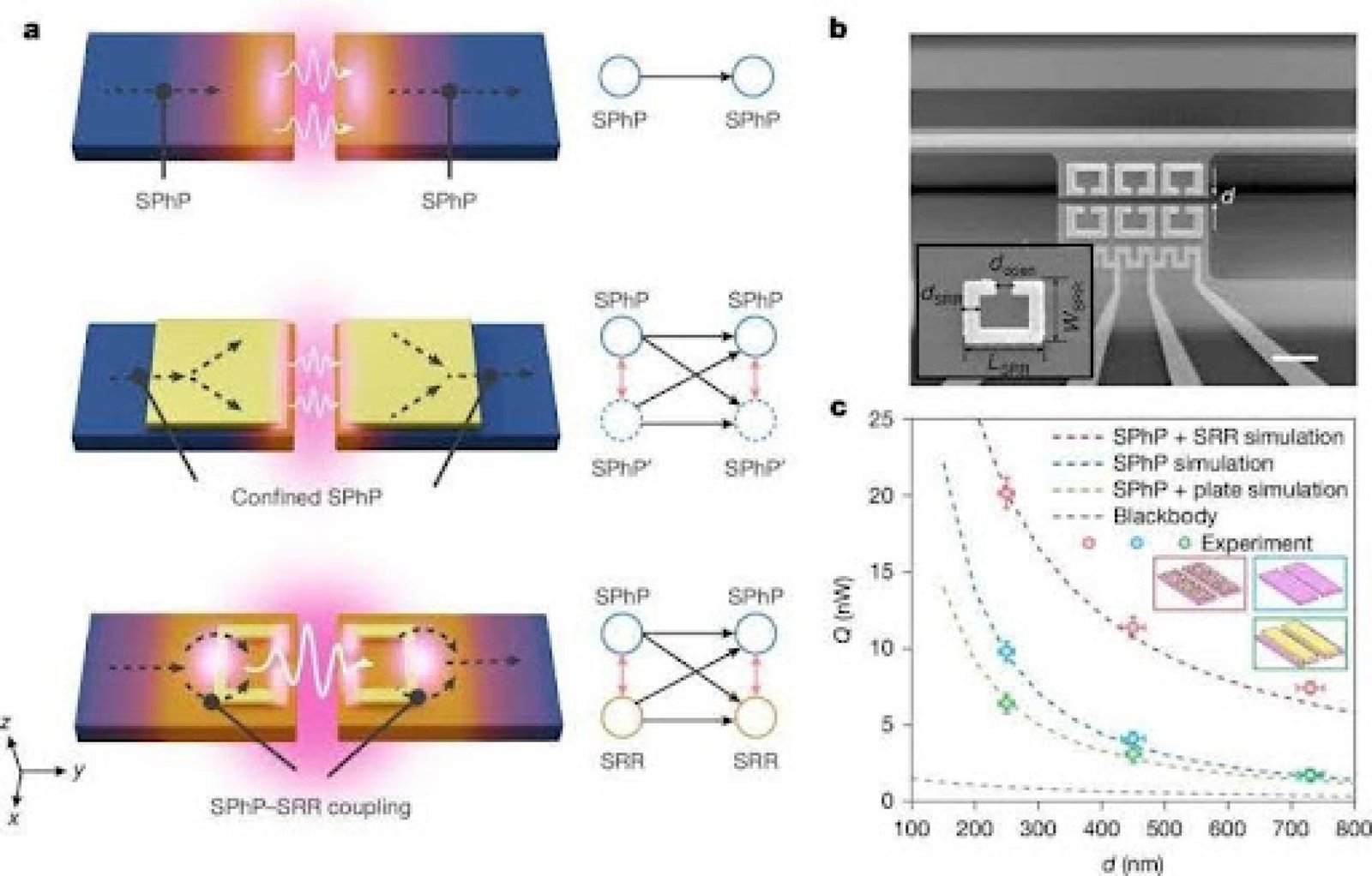
That distinction is crucial. In the same manner that adding more lanes to a freeway boosts traffic capacity, the gold rings do more than simply provide additional paths for heat to flow. By actively coupling with the material’s inherent energy landscape, they produce a resonance that allows more energy to pass through the same small gap than either component or the material could handle on its own.
Heat management applications and potential impacts
The potential applications are broad. In electronics, better control of heat flow could help devices stay compact without sacrificing performance. That matters for computer chips, high-performance systems, and future AI hardware, where thermal limits are already a major bottleneck.
The same principle could also improve thermophotovoltaic systems, which convert heat into electricity by harnessing thermal radiation. If radiative heat transfer can be tuned more efficiently, such systems could become more practical. In sensing technologies, especially infrared detection, stronger and more controllable heat signals could improve performance in environmental monitoring, security, and other specialized applications.
More precise heat control not only optimises electronics’ operation, but it also reduces waste by precisely controlling the heat flow, allowing for a more sustainable operation in the long run. The research points toward a future in which heat is not just something to remove, but something to engineer deliberately. That is an important shift in thinking, especially in fields where waste heat limits both efficiency and scale.
Metamaterials: The future ahead
For now, the work is still at the nanoscale and has been demonstrated only in tightly controlled laboratory conditions. The devices use specific gold and silicon nitride structures, and the effect depends on precise resonant tuning. Turning this into a manufacturable technology will require major advances in durability, scaling, and integration with existing hardware.
On the theoretical side, notes Fan (3), the complex interactions between the metamaterial units and their supporting substrate make numerical calculations and analyses exceptionally difficult. “To address this difficulty, we have developed a numerical tool based on fluctuational electrodynamics to design the structures, alongside a coupled-mode theory model to fully elucidate the underlying physics,” he says. Measuring the heat exchange is equally demanding: the signals are extremely small, on the order of nanowatts, so the team had to use a specialized suspended thermal bridge method to detect them reliably.
Even so, the study marks an important step forward, even if it remains at the lab scale. It moves the idea of nanoscale heat control from theory into experimental reality. If future work can scale the approach beyond the lab, thermal metamaterials could become an important tool for the next generation of electronics and energy technologies.
“If heat can be engineered with the same precision as electricity or light, it may open the door to a new class of technologies built not just to withstand heat, but to harness it,” Shen said (4).
References:
- College of Engineering, Carnegie Mellon University. Heat breaks the rules at the nanoscale and scientists used it to their advantage. ScienceDaily. [Online] 2026. https://www.sciencedaily.com/releases/2026/06/260606075511.htm
- Metamaterial-enhanced near-field radiative heat transfer. Zexiao Wang, Renwen Yu, Hakan Salihoglu, Xiao Luo, Zhuo Li, Hyeonggyun Kim, Xiu Liu, Tianyi Huang, Yibai Zhong, Shanhui Fan, Sheng Shen. 2026, Nature, pp. 64-68.
- Dumé, Isabelle. Metamaterial boosts heat transfer on the nanoscale. PhysicsWorld. [Online] 2026. https://physicsworld.com/a/metamaterial-boosts-heat-transfer-on-the-nanoscale/.
- Carnegie Mellon University. Metamaterials enable control of heat transfer at nanoscale, potentially transforming energy and electronics. [Online] 2026. https://phys.org/news/2026-05-metamaterials-enable-nanoscale-potentially-energy.html.
More from the author: Pakistan’s Climate Migrants: A Window into an Escalating Crisis

Zoha is a Chemical Engineer working in the field of sustainability and process safety. Having completed her education in Chemical Engineering, she now pursues keen research interests in sustainability and Nanotechnology, while also advocating for and encouraging female representation amongst engineers.

