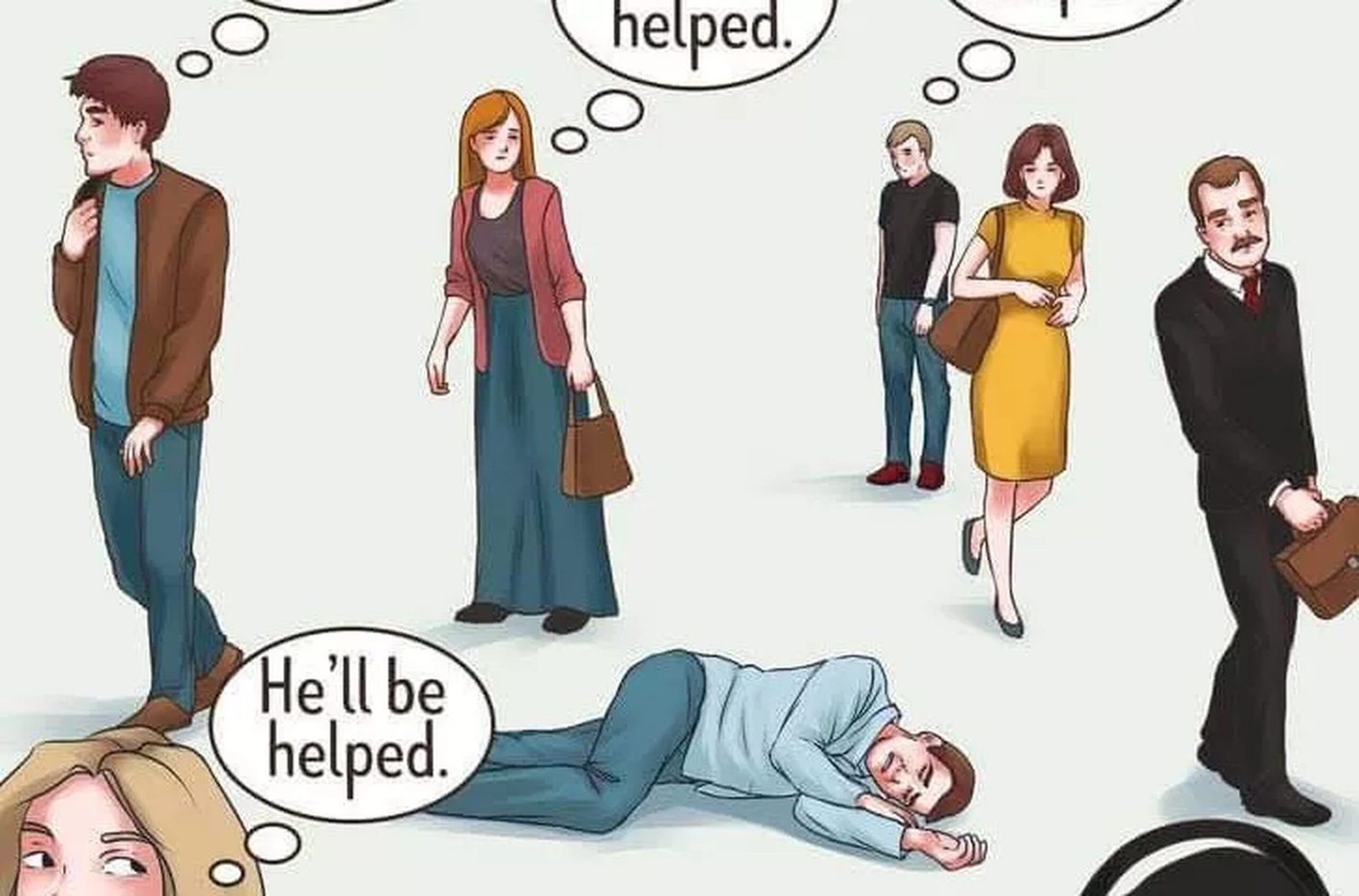
People often shift the responsibility to others when they see someone in trouble, surrounded by witnesses; however, the tragedy is that, ultimately, nobody helps, leading to harmful or fatal outcomes. As Elie Wiesel, a Romanian-born American writer, Holocaust survivor, and political activist, says, “what hurts the victim most is not the cruelty of the oppressor, but the silence of the bystander”.
On 13th March 1964, a brutal incident involving the murder of Catherine “Kitty” Genovese, a 28-year-old bartender, took place outside her apartment in New York City. After work, she returned home very early in the morning when Winston Moseley followed her and stabbed her with a hunting knife. Kitty cried out for help, and a neighbour shouted at Moseley, prompting him to flee at first. However, he returned, continued the assault, followed by sexual assault, and fatally injured her.
After a few days, Moseley was arrested. He confessed to the crime and was convicted of murder. This case gained international fame because, according to an early newspaper report, there were 38 witnesses to the attack, but no one called the police or intervened, which made it a classic example of the bystander effect. Later investigations claimed that the number of witnesses was lower, some even attempted to call the police, and none observed the complete incident. Still, this case inspired extensive research in psychology on bystander behaviour.
A large study of 16.2 million emergency medical service cases in the United States revealed that bystanders helped in only 11% of such cases before medical services arrived. The willingness to help increased in situations such as cardiac arrest or traumatic injuries.
Traditionally, the bystander effect considers the unlikelihood of individuals intervening in an emergency as the number of witnesses increases, due to mechanisms such as diffusion of responsibility, pluralistic ignorance, and evaluation apprehension. In social psychology, it is considered a foundational concept.
Bystander and Diffusion of Responsibility
According to the latest research, the bystander effect is considered a context-dependent behaviour rather than a universal law of human behaviour. In certain low-risk situations, diffusion of responsibility may be seen as one of the cognitive mechanisms; however, investigations have shown helping behaviour to be shaped by the merging of emotional, neural, and social factors.
For example, research suggests that the bystander effect emerges in 5-year-old children due to diffusion of responsibility, not necessarily out of shyness. Social influence, indeed, is a key factor in human decision-making, and an individual’s willingness to get involved in prosocial acts can be lessened by mere perception of a social presence even in the absence of real bystanders.
As American journalist and political activist Gloria Steinem says, “Whenever one person stands up and says, ‘wait a minute, this is wrong’, it helps other people to do the same”. Passive behaviour does not always arise because of the presence of others. As emergencies become more dangerous, bystanders mutually coordinate to deal with the situation.
The additional bystanders are seen as a helping hand rather than a hindrance to helping. Intervention levels increase rather than decrease. Public self-awareness of the individuals is pivotal in such situations. People always protect their reputation when cameras record them, suppressing their impulse to remain passive. The audience works as a catalyst to boost moral responsibility and enhance the public image of the individuals in emergency scenarios.
Biological Foundation of Bystander Effect
Recent studies provide insights into the biological and emotional foundations of bystander passivity. Brain imaging shows an involuntary reduction in activity in brain regions, suggesting that apathy is an automatic, reflexive reaction rather than a deliberate decision. Personality plays a key role in this connection. Individuals who have higher anxiety levels have greater chances of becoming passive in the presence of bystanders. On the other hand, sympathetic individuals continue to help despite any social pressure. Successful development of integrated models has been carried out that take into account both rapid, emotional responses and slower, conscious evaluations.
Everyday social interactions, such as classroom participation, reveal the mechanisms underlying the bystander effect, and it is not restricted to emergencies. The bystander effect is observed to weaken with increasing personal involvement in a situation, irrespective of the number of witnesses. Environments, both digital and physical, with minimal fear of evaluation, always promote a greater sense of responsibility, thereby adding to engagement and prosocial behaviour.
In the modern era, the bystander effect is more of a flexible psychological phenomenon. It is shaped by both the number of witnesses and the level of danger in the situation, as well as by the connection to the incident, social responsibility, and other personality traits. Researchers can create encouraging environments that turn the presence of individuals from an inhibitor into a catalyst for action.
References:
- Darley, J. M., & Latané, B. (1968). 8(4p1), 377.
- Faul, M., Aikman, S. N., & Sasser, S. M. (2016). Prehospital emergency care, 20(3), 317-323.
- Urschler, D. F., Fischer, J., Kastenmüller, A., & Fischer, P. (2015). Bystander effect. Psychology, 29, 203-206.
- Chekroun, P., & Brauer, M. (2002). European Journal of Social Psychology, 32(6), 853-867.
- From empathy to apathy: The bystander effect revisited. Current directions in psychological science, 27(4), 249-256.
- Plötner, M., Over, H., Carpenter, M., & Tomasello, M. (2015).
- Hudson, J. M., & Bruckman, A. S. (2004). The bystander effect: A lens for understanding patterns of participation. The Journal of the Learning Sciences, 13(2), 165-195.
- Fischer, P., Krueger, J. I., Greitemeyer, T., Vogrincic, C., Kastenmüller, A., Frey, D., & Kainbacher, M. (2011).
- Van Bommel, M., Van Prooijen, J. W., Elffers, H., & Van Lange, P. A. (2012). Be aware to care: Public self-awareness leads to a reversal of the bystander effect. Journal of Experimental Social Psychology, 48(4), 926-930.
More from the author:
The Paradox of Free Will: Neuroscience and Psychology on Human Decision-Making
Think Twice: Understanding the Psychology of Irrational Decision-Making

Syeda Khair-ul-Bariyah has been associated with teaching since 2007. She is a synthetic organic chemist and a science and fiction writer. She has publications in both national and international journals in the field of Chemistry. Moreover, she is the author of a stage playbook, “Peregrination of the Soul,” and has a couple of articles and poems published on various websites.

