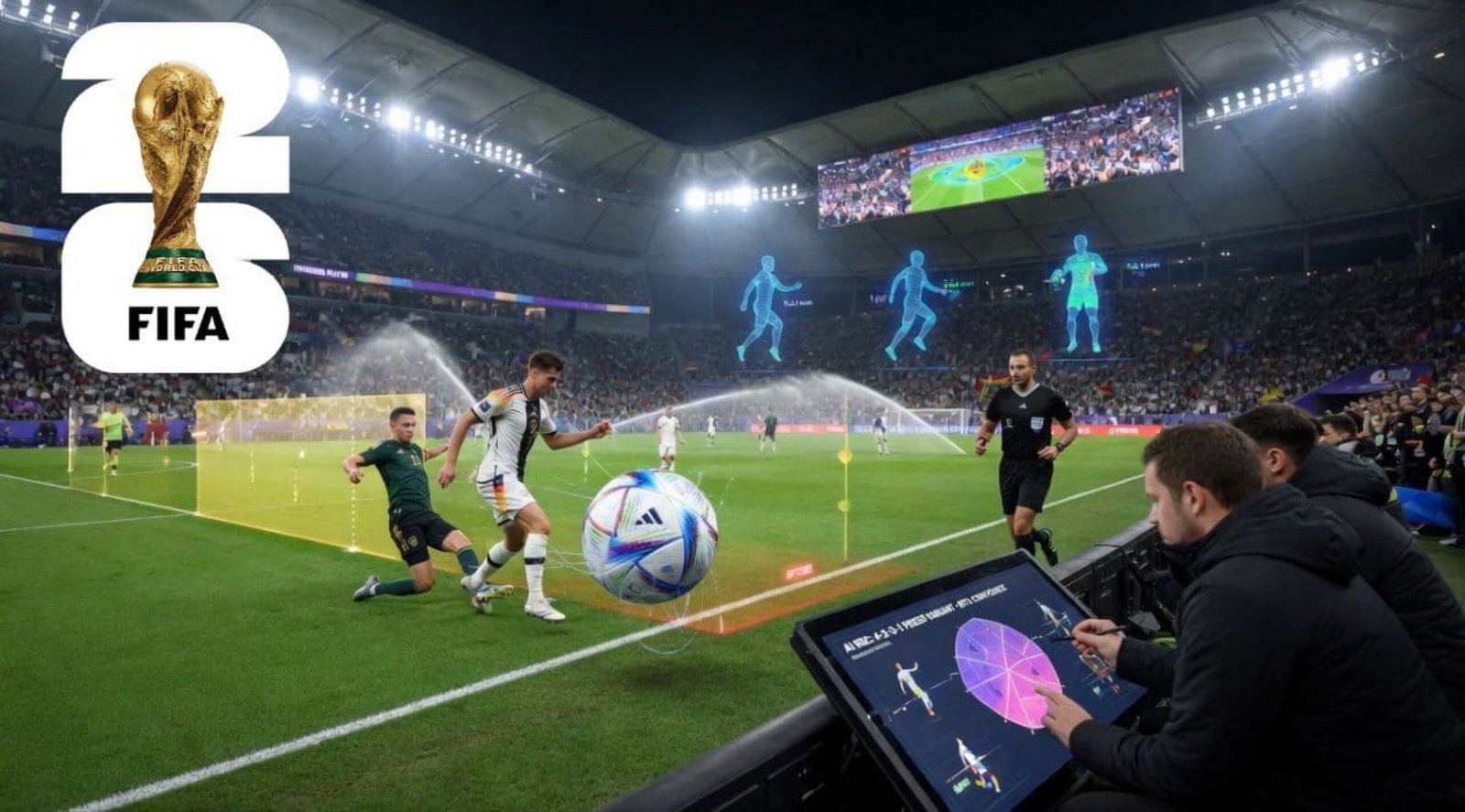
From Cape Verde’s fairy-tale run to Morocco’s historic semi-final, football’s underdogs had their moment. Behind the scenes, artificial intelligence was quietly reshaping how the game was played, coached and understood — though not always in the ways the headlines suggested.
On June 15, 2026, a 40-year-old goalkeeper named Vozinha stood between the posts in Atlanta and did something extraordinary. He shut out Spain, the reigning European champions, for the full ninety minutes. His team, Cabo Verde, ten small islands off the coast of West Africa, home to barely half a million people, was playing in its first-ever World Cup match.
The final score: 0-0. Three weeks and two more draws later, the “Blue Sharks” had pulled off the impossible, becoming the smallest nation ever to reach a World Cup knockout round and setting up a last-32 date with defending champions Argentina. As Vozinha put it after the final group game, “We are small, but we have big hearts, and we are fighters.”
It was a story about heart, nerve, and a goalkeeper having the game of his life. But it was also playing out inside a tournament FIFA itself called the most heavily instrumented in the sport’s history. For the first time, every one of the 48 teams competing across the United States, Mexico and Canada, World Cup debutants and five-time champions alike, had access to the same AI-powered scouting and analytics platform, a tool FIFA built specifically because it worried smaller federations were being left behind.
Whether or not it played any part in Cape Verde’s run, it said something about where football was heading: a sport once decided almost entirely by instinct and shoe leather was generating more data, in real time, than any coaching staff had the hours to read alone.
What the Machines are actually Watching
So what does “AI-driven performance analysis” mean, once you get past the buzzwords? At its simplest, it’s pattern recognition at a scale no human analyst could manage by hand. Optical tracking cameras installed in every football World Cup stadium record the position of all 22 players and the ball several times a second, generating a continuous, moving map of the match.
Add event data- every pass, tackle, shot, and foul, tagged and time-stamped, plus video and, increasingly, wearable sensors- and a single ninety-minute match produces a dataset that would take a human analyst days to work through by hand. Machine-learning models are simply the tool used to find the signal in that noise, i.e., which patterns of play tend to produce shots, which formations tend to concede them, which players are covering the most ground when their team is winning.
This isn’t new, exactly. Researchers were building neural networks to study World Cup performance as early as the 2018 tournament in Russia, when a team of sports scientists fed match statistics into a neural network and identified nineteen indicators, shots on target and successful tackles among them, that reliably separated winning teams from losing ones.
By the 2022 tournament in Qatar, the models had sharpened as one widely cited study built a neural network on fourteen performance indicators and correctly predicted match outcomes 75.4 percent of the time, flagging on-target shots, clear scoring chances and forward ball progression as the features that mattered most. What’s changed since then is less the underlying idea than the richness of the data feeding it, and how candidly researchers have started reporting where their models fall short.
Where the “CRYSTAL BALL” BREAKS
That honesty has produced one of the more interesting findings to come out of the field. Ask an AI model to guess whether a team will win or lose, and it does reasonably well. Ask it to predict a draw, or a goal, and its accuracy collapses.
A 2025 study built on technical statistics from FIFA’s own World Cup reports trained a neural network that hit 86.7 percent overall accuracy, which is impressive, until you learn the errors clustered heavily around draws, which the model struggled to tell apart from decisive results. The same pattern shows up just as clearly in the women’s game when researchers studied the Women’s World Cup 2023. When they built a model that called wins and losses correctly about two-thirds of the time, but its accuracy on draws fell to roughly one in three, dragging the overall score down to 0.58.
Push the models further, toward something as specific as whether a passage of play will end in a shot or a goal, and the picture gets starker. One team of researchers trained a model that looked outstanding in testing, correctly flagging more than 93 percent of goal-scoring sequences, but that figure came from an artificially balanced practice dataset. Run against real match data, where goals are rare and irregular by nature, the same model’s success rate for spotting a shot-or-goal sequence fell to 13 percent. For goals alone, it caught zero.
The reason isn’t that the AI is badly built but that goals are rare almost by definition. In that study, an actual goal occurred in only about one of every seventy-eight ball possessions analyzed. Ask a model to spot something that happens once in roughly eighty tries, using only the patterns that preceded it, and you’re asking it to do something closer to predicting exactly where one raindrop will land than to forecasting whether it will rain this afternoon. Football’s biggest, most exciting moments are, statistically speaking, its least predictable ones, which is a large part of why they’re so thrilling to watch in the first place.
Better Coach than a “FORTUNE-TELLER”
If prediction is where AI struggles, tactical analysis is where it has quietly become genuinely useful, not as an oracle, but as an extra set of eyes. Take TacticAI, a system built by Google DeepMind with Liverpool FC and published in the journal Nature Communications. Rather than trying to guess who’ll win, it focuses on something narrower and more practical, i.e., corner kicks, which produce a disproportionate share of goals but are notoriously hard to coach systematically.
Researchers showed football experts a mix of TacticAI’s suggested player setups and the routines teams actually used, without saying which was which. The experts couldn’t reliably tell the difference, and rated the AI’s suggestions as good as, or better than, the real ones roughly nine times out of ten.
That kind of pattern-finding has also been turned on entire tournament runs, and one of the richest case studies belongs to another underdog story, i.e. Morocco’s run to the 2022 semi-finals, the first time any African or Arab nation had gone that far.
Researchers who later reconstructed Morocco’s seven matches using FIFA’s official tracking data confirmed what many fans suspected but couldn’t prove in the moment: a team built on defensive discipline rather than possession, holding the ball less than 40 percent of the time in five of its matches while unleashing intense defensive pressure at key moments, 288 pressing actions against Spain, 299 against France.
Statistical clustering split Morocco’s matches into three distinct types: cautious, low-block defending; quick transitions; and more open, technical contests, giving coaches and historians of the tournament a data-backed account of exactly how a team with a fraction of its opponents’ resources kept finding a way through.
The same tools are, for the first time, being pointed at the women’s game with comparable depth. At the 2023 Women’s World Cup, researchers used machine learning to sort more than 227,000 individual passes from all 64 matches into five distinct tactical families, exposing clear differences in how higher- and lower-performing teams built their attacks, the kind of granular, style-level analysis that used to exist only for the best-funded men’s teams.
Behind the Scenes of the Tournament
None of this was hypothetical or confined to a research lab. It ran behind the scenes of the tournament that unfolded across sixteen host cities in three countries, the biggest World Cup in history, with 48 teams and 104 matches.
FIFA’s headline tool was Football AI Pro, built with Lenovo and trained on what the organisation called its Football Language Model. It is a generative AI assistant that could process hundreds of millions of FIFA’s own match data points and answer a coach’s question in plain language, in multiple languages, producing text summaries, video clips, graphs or even 3D replays of a passage of play. Coaches couldn’t use it live, mid-match; FIFA had drawn a deliberate line there, reserving in-game decisions for human staff.
Before and after matches, though, it was available equally to all 48 federations, from the wealthiest to the newest arrivals. FIFA president Gianni Infantino had framed the entire project around a single goal: narrowing the gap between football nations that could afford large data-science departments and those that couldn’t.
Officiating had its own AI layer at the tournament. All 1,200-plus players were digitally body-scanned in roughly a second each to build precise 3D avatars, used to render offside decisions as short animations on stadium screens and broadcasts rather than the fuzzy, disputed lines fans had grown used to. The system built on semi-automated offside technology first tested at Qatar 2022, working alongside a sensor embedded in the official match ball that recorded its motion 500 times a second, precise enough to tell officials the exact instant a pass was struck. Referees wore AI-stabilised body cameras too, which Lenovo said cut out most of the shake and blur that used to make first-person referee footage almost unwatchable.
The gap between big and small federations that FIFA was trying to close with its shared tools hadn’t disappeared but just shifted shape. England’s federation reportedly used automated video analysis to compress penalty-shootout preparation from roughly five days of manual review down to five hours.
Curaçao, another of this tournament’s smallest debutants, used geospatial and ancestry data to trace footballing talent across its global diaspora, a squad on which, by one count, only a single player was actually born on the island. Different budgets, different tools, the same underlying idea: find an edge in data that a purely eye-test approach would miss.

The FINE PRINT!
For all that momentum, the researchers who studied this field for a living tended to sound a more cautious note than the press releases did. “An increase in quantity doesn’t always come with a similar increase in quality,” Franco Impellizzeri, editor-in-chief of the journal Science and Medicine in Football, told the journal Nature, describing the flood of AI-and-football papers now landing in his inbox at the time.
That caution shows up in the technical details, too. A running theme across dozens of studies, including a systematic review that screened 190 peer-reviewed articles on AI in football, is a demand for explainable results, not just accurate ones. Coaches don’t want a system that simply announces a 72 percent chance of losing; they want to know why, in terms they can act on before Saturday’s training session. Techniques that highlight which specific stats actually drove a model’s verdict have become almost as important to researchers as raw accuracy.
Reviews of the field flag the same handful of unresolved concerns again and again: who owns players’ biometric and tracking data, how securely it’s stored, whether algorithms trained mostly on wealthy European leagues generalise fairly to other confederations and playing styles, and whether the whole enterprise risks becoming just another advantage for federations that can already afford to buy it. Tellingly, even FIFA has acknowledged that some form of regulation on tournament AI use may eventually be necessary; the technology, in other words, was outrunning the rulebook.
What No Algorithm Predicted
Which brought the story back to Atlanta, and to Vozinha diving low to his right. No dataset predicted that Cape Verde would hold Spain scoreless, just as no model foresaw Morocco’s run to the semi-finals four years earlier, as both were, statistically speaking, among the least likely outcomes of their respective tournaments.
What AI increasingly offered, to big and small federations alike, was a far richer account of how such things happened after the fact, and a genuinely useful assistant in the unglamorous week-to-week work of preparing for the next one, i.e. which zones to press, which set-piece routine to try, whose workload needs managing before it becomes an injury. It has become a serious tool for understanding football. It has not, and on the evidence so far may never, replace the nerve of a goalkeeper standing his ground against the run of play. For now, that part is still all human.
References:
Elstak, I., Salmon, P., & McLean, S. (2024). Journal of Sports Sciences, 42, 1184–1199. https://doi.org/10.1080/02640414.2024.2383065
Hassan, A., Akl, A.-R., Hassan, I., & Sunderland, C. (2020). Sensors, 20(11), 3213. https://doi.org/10.3390/s20113213
Iván-Baragaño, I., Ardá, A., Losada, J. L., & Maneiro, R. (2025a). https://doi.org/10.3389/fpsyg.2025.1516417
Iván-Baragaño, I., Ardá, A., Losada, J. L., & Maneiro, R. (2025b). International Journal of Performance Analysis in Sport, 25, 946–959. https://doi.org/10.1080/24748668.2025.2468623
Kim, J.-H., Kim, J., Kang, H., & Youn, B.-Y. (2025). https://doi.org/10.1016/j.jshs.2025.101047
Luo, Y., Quan, T., & Cao, Y. (2025). Predicting football match outcomes: a multilayer perceptron neural network model based on technical statistics indicators of the FIFA World Cup. Frontiers in Sports and Active Living, 7. https://doi.org/10.3389/fspor.2025.1705198
Mohammed, B., Said, E., Lotfi, Z., Nourddine, E., & Fatima-Zahra, G. (2025). Applied Sciences, 15(18), 9994. https://doi.org/10.3390/app15189994
Moustakidis, S., Plakias, S., Kokkotis, C., Tsatalas, T., & Tsaopoulos, D. (2023). Future Internet, 15(5), 174. https://doi.org/10.3390/fi15050174
Oliva-Lozano, J. M., Vidal, M., Yousefian, F., Cost, R., & Gabbett, T. J. (2025). https://doi.org/10.5114/jhk/195563
Song, Y., Sun, G., Wu, C., Pang, B., Zhao, W., & Zhou, R. (2024). Frontiers in Sports and Active Living, 6. https://doi.org/10.3389/fspor.2024.1410632
Teixeira, J., Maio, E., Afonso, P., Encarnação, S., Machado, G., Morgans, R., Barbosa, T. M., Monteiro, A. M., Forte, P., Ferraz, R., & Branquinho, L. (2025). https://doi.org/10.3389/fspor.2025.1569155
TacticAI: an AI assistant for football tactics. Nature Communications, 15. https://doi.org/10.1038/s41467-024-45965-x
Tournament reporting & organisational sources
Associated Press & Al Jazeera Staff. (2026, June 27). https://www.aljazeera.com/sports/2026/6/27/cape-verde-break-record-as-smallest-nation-to-reach-world-cup-knockouts
FIFA & Lenovo. (2026). inside.fifa.com. https://inside.fifa.com/media-releases/lenovo-tech-world-ai-powered-innovations-world-cup-2026
Gal, I. (2026). https://www.jpost.com/business-and-innovation/all-news/article-899268
AI Magazine. https://aimagazine.com/news/how-ai-will-power-the-2026-fifa-world-cup
Breaking down the technology transforming the FIFA World Cup 2026. https://news.lenovo.com/breaking-down-the-technology-fifa-world-cup-2026/
This World Cup could be the most high-tech yet — the innovations to watch for. (2026). Nature. https://www.nature.com/articles/d41586-026-01866-1
https://en.wikipedia.org/wiki/Cape_Verde_at_the_FIFA_World_Cup
More from the author: How Waste Burning in Karachi Neighborhoods Is Fueling a Toxic Pollution Crisis

Sufyan is the 3rd-ranked intern of Scientia Pakistan’s Science Writing Internship (Cohort Five). He is an engineering student from Karachi dedicated to bridging the gap between technical research and public understanding.

