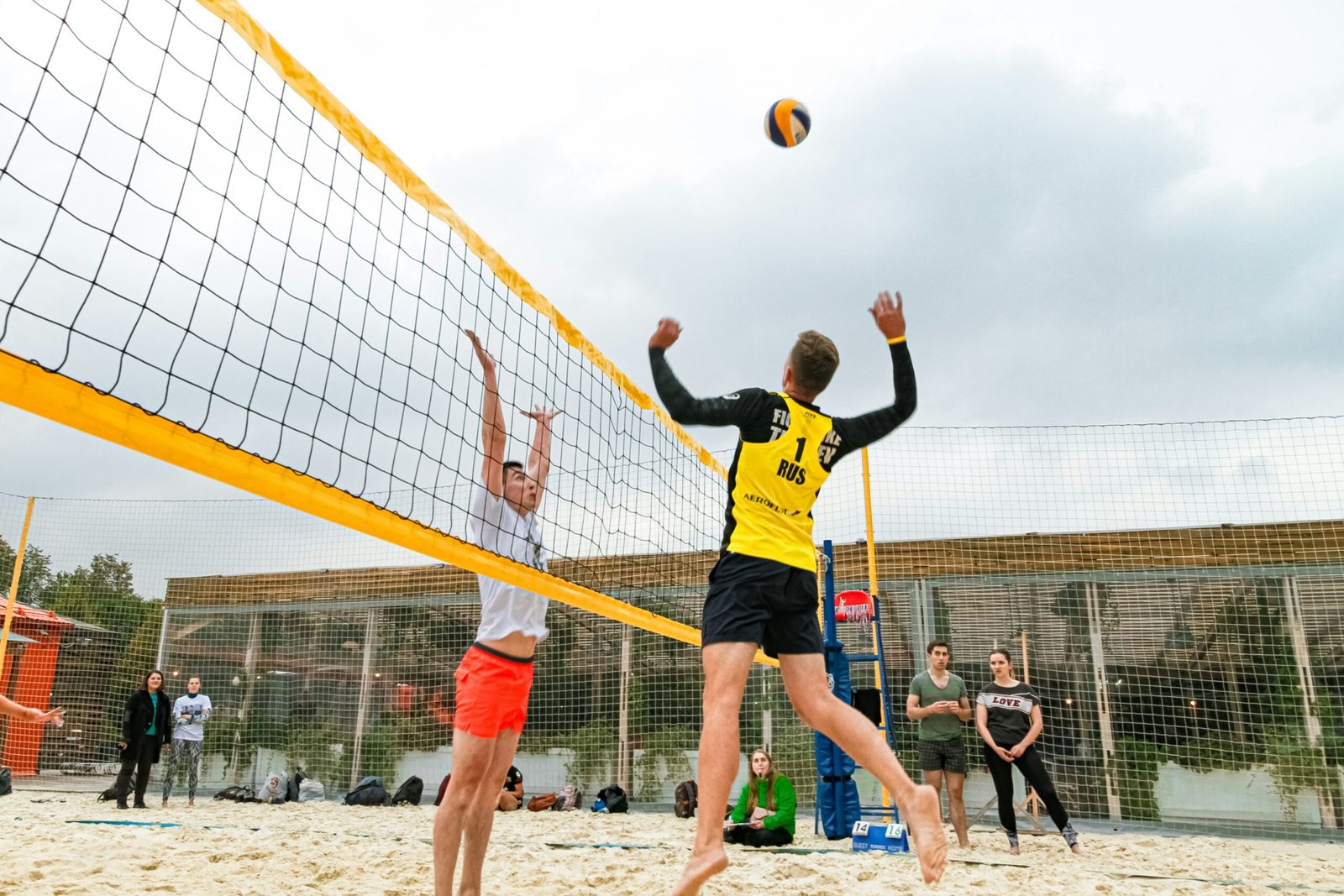
Ever wondered what actually happens in the split second before a spike? Behind the raw power and high jumps lies a high-speed neural calculation that dictates both victory and injury. Here is how your brain and biomechanics work together to master the court.
It is time for the match point. The arena is brimming with spectators leaning forward in anticipation as the game hangs on a single play.
To everyone in the stands, what unfolds next feels perfectly orchestrated. A ball pops into the air, an athlete takes a high jump, and with a whip of an arm, ends up delivering a game-winning spike. Although it may look effortless and like just raw training, beneath the spectacle lies a calculated sequence of neural processing and decisions that are executed faster than the blink of an eye.
How Volleyball Spikes Reveal Physics and Biology Lessons
Focusing through the lens of Sports Science, a volleyball spike reveals a great lesson for Physics and Biology. It is a continuous loop of neuromechanical feedback that converts central cognitive processing into kinetic energy and joint preservation. Long before the athlete’s feet leave the floor to jump, the brain already starts to do intense computational work. The human brain acts as a dynamic command center that takes sensory information and interprets it into instant physical action. That is exactly what happens while performing a spike.

When the setter makes contact with the ball, the hitter’s auditory cortex decodes the speed and trajectory of the set. Simultaneously, visual data is used to scan the opposing court to map out the defenders and calculate blocker positioning. All of this processing occurs in the Central Nervous System (CNS), which dictates the attack pattern under extreme time pressure. Responding to the flood of sensory input, the motor cortex generates a chain of nerve signals that travel down the spinal cord to drive the actual movement patterns. These signals stimulate the muscle fibers for dynamic contraction.
If this loop is disrupted or delayed by even a few milliseconds—whether due to exhaustion or visual distraction—the body pays a physical price. The brain sends quick, uncoordinated commands to the lower body, forcing the athlete to execute a rushed, off-balance approach. In Biomechanics, a flawed mental calculation at the start always leads to a mechanical breakdown at the end.
Physical execution on the floor begins once accurate processing of the neural signals is completed. The height of the vertical jump is rarely a matter of raw leg strength alone; it is the product of how effectively an athlete absorbs and converts the horizontal momentum into vertical elevation through the ground reaction forces. As the hitter sprints toward the net, the final two steps of the approach— the penultimate step and the block plant step—are critical.
The Neuromechanics involved
During the penultimate step, the athlete extends their plant leg forward at an angle and lowers his center of mass. This helps the lower body function like a coiling spring. Major tendons, including the Achilles Tendon and Patellar Tendon, stretch rapidly under the load of the plantar step to store elastic strain energy. Within a second, the hips, knee, and ankles extend in coordination to perform a movement known as Triple Extension.
The kinetic energy stored in the tendons is released violently and drives the athlete upward in the air. By using the ground as a launchpad, elite hitters generate great vertical lift without overworking the upper extremity. This principle of energy conversion is precisely the science behind undersized athletes dominating the net.
Do you know that Japanese star YUJI NISHIDA is famous for his spikes, which top eleven feet and four inches. Standing at 6’4”, which is considered shorter than average international blockers, he erases this structural gap through kinetic efficiency and neuromechanical mastery.
Once the athlete reaches the highest point of his jump, force generation transitions smoothly from the lower part of the body to the core. A common misconception in sports is that spiking power originates in the shoulder girdle, but in reality, the shoulders contribute only a fraction of the terminal force. The upper body—specifically the shoulders works primarily to direct energy from the larger muscles of the torso forward. This energy transfer follows a classic whip mechanism.
The final act involves the strike. The hitter arches their upper back and pulls their hitting arm back. This position places the chest and abdominal muscles under great dynamic tension—which is similar to drawing back the strings of an archer’s bow.
The pelvis rotates and the core contracts. This forces the stored rotational energy to whip up through the core, down the arm, and right through the wrist. Through the smooth functioning of these kinetic energy highways, energy flows seamlessly through a pattern: from the gym floor to the legs, then towards the core, up the arms, and forced into the ball. This maximizes the spike speed while minimizing strain on the joints involved.
If this neuromechanical system breaks down midway, the shoulder joint pays the heaviest toll. Multiple factors can contribute to the damage that may be incurred, the main being an athlete’s misjudgment of their approach timing. This may be due to mental exhaustion or poor communication.

As a compensatory mechanism to hit over the net, the athlete is forced to complete the action in an awkward position, which results in physical injuries. Without the complete, smooth mechanism flowing, the athlete is deprived of multiple forces that support the spike. This compensation trap isolates power to only the shoulder girdle, which cannot act independently.
When the shoulder girdle takes on the whole burden of this force production, compression of the supraspinatus tendon against the acromion bone may occur. This leads to subacromial impingement, which later causes radiating pain towards the arm. Besides this injury, extreme eccentric stress to the area can cause micro-tears followed by inflammation that usually becomes a chronic condition. Repeated injury to the area can lead to joint degradation if not treated. Treatment intervention usually involves following guided Rehabilitation Programs under a Physical Therapist.
Shoulder pain in overhead athletes is rarely an isolated shoulder problem; it is mostly the symptom of a broken kinetic chain further down the line.
The Role of Advanced Physical Therapy and Sports Science
For decades, the traditional athletic conditioning targeted physical strength and technical skill as separate domains. But now, advanced Physical Therapy and Sports Science highlight that long-term athlete durability belongs to those who train the central nervous system, not just through intensive training. New protocols focus on movement patterns and muscle structures as a unified network. Protecting an athlete’s career requires integrated training, which includes cognitive drills in daily routines. Forcing the nervous system to adapt to unpredictable auditory and visual stimuli during jump training keeps approach timing sharp under match pressure.
It is important to keep in mind that a successfully performed volleyball spike is not just a display of brute force but a rhythmic conversation between the mind and muscles. This exact balance between neural feedback, calculation, biomechanics of the body, and energy transfer is the key.
By observing the spike as a connected neuromechanical network, every person included in the field, from coaches to athletes, can explore beyond muscle power alone. When we train our brain to process at faster rates, the lower body to store ground forces, and the core to transfer torque in time, we do more than just build stronger hitters. We protect joint health, prevent career-ending injuries, and unlock true athletic longevity, ensuring that the human body can continue to perform at its peak for years to follow.
References:
- Wagner, H., Tilp, M., von Duvillard, S. P., & Mueller, E. (2009). Kinematic analysis of volleyball spike jump. International Journal of Sports Medicine, 30(10), 760–765.
- Radnor, J. M., Oliver, J. L., Waugh, C. M., Myer, G. D., Moore, I. S., & Lloyd, R. S. (2018). The influence of growth and maturation on stretch-shortening cycle function in youth. Sports Medicine
- Alves, H., Voss, M. W., Boot, W. R., Deslandes, A., Cossich, V., Salles, J. I., & Kramer, A. F. (2013). Perceptual-cognitive expertise in elite volleyball players. Frontiers in Psychology
- De Waelle, S., Warlop, G., Lenoir, M., Bennett, S. J., & Deconinck, F. J. A. (2021). The development of perceptual-cognitive skills in youth volleyball players. Journal of Sports Sciences
- Hu, L., et al. (2022). Biomechanical analysis of volleyball spike swing based on deep learning. Journal of Healthcare Engineering
- Farihandiandra, Y., et al. (2024). Biomechanical analysis of open spike movement in volleyball. Journal of Physical Education and Sports Science
- Kim, S., Koo, D., & Moon, J. (2025). Biomechanical improvements in performance and injury prevention in volleyball spikes: effects of a 4-week training program. Scientific Reports, 15, Article 1841.
More from the author: Building Prosperity: How Financial Education is Empowering Women Across Pakistan

Dawood Choudhary was raised in Kuwait. He is currently pursuing the Doctor of Physical Therapy at the University of Sialkot. In his free time, he enjoys reading and writing.

