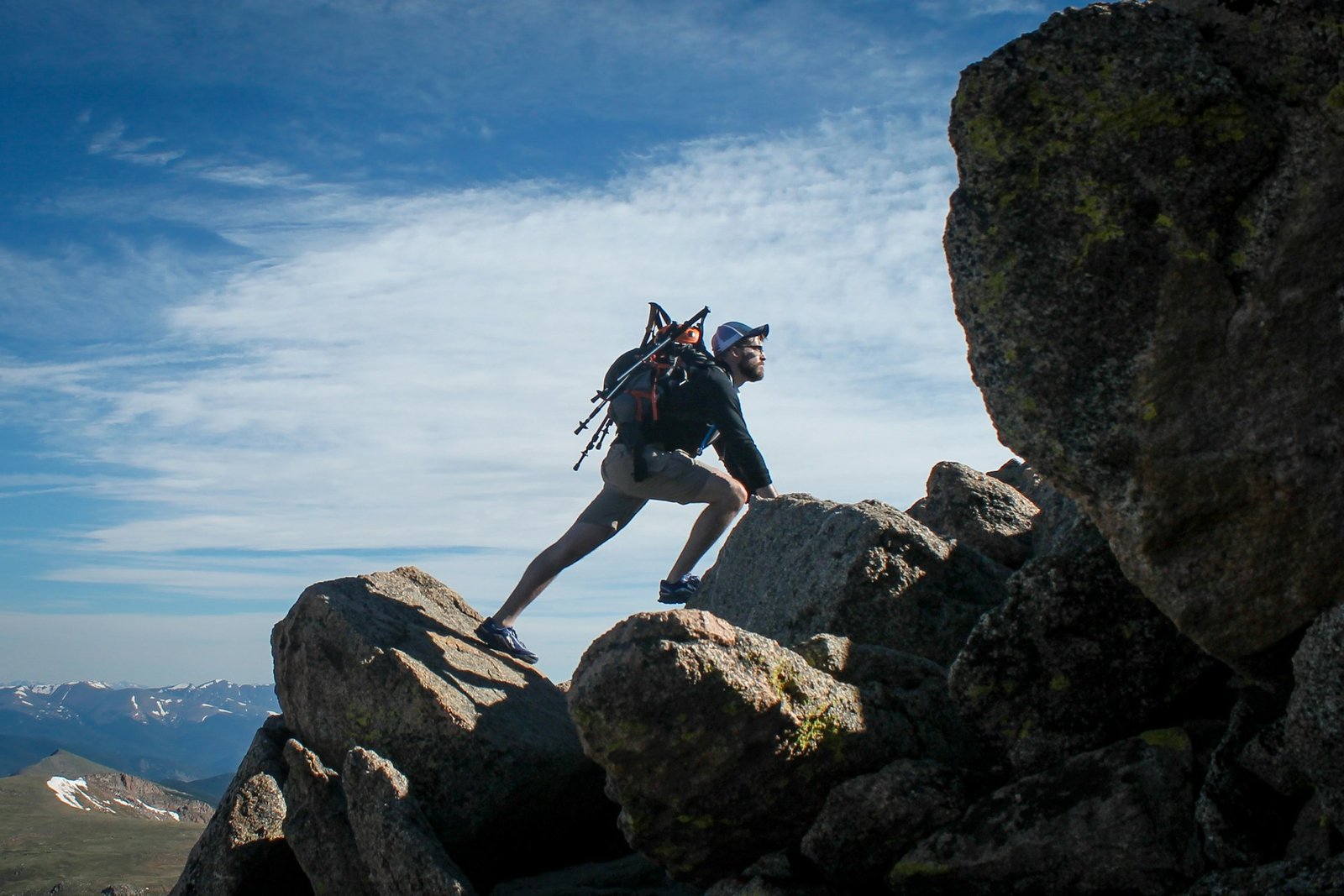
Imagine hanging several meters above the ground with nothing but your fingertips holding you to a wall. Your heart is racing, palms are sweaty, and you have to decide whether the tiny hold above you is strong enough to trust. At the same time, your feet are searching for the right position, your body is trying to maintain balance, and your brain is already planning the next move. Now it’s a game of fear, control, and science.
That is rock climbing. From the outside, it may look like a simple test of strength and courage. But behind every movement is a combination of physics, biomechanics, neuroscience, and decision-making. Climbing is a fast-growing sport, with one of the most common injuries being a rupture of the finger flexor tendon pulley.
A study was conducted on Motion Analysis of the Wrist and Finger Joints in Sport Climbing, in 2024, led by Gabreilla Fischer. This study aimed to examine finger kinematics during typical climbing tasks. Eleven elite climbers performed a sequence of four climbing moves, which were recorded by an optical motion capture system. Participants used crimp, half-crimp, and open-hand grips for three trials each, with the fourth condition involving campusing using any grip except crimp.
The Science Behind Grip
The first challenge in climbing is maintaining contact with the wall. This depends largely on friction, the force that resists motion when two surfaces come into contact. The amount of friction available depends on several factors, including the nature of the surfaces and the force pressing them together. Climbers therefore need to control how their hands and feet interact with the rock or artificial holds [1].
Sweat can make this more difficult. Moisture can reduce the effectiveness of friction between the skin and a climbing surface. This is why climbers commonly use magnesium carbonate, or climbing chalk, to absorb moisture from their hands [2]. However, chalk is not an adhesive. Its main purpose is to reduce moisture and improve grip conditions rather than make the hand literally stick to the rock. The shape of a hold also determines how a climber can use it. Large holds may allow the hand to wrap around them, while small edges require precise finger placement and greater force from the finger flexor muscles.

What Happens Inside the Fingers?
Our fingers may look simple, but their biomechanics are remarkably sophisticated. Muscles located primarily in the forearm generate force that is transmitted through tendons to the fingers. A series of structures called annular pulleys keep the flexor tendons close to the finger bones as the fingers bend [3]. This arrangement allows the fingers to efficiently transmit force.
Climbers use different grip positions depending on the shape and size of a hold. In an open-hand grip, the fingers remain relatively extended. In a crimp grip, the finger joints are more flexed, allowing the climber to generate substantial force on small edges [4].
Balance: Keeping the Center of Mass in Control
Strength alone cannot explain successful climbing. A climber must constantly control their center of mass, the point at which the mass of the body can be considered concentrated. Imagine trying to reach for something while standing on one foot, instinctively shifting the body to prevent falling. A climber performs similar adjustments continuously, but often on a much smaller and more demanding base of support.
Moving the hips closer to the wall can alter the forces acting on the hands. Rotating the body can make a distant hold easier to reach. Moving one foot can shift the center of mass and allow the opposite hand to move freely. [5] Efficient technique allows the climber to distribute forces between the arms, legs, and core. A climber who uses their skeleton and body alignment efficiently may conserve energy compared with someone who continuously pulls with their arms. [6]
The Brain Is Climbing Too
Climbing is also a cognitive activity. Before making a move, climbers visually examine the route and identify possible sequences. They have to estimate distances, recognize holds, plan foot placements, and anticipate how their body will move. This process is often called route reading. [7] With experience, the brain becomes better at recognizing movement patterns. Instead of consciously analyzing every individual action, experienced climbers can quickly identify familiar sequences and adjust them according to the route. Height introduces another biological component: the response of the body to perceived danger.

When the brain detects a potential threat, the sympathetic nervous system can activate the body’s fight-or-flight response. But fear can encourage a climber to pay closer attention to their surroundings and avoid unnecessary risks. But excessive anxiety can interfere with movement and decision-making [8]. A frightened climber may grip too tightly, increasing energy expenditure. They may also rush movements or become unable to commit to the next move.
Experienced climbers therefore do not necessarily eliminate fear. Instead, they learn to regulate their response to it and distinguish between useful caution and unnecessary panic.
The Human Body as a Climbing System
Rock climbing demonstrates that athletic performance is not simply about producing maximum force. It is about using force efficiently. A climber has to understand the surface through touch, interpret the route through vision, coordinate movement through the nervous system, maintain balance through constant adjustments, and manage fear while making decisions under pressure. On a climbing wall, science is not something happening in a laboratory [9].
It is happening in every grip, every movement, and every decision.
References:
- https://www.ebsco.com/research-starters/engineering/friction.
- https://shop.boulderplanet.sg/blogs/news/does-climbing-chalk-make-you-stronger?srsltid=AfmBOornhe_UiAcZ8v7_yhIQMHzgVKIrw3rJRkxp1tHWFDySvaYP7B2b.
- https://www.ncbi.nlm.nih.gov/books/NBK279362/.
- https://evmt.co/blogs/news/climbinggrip?srsltid=AfmBOoow3KgCgIsHO0BL0P0kAUJg8DngEld6khrjr_t1qhXniz3s8Omk.
- https://pmc.ncbi.nlm.nih.gov/articles/PMC13027491/
- Devise M, Quaine F, Vigouroux L. Assessing climbers’ pull-up capabilities by differentiating the parameters involved in power production. PeerJ. 2023 Sep 26;11:e15886. doi: 10.7717/peerj.15886. PMID: 37780381; PMCID: PMC10540777.
- https://routereading.com/
- https://www.health.harvard.edu/healthy-aging-and-longevity/understanding-the-stress-response
- https://www.mdpi.com/2071-1050/15/24/16687
More from the author: CAR-T Cell Therapy in Pakistan: A New Hope for Cancer Patients

Sadaf Sarfraz, currently a lecturer, holds an MPhil in Molecular Pathology and Genomics, complemented by a BSc in Medical Laboratory Technology. Contributing as a healthcare writer at Scientia-Pakistan, she passionately engages in calligraphy and art.

