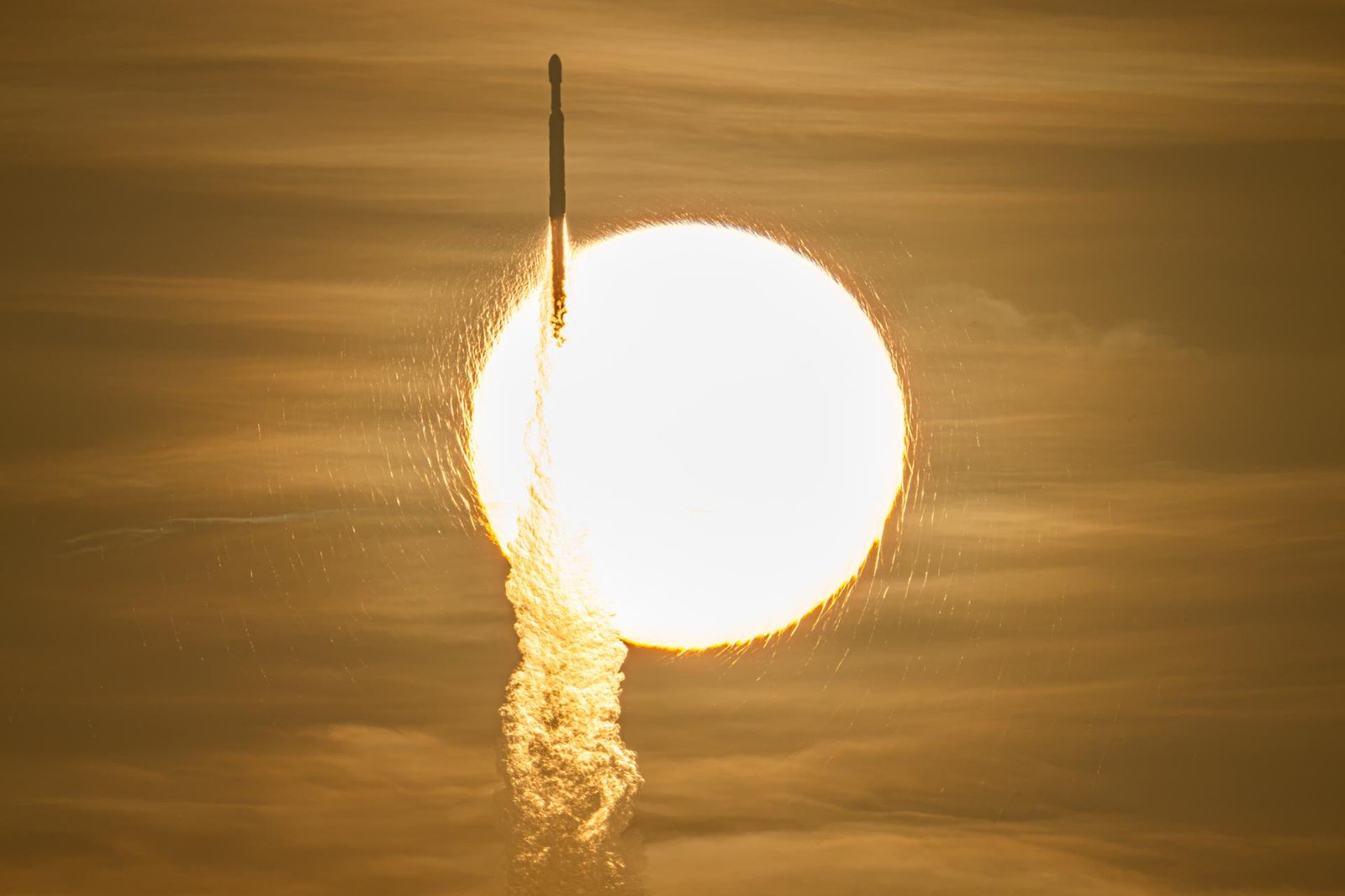
NASA’s powerful next-generation Nancy Grace Roman Telescope has blasted off into space at 7:26 a.m. EDT Sunday aboard a SpaceX Falcon Heavy rocket from Launch Complex 39A at the agency’s Kennedy Space Center in Florida, with a mission to explore dark energy, black holes and other mysteries of the Universe.
Ever since the James Webb Space Telescope launched on Christmas Day in 2021 and revealed its stunning first deep-space images six months later, it has continued to unravel the universe’s infrared mysteries. Yet, our drive to understand exoplanets, distant galaxies, and dark energy led NASA and its international partners to develop the Wide Field Infrared Survey Telescope. Now named the Nancy Grace Roman Space Telescope, this powerful observatory, widely viewed as Hubble’s true successor, has been launched to transform modern astronomy.
While the baseline mission is planned for five years, NASA’s impressive track record will most probably mean this observatory will likely stretch its operations well into the next decade. The primary goal of the Roman is straightforward. Roman has been designed to provide the same kind of detail that Hubble did. However, unlike Hubble, it is going to examine a much greater area of the sky. Specifically, Roman’s field of view is 100 times larger than Hubble’s. Therefore, it will be used to conduct large-scale surveys of the cosmos. Ultimately, Roman is not just about gathering data faster. It is about unlocking entirely new science.

The Woman Behind the Name: Nancy Grace Roman
Nancy Grace Roman completed her PhD in astronomy in 1949, establishing herself during an era when women were rarely seen in the discipline, let alone in leadership roles. She broke further ground by becoming NASA’s first Chief of Astronomy, marking her as the first female executive in the agency’s history.
During her 21 years at NASA, Dr Roman played an important part in developing a wide range of space-based observatories, including those designed to investigate the Sun, Earth’s upper atmosphere, and very distant parts of the cosmos. Her defining legacy, however, remains her crucial contributions to laying the groundwork for developing the Hubble Space Telescope, earning her the title of “Mother of Hubble.”
“It is because of Nancy Grace Roman’s leadership and vision that NASA became a pioneer in astrophysics and launched Hubble, the world’s most powerful and productive space telescope,” said then NASA Administrator Jim Bridenstine when the mission was renamed in her honour. “I can think of no better name for WFIRST, which will be the successor to NASA’s Hubble and Webb Telescopes.”
After retiring from NASA and throughout her post-retirement years, she remained active in supporting the next generation of astronomers through mentoring and consultation. With this mission being named after Dr. Roman, NASA ensures that her pioneering spirit will continue to inspire future generations of space scientists.
Inside the Machine
A telescope’s ability to resolve fine detail depends heavily on the size of its mirror; bigger mirrors gather more light. Surprisingly, the Roman Space Telescope’s 2.4-meter-diameter primary mirror. It was gifted to NASA to become the core element of its new observatory. Although it measures the same as Hubble’s mirror, it only weighs 186 kg, or roughly 25% as heavy as Hubble’s mirror. The mirror itself is made out of specially formulated low-expansion glass and is supported using mechanical engineering methods that ensure minimal deformation when subjected to extreme temperature variations between Earth and outer space.
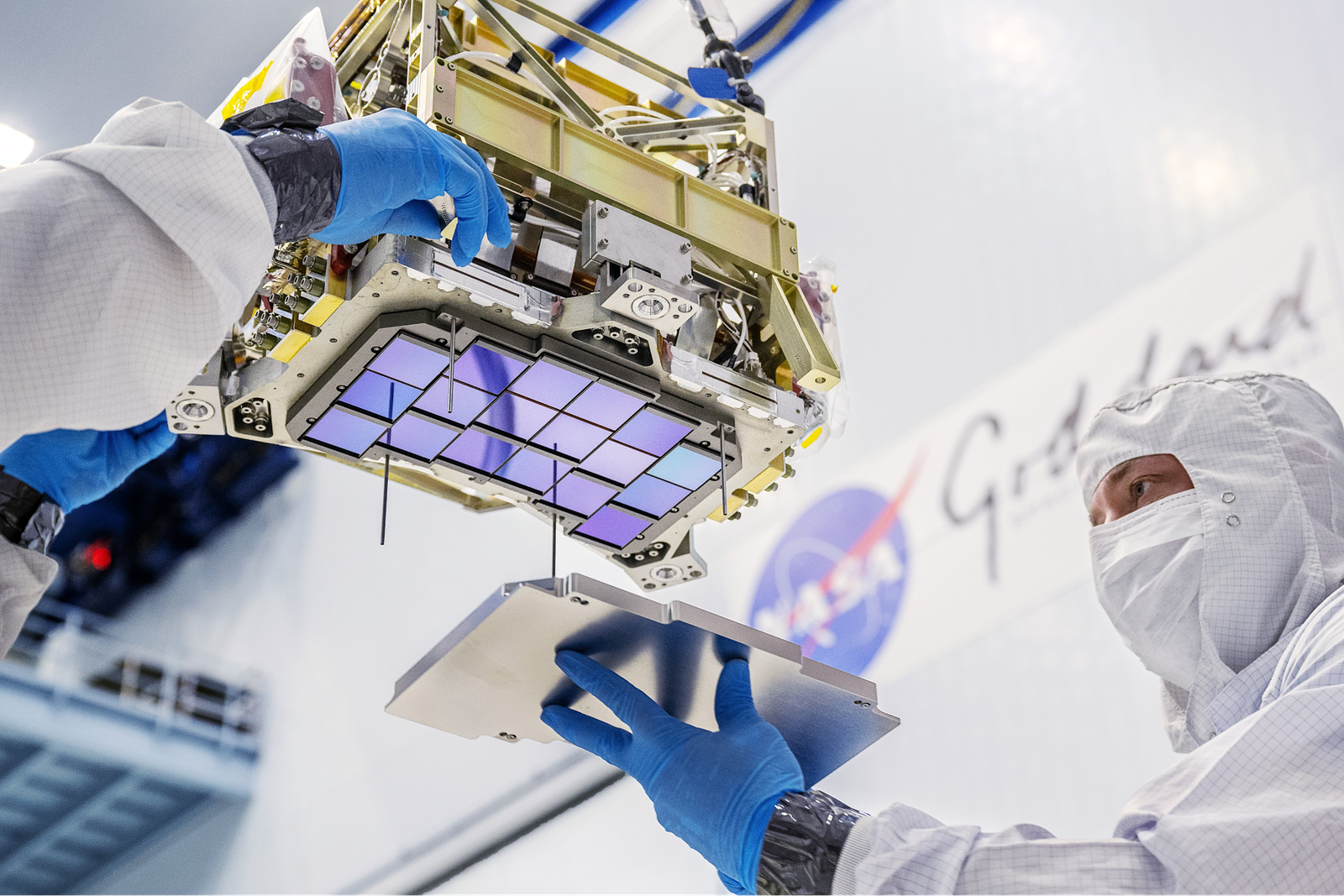
The real leap forward isn’t the mirror, though; it’s the camera. Roman’s Wide Field Instrument (WFI) is a 300-megapixel imager built to capture visible and near-infrared light, assembled from 18 separate detectors, stitched together into one seamless field of view. When placed side by side, the sensor array of the Roman Space Telescope significantly outscales the detector chips of both the Hubble and Webb space telescopes. Upon closer inspection of detector layouts, you may note small gaps between sensors.
These gaps are essential for accommodating electrical wiring and ensuring thermal stability across the array; however, light striking these seams would ordinarily be lost. To resolve this issue, Roman uses a technique known as dithering. Between exposures, small reaction wheels move the spacecraft slightly about .01 degrees, so when stacking similar frames on the ground into a single frame, Roman produces one continuous image of the sky.
The Wide Field Instrument (WFI) is far more than a typical space imaging camera. In addition to functioning as a standard imaging camera, the WFI is capable of being a very sophisticated multi-band observatory on its own. Designed to record light across eight distinct spectral bands ranging from visible wavelengths (approximately 0.48 microns) out into the near-infrared spectrum (up to 2.3 microns), which remains entirely invisible to human sight.
That way, WFI is able to view areas obscured by thick layers of interstellar dust clouds surrounding active regions of star formation and large cosmic structures. In addition to the imaging arrays of the WFI, there exist two other unique optical devices. A prism and a grism both serve as slitless spectroscopy systems. Each of these devices disperses incoming electromagnetic radiation into the spectrum of each object to be analyzed, providing astronomers with data about many critical aspects of the objects observed, including their temperature, chemical makeup, density, and redshift.
Additionally, both instruments have the capability of observing tens of thousands of separate objects during each exposure, allowing astronomers to create an unprecedented amount of data for use in future wide-field spectrographic survey missions.
Coronagraph: A pair of tinted glasses for starlight
The second major instrument aboard Roman is the Coronagraph. The Coronagraph functions much like a pair of tinted glasses made for starlight. When viewing a host star, the Coronagraph blocks the host star’s brightness to enable astronomers to visually inspect the very faint planetary bodies that orbit it. To accomplish this task, it utilizes tiny deformable mirrors that bend by fractions of a billionth of a meter to correct minute optical aberrations in real-time.
With this capability, the goal is to create a stable environment where distant planets may be brought into focus. Even the slightest movement or slight temperature changes would disrupt this process. If successful, this technology represents an important milestone toward the ability to photograph exoplanets similar to Earth.
Roman vs Hubble and JWST
While Hubble provided us with revolutionary visual and ultraviolet imagery of the universe, Webb serves as an “ultra-deep” time machine, observing the mid- and far-infrared regions of the electromagnetic spectrum. Like Hubble and Webb, Roman is an extraordinary instrument designed for depth, providing exquisite detail of very limited areas of the sky.
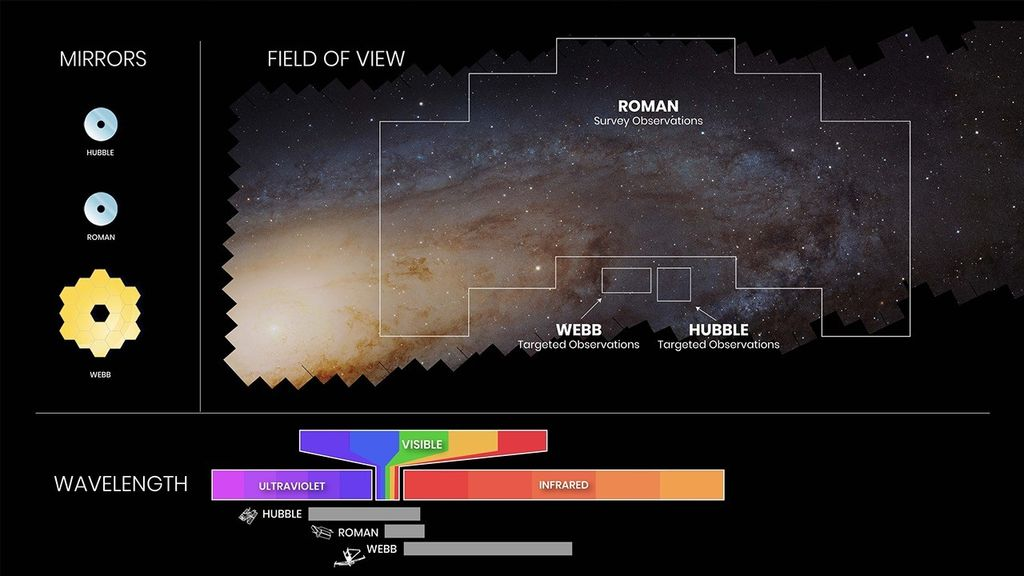
Roman covers much of the same wavelength range Hubble and Webb already reach into, roughly 480 to 2,300 nanometers. So why build another telescope to look at light we can already see? The answer is scale. Roman has a field of view that is greater than 100 times larger than the camera onboard Hubble while maintaining Hubble’s level of resolution. This massive panoramic view is the result of a brilliant optical design. While Hubble uses two mirrors to bounce and focus light, Roman utilizes a three-mirror design that gives it a focal length roughly three times shorter than Hubble’s.
Roman is not intended to replace either Hubble or Webb. Instead, Roman is meant to enhance their capabilities by surveying large portions of the sky and identifying those rare, unique objects worthy of further investigation using the narrow fields of view afforded by Hubble and Webb.
The Science we expect from Nancy Grace Roman Telescope
Roman’s science objectives are extremely aggressive. Its High Latitude Wide Area Survey will examine vast regions of the Milky Way galaxy. Within just 17 months, Roman will conduct a survey covering nearly 12% of the observable sky. For comparison purposes, if Hubble were to conduct such a survey, it would require over 1700 years to achieve this objective. As part of this survey, Roman will produce over 20 TB of data per day.
Buried in that flood of data will be an estimated 160,000 gravitational lenses. Think of these as cosmic magnifying glasses that distort incoming light travelling through spacetime caused by unseen mass, which scientists desire to utilize this information to better understand dark matter and ultimately explore the 85% of the universe we cannot directly observe today.
In addition to its search for gravitational lens systems, Roman will investigate dark energy, which, by common belief, drives the universe’s acceleration. Its High Latitude Time-Domain Survey will repeatedly photograph specific sections of the sky to find Type Ia supernovae, exploding stars that serve as essential standard candles or distance markers across space. Astronomers currently have only a few thousand of these rare stellar events catalogued in great detail.
Roman is projected to discover and precisely analyse close to 21,700 Type Ia supernovae, with some of the most distant events dating back more than 11 billion years to the universe’s early epoch (Rose et al., 2025). This unprecedentedly massive dataset could help resolve what cosmologists have started calling a crisis in the field, specifically testing whether our standard model of cosmology still holds up or requires fundamental revisions.
Finally, Roman will conduct its Galactic Bulge Time-Domain Survey directed at studying the central core of the Milky Way galaxy. By utilising gravitational microlensing techniques, Roman will seek to identify exoplanets/brown dwarfs via transient increases in brightness in background stars due to the passage of nearby exoplanet/brown dwarf masses. Due to Roman’s ability to maintain exceptionally high positional stability during target acquisition/exposure, Roman is expected to be able to detect exoplanetary systems with masses down to that of Mars (masses as small as Mars.
Additionally, Roman’s coronagraph enables direct imaging of distant gas giant exoplanets’ reflected light, allowing for future studies of potentially habitable terrestrial-type exoplanets.
Looking Ahead
With Roman’s launch, the astrophysics community is bracing for the flood of data heading its way, and the discoveries likely to follow. However, as with all previous space missions, the curiosity doesn’t end. With NASA preparing for Roman’s “first light”, engineers are currently developing the next-generation telescope already, the Habitable Worlds Observatory (HWO), which will allow them to actively look for biosignatures from Earth-like exoplanet environments. Until then, the Nancy Grace Roman Space Telescope is prepared to reveal the universe to us in a broader, richer, and even more dynamic manner than ever before.
References:
- Wide field instrument – NASA Science. https://science.nasa.gov/mission/roman-space-telescope/wide-field-instrument/
- NASA telescope named for ‘Mother of Hubble’ Nancy Grace Roman – NASA. https://www.nasa.gov/news-release/nasa-telescope-named-for-mother-of-hubble-nancy-grace-roman/
- Planned Observations – NASA Science. NASA Science. https://science.nasa.gov/mission/roman-space-telescope/planned-observations/
- Ravisetti, M. (2026, July 29). ‘It’s going to do things that currently are impossible’: The Roman Space Telescope, NASA’s next. . .. Space. https://www.space.com/astronomy/its-going-to-do-things-that-currently-are-impossible-the-roman-space-telescope-nasas-next-great-observatory-is-ready-to-launch-aug-30
- Ravisetti, M. (2026, April 21). The Nancy Grace Roman Space Telescope, NASA’s next great observatory, is finally complete. Space. https://www.space.com/space-exploration/the-nancy-grace-roman-space-telescope-nasas-next-great-observatory-is-finally-complete
- The Astrophysical Journal, 988(1), 65. https://doi.org/10.3847/1538-4357/ade1d6
- Balzer, A. (2026, May 30). NASA’s Roman space telescope primary mirror gets last look – NASA. https://www.nasa.gov/missions/roman-space-telescope/nasas-roman-space-telescope-primary-mirror-gets-last-look/
- The Wide Field Instrument – Roman User documentation. (2025, January 2). https://roman-docs.stsci.edu/roman-instruments/the-wide-field-instrument
More from the author:
Decoding Bennu: Groundbreaking 2024 research redefines life’s origin

Aly Muhammad Gajani holds a Master’s degree in Space Science and Technology, specializing in Astrophysics together with GIS applications. His research focuses on galaxy evolution, astrophysical cosmology, exoplanet detection, and computational astronomy.

