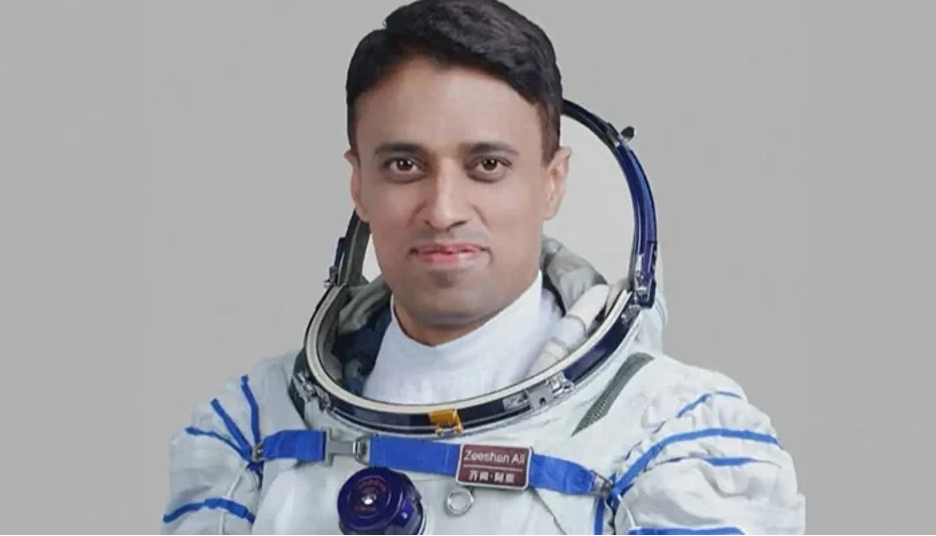
Pakistan is set to achieve a historic milestone in its space programme as Muhammad Zeeshan Ali prepares to travel to China’s Tiangong space station aboard the Shenzhou-24 spacecraft on Wednesday, November 25. The mission will make Ali the first Pakistani national to travel into space and the first foreign astronaut to visit China’s space station.
The China Manned Space Agency (CMSA) officially announced Zeeshan Ali’s selection on Tuesday, confirming that he will join Chinese astronauts Tang Hongbo and Wu Yi on the mission. The spacecraft is scheduled to launch at 8:18 am Beijing time (5:18 am Pakistan time) from the Jiuquan Satellite Launch Centre in northwestern China.
Ali, a former military pilot, will serve as a payload specialist, focusing primarily on scientific experiments. He is expected to spend approximately one week aboard Tiangong before returning to Earth aboard the Shenzhou-23 spacecraft, which is already docked at the station.
The mission also marks the first time China has included a foreign astronaut in a crewed spaceflight programme.
The Science in Orbit
While the astronaut’s journey is the headline achievement, the scientific work accompanying him is another important aspect of the mission.
According to SUPARCO officials, more than 300 research proposals were submitted by universities in Karachi, Lahore and Islamabad. Chinese research institutions selected four experiments for the mission, focusing on biotechnology and areas relevant to food security and climate change.
The experiments were developed and tested in SUPARCO laboratories before receiving clearance from Chinese engineers. They will allow Pakistani researchers to conduct scientific work in the microgravity environment of an operational space station.
This is significant because the value of human spaceflight extends beyond sending an individual into orbit. It creates opportunities for scientists, universities, and research institutions to participate in experiments that are difficult to conduct under normal conditions on Earth.
Pakistan’s Space Programme
Although this is Pakistan’s first human spaceflight, the country’s involvement in space science goes back more than six decades. Pakistan established the Space and Upper Atmosphere Research Commission (SUPARCO) in 1961, becoming one of the earliest countries in Asia to establish a national space programme.
Initially focused on atmospheric research and sounding rockets, SUPARCO gradually moved towards satellite development. In 1990, Pakistan launched Badr-1, its first indigenously developed satellite, followed by Badr-B in 2001, which expanded its capabilities in Earth observation and remote sensing.
Over the years, the programme has expanded into satellite communications and Earth observation. Key developments include PAKSAT-1R, launched in 2011, and PRSS-1 and PakTES-1A, launched together in 2018. These satellites support telecommunications, agricultural monitoring, urban planning and disaster management.
More recently, Pakistan has made progress in developing its own Earth observation technology. In January 2025, SUPARCO launched PRSC-EO1, an indigenously developed electro-optical satellite designed to capture images of the Earth’s surface. This was followed by PRSC-S1 in July 2025, Pakistan’s first Synthetic Aperture Radar satellite, which can capture images even through cloud cover and in darkness. Both missions strengthen Pakistan’s ability to monitor agriculture, water resources, infrastructure and natural disasters.
Pakistan has also begun participating in deep-space exploration. In May 2024, the country sent its first lunar satellite, ICUBE-Qamar (iCube-Q), aboard China’s Chang’e-6 mission. Jointly developed by Pakistan’s Institute of Space Technology and Shanghai Jiao Tong University, the satellite entered lunar orbit and transmitted its first images of the Moon.
The mission marked Pakistan’s first contribution to lunar exploration. It also demonstrated the growing role of Pakistani universities and research institutions in international space projects. China’s Chang’e-6 mission itself made history by returning the first-ever samples collected from the far side of the Moon.
A Growing Partnership with China
China has played an important role in Pakistan’s space programme, from launching early satellites to supporting more recent research and exploration missions.
The two countries have expanded their cooperation through satellite development, lunar exploration, navigation technology and scientific research.
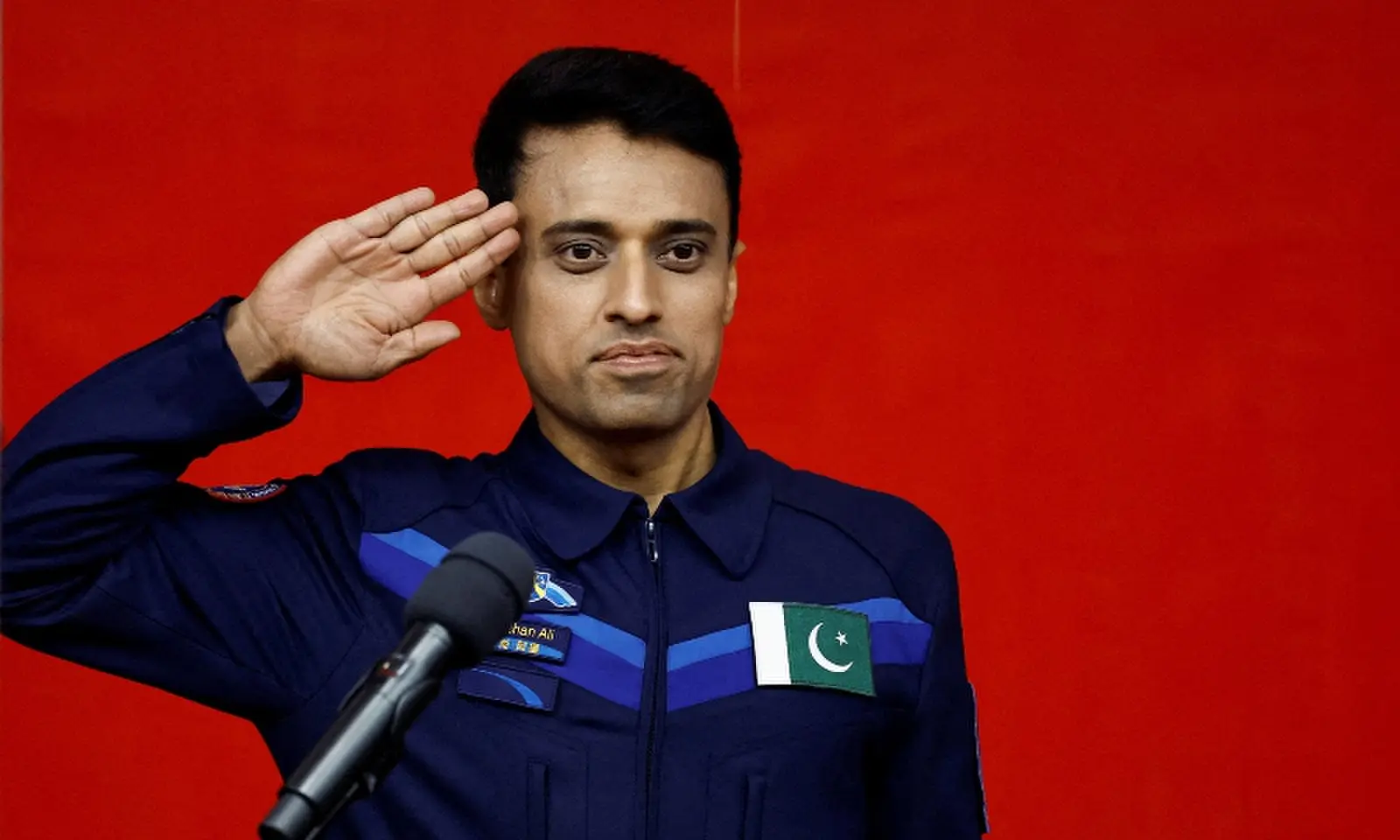
In February 2025, SUPARCO and the China Manned Space Agency signed an agreement to facilitate Pakistan’s participation in China’s human spaceflight programme. Under the agreement, two Pakistani candidates would receive astronaut training in China, with one eventually selected to travel to the Tiangong space station.
Ali and fellow candidate Khurram Daud were selected following a multi-stage screening process and sent to China for specialised training. Their preparation included spacecraft and space station operations, emergency procedures, crew coordination and technical communication in Chinese.
Ali’s selection for the Shenzhou-24 mission is the first major outcome of that agreement.
The collaboration also allows Pakistan to develop experience in human spaceflight without having to establish an independent crewed space programme from scratch.
What Comes Next for Pakistan?
The upcoming mission is an important milestone, but it also raises a broader question about the future direction of Pakistan’s space programme.
For now, much of the country’s progress has been built through international partnerships, particularly with China. While Pakistan has developed and contributed to several satellites and scientific payloads, its ability to independently launch and operate complex space missions remains limited.
The next challenge will be to translate these collaborations into stronger domestic capabilities.
This means investing in research and development, expanding university-level space science programmes, developing indigenous satellite technologies and building a stronger base of engineers and scientists.
There is also a practical reason to continue investing in space technology. Satellite data can support agriculture, weather forecasting, disaster response, water management, telecommunications and environmental monitoring. For a country facing growing climate and resource challenges, these applications could have considerable value.
Zeeshan Ali’s journey to Tiangong therefore represents more than a symbolic achievement. It marks Pakistan’s entry into human spaceflight and opens another avenue for the country’s scientific community to participate in international space research.
The mission may last only about a week, but its significance could extend much further, depending on how Pakistan builds on the experience.
References
- https://suparco.gov.pk/
- https://suparco.gov.pk/major-programmes-satellite-programs/
- https://apnews.com/article/china-pakistan-shenzhou-24-space-a618c7d419cd556de0392829286ede66
- https://www.reuters.com/science/china-launch-shenzhou-24-spaceship-with-first-foreign-astronaut-2026-11-24/
- https://pakistan.shafaqna.com/EN/342624
Also Read: The Science of Tiny Particles in Earth’s Atmosphere: Dr Joelle Buxmann

Adnan Baig is a space science graduate who also served as a student research assistant at the Leibniz Institute of Astrophysics, Potsdam, Germany. He has co-authored several international research publications. Adnan is interested in space research, astrophysics, environmental science, nature photography, writing, reading and watching movies and anime.

