Current medical research has established the importance of gut health in wellbeing. It has been proposed that most chronic diseases originate within the gut. Inflammation, a damaged gut blood barrier, and dysbiosis are some of the postulated mechanisms for the disease process to jump from the gut to other major organ systems.
There has been a spotlight on the role of the gut microbiome in homeostasis, immunity, and mental health. The interplay between the microbiome and the gut nervous system can be read about here. Similarly, the microbiome’s role in athletic performance and its modulation has been an area of research recently, considering the astonishing yet intricate effects of these bacteria on our everyday health.
There are around 40 trillion microbial cells in the human gut. They constitute the microbiome, a complete ecosystem interacting with and modulating key functions in the human body through the gut. We know that living a healthy lifestyle promotes greater diversity in the gut microbiome. Eating healthy, nutrient-rich foods such as whole fruits, whole grains, healthy fats, fermented foods, physical activity, and good-quality sleep all play vital roles in supporting a healthy microbiome.
To understand how the microbiome and a healthy gut can influence athletic performance, we will first review information ascertained from animal and limited human studies. We will discuss how prebiotics and probiotics can modulate gut health and consequently athletic performance. And finally, rounding off with the way forward in this unraveling field of nutritional health & exercise.
Read: Love-Hate Relationship between the Gut Microbiota and the Brain
Gut microbial diversity, metabolism & athletic performance
Gut microbes share a huge metabolic maintenance burden with our own cells. They play diverse roles in the breakdown of food into macronutrients and vitamin production in the gut. The end products either way are integral to athletic performance.
It has been shown that athletes have greater diversity of microbes as compared to non-athletes. Greater diversity means greater attention to detail in everyday homeostatic functions and also in demanding activities like athletic performance. Generally speaking, the gut microbiome diversity & athletic activity have a bidirectional relationship. However, it is not a linear relationship since it has been shown that in the case of certain high intensity/endurance exercises such as ultra-marathon competitions, the diversity takes a hit (? due to reduced blood supply to the gut)
Microbial diversity also varies according to the type of exercise involved. Dynamic and sustained exercises involve greater aerobic activity and promote greater microbial diversity (e.g., endurance running, high-intensity interval training, field sports, etc.) compared to static exercises (resistance exercises such as weightlifting). This emphasizes that exercise type and intensity influence gut microbial diversity and reciprocally, diversity influences athletic performance. Studies have shown marathon runners having an abundance of Veillonella atypica, which was further shown in mice studies to reduce blood lactate levels and increase endurance.
Gut microbe groups such as Bifidobacterium, Lactobacillus & Fecalibacterium are known for producing short-chain fatty acids (SCFA), e.g., butyrate, from digestion of food. The SCFAs serve many functions, a few being immunomodulation, muscle metabolism, lipid & carbohydrate metabolism, and fatty acid oxidation. SCFAs have been shown to increase VO2 max (maximum oxygen utilization capacity during exercise) in animal models. SCFAs are produced by the breakdown of complex starches such as those present in whole grains, legumes, and starchy vegetables (e.g., potatoes).
Gut microbiome & muscle metabolism
Gut microbiome influences muscle and protein metabolism through increased availability of amino acids, particularly Branched-Chain Amino Acids (BCAAs), i.e., valine, leucine & isoleucine, which contribute to muscle growth and function. Microbes influence muscle metabolism through nutrient-sensitive pathways as well. mTOR (mechanistic target Of Rapamycin) and AMPK (AMP-activated protein kinase) are master regulatory proteins of cell metabolism. They are influenced by numerous factors such as amino acids, stress, IGF-1 (insulin-like growth factor-1), and oxygen levels.
At the cellular level, growth and development are determined by these regulators. mTOR is crucial in protein synthesis, especially under the influence of IGF-1. Gut microbes play an integral role in this process by providing ample amino acid availability, fatty acid utilization, and fat store generation.
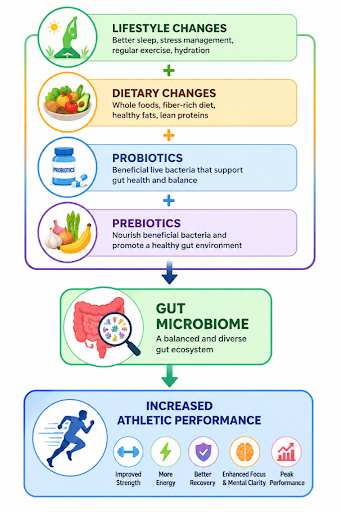
Modulation of the gut microbiome to enhance athletic performance
Probiotics are live beneficial bacteria and yeasts taken to modulate the gut microbiome. They occur in fermented foods such as yogurt, kefir, kimchi, and kombucha. They are also ingested as supplement preparations (available as multi-strain bacteria + yeast). They impact the intestinal microbiome by killing off harmful bacterial strains, competing with their binding sites, and modulating immunity through the intestinal nervous system. Key probiotic organisms are Lactobacillus, Bifidobacterium, and Saccharomyces boulardii (yeast).
There is a paucity of research on the effects of probiotic supplementation on exercise/athletic performance. However, we do have enough to highlight their role.
A study showed that after ingestion of milk supplemented with W. Coagulans pre-training, there was significantly reduced muscle soreness and sped-up recovery in non-athletes. There was evidence of reduced TNF-α levels (pro-inflammatory marker) in athletes after supplementation with certain probiotics, lesser inflammation, faster recovery, and growth after exercise. In addition, there was increased run-to-fatigue time in athletes by supplementation with certain strains of probiotics.
The role of probiotic supplementation
Probiotic supplementation has been shown to enhance aerobic exercise efficiency by increasing nitric oxide availability and improving vascular function. The studies show evidence for increased duration to exercise failure. Some studies report increased muscle mass and strength in power exercises with probiotic supplementation.
Gut microbiome modulation suggests better recovery from intense exercises with improved sleep quality and reduced inflammation markers. A small set of studies suggest psychological benefits such as reduced anxiety/stress and increased attention. All of which can lead to improved athletic performance, especially during elite-level competitions where stakes are high.
Extensive endurance training (e.g., elite runners) like strength training can predispose to infections, particularly respiratory tract infections. This can happen since the human body perceives exercise/training as stress, whereby the immune system is transiently suppressed. This is relevant especially when athletes are undergoing continuous and long training and competitive sessions, especially when traveling as well. Probiotics supplementation could lower the risk of infection by bolstering immunity through gut modulation.
Several gastrointestinal effects that runners feel are not limited to nausea, vomiting, abdominal discomfort, and diarrhea. This is suggested to be due to reduced blood supply to the gut during exercise, where most of the blood supply is diverted to the contracting muscles. Probiotics can lower perceived exertion and, as such, reduce these negative gastrointestinal effects. They have also been shown to reduce performance decrements towards the end of the race compared to placebo.
Prebiotics are compounds (pectin, inulin, fructo-oligosaccharides [FOS], galacto-oligosaccharides [GOS], polyphenols) within natural foods (fruits & veggies) which are consumed by gut bacteria to generate products which have beneficial effects on immunity, the gut-brain axis and exercise capacity.
Research on prebiotics acting as gut modulators for athletic performance is limited. Data are mostly in combination with probiotics (symbiotic). Polyphenols (naturally present in most veggies & fruits), when supplemented, interact with the gut microbiome to produce increased muscle recovery, reduced muscle fatigue and reduced lactate production, all leading to improved exercise efficiency.
Fermented food
Fermented foods like yogurt, kefir, pickles, and kimchi have Lactobacillus and Bifidobacterium strains of bacteria which, as previously described, have beneficial effects on the ecosystem of the gut, all the while reducing pathogenic bacterial strains, increasing SCFA, and reducing bloating. Regular consumption of fermented food imparts positive health effects in preventing chronic disease by reducing inflammation and serving as an adjunct to a good-quality diet in exercising individuals. There is less research on how fermented food affects athletes, though.
Gut microbiome stability and the way forward
Gut microbiome changes dramatically with our diets, perceived stress, surgeries, and antibiotics. It has been observed that after antibiotics or gut surgeries, the microbiome requires up to 180 days to fully recover to the baseline. It is known now that the gut microbiome can influence exercise performance and metrics; having a stable gut microbiome would be considered gold in the future.
Gut microbiome becomes more or less stable over time. It has been shown that athletes with stable microbiomes respond better to beneficial dietary changes. Longitudinal or periodic microbiome testing (fecal) could be something to consider for athletes in the near future. This can assess athletes’ preparedness for the steep competition of the particular sport, and any shortcomings could be addressed with diet/lifestyle changes and supplementation.
Travel-associated dietary changes (consumption of ultra-processed food) and disrupted sleep can significantly affect athletes’ microbiome. Synbiotics (pre+probiotics) could be used to address this issue.
Could it be that the gut microbiome can be tweaked according to the type & and intensity of exercise and competition? Maybe so. Interdisciplinary collaboration between fields of sports nutrition & metabolism and microbial physiology can deal with this situation effectively.
Final Words!
Our gut microbiome is a complete ecosystem which works in harmony with our bodily processes and modulates them. It affects exercise performance in more than one way and is an open area of study with new revelations now and then.
While there is not a particular way to build a healthy microbiome for health and exercise, we can help our cause by eating healthy, getting good quality sleep, and dealing better with stress. There are synergistic effects between training & pro- and pre-biotic supplementation. This can lead to better athletic performance through modulation of energy, the inflammatory response, and recovery.
An integrated approach that integrates nutrition, training, monitoring, and optimization of gut microbiome trends across different sports is key to the way forward in this emerging domain.
References:
- Clarke SF, Murphy EF, O’Sullivan O, et al. (2014). Exercise and associated dietary extremes impact on gut microbial diversity. Gut, 63(12), 1913–1920.
DOI: 10.1136/gutjnl-2013-306541 - O’Brien MT, O’Sullivan O, Claesson MJ, Cotter PD. (2022). The Athlete Gut Microbiome and its Relevance to Health and Performance: A Review. Sports Medicine, 52(Suppl 1), 119–128.
DOI: 10.1007/s40279-022-01785-x - Cullen JMA, Shahzad S, Dhillon J. (2023). A systematic review on the effects of exercise on gut microbial diversity, taxonomic composition, and microbial metabolites: Identifying research gaps and future directions. Frontiers in Physiology, 14, 1292673.
- Scheiman J, et al. (2019).
Meta-omics analysis of elite athletes identifies a performance-enhancing microbe that functions via lactate metabolism.
Nature Medicine, 25(7), 1104–1109.
DOI: 10.1038/s41591-019-0485-4 - Liu Y, et al. (2023).
mTOR Signaling Pathway and Gut Microbiota in Various Disorders: Mechanisms and Potential Drugs in Pharmacotherapy.
International Journal of Molecular Sciences, 24(15):12156.
DOI: 10.3390/ijms241512156 - Jäger R, Purpura M, Farmer S, Cash HA, Keller D. (2016).
Probiotic Bacillus coagulans GBI-30, 6086 reduces exercise-induced muscle damage and increases recovery.
PeerJ, 4:e2276.
DOI: 10.7717/peerj.2276 - Su H, Tsai YL, Huang WC, et al. (2022).
Effects of Probiotic Supplementation on Immune and Inflammatory Markers in Athletes: A Meta-Analysis of Randomized Clinical Trials.
Medicina, 58(9):1188.
DOI: 10.3390/medicina58091188 - West NP, Horn PL, Pyne DB, Gebski VJ, Lahtinen SJ, Fricker PA, Cripps AW. (2014).
Probiotic supplementation for 4 weeks increases running time to fatigue in the heat in recreational runners.
European Journal of Applied Physiology, 114(9), 1831–1841.
DOI: 10.1007/s00421-013-2748-y - Cheng LH, et al. (2023).
Effects of heat-killed Lactiplantibacillus plantarum TWK10 on exercise performance, fatigue, and muscle growth in healthy male adults.
Physiological Reports, 11:e15835. - The effect of probiotic and synbiotic supplementation on sleep parameters in the exercised population: a systematic review and synthesis without meta-analysis (SWiM) of randomized controlled trials.
Journal of the International Society of Sports Nutrition (2026). - Polyphenols and Performance: A Systematic Review and Meta-Analysis.
Sports Medicine, 47(8):1589–1599.
DOI: 10.1007/s40279-017-0675-5
More from the author:
The Nabateans: Rock-Cut Wonders of the Ancient World
Negativity and its Biological Impact on Our Mental Health

Dr Syed Hunain Riaz is a Physician with expertise and experience in Endocrinology & Metabolism with a passion for eliciting change through the dissemination and application of precise knowledge. He is a space enthusiast, avid reader, blog writer, amateur photographer ( Astro & every day), and gamer.
Writing interests include preventive & lifestyle medicine and psychosocial issues. Dr. Hunain believes in limitless creativity and productivity of the human mind. Nature of consciousness, reality, and patterns in the universe are areas of special interest. He can be reached at syedhunain@gmail.com

