Stephen Hawking led an incredible life and provided an
amazing service to science. He inspired millions and made an undeniable impact
not only among the scientific community but around the world. Here are a few glimpses
of his marvelous life.
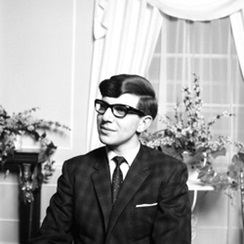
Young Stephen Hawking in 1962
This is a picture of young Stephen Hawking. He studied natural sciences at Oxford and after receiving his B.A. in 1962, he went to Cambridge for graduate studies in Physics. He initially worked with his friend on the role of singularities in general relativity and later pursed and immortalized new concepts of space and time.
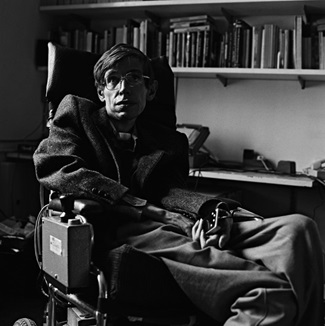
Stephen Hawking in 1985, after diagnosis with ALS
Hawking in 1985. After he was diagnosed with ALS, a motor neuron
disease, he used a special electric wheelchair equipped with new technologies
for locomotion.
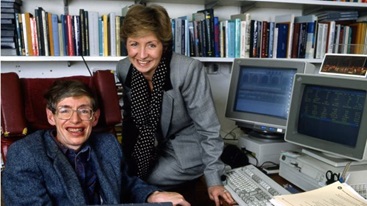
At Cambridge, England, with his family
Hawking, on left, pictured in 1985, with his family in
Cambridge, England. He married his first wife two years before he was diagnosed
with the disease. Here, their two children are seen enjoying a cookout.
At Cambridge, England
Professor Hawking pictured with his family arriving at Cambridge to receive an honorary degree awarded to him for his services to scientific research.
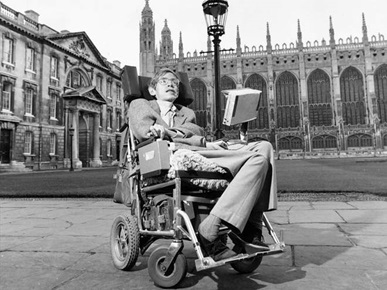
At Trinity college Lawn.
Pictured in Cambridge. Stephen Hawking is seen here in the
Trinity College Lawn.
A Brief history of time
Hawking best selling book was published in 1988 called A Brief History of Time. He brought theories
of black holes, space exploration and cosmology to a wider audience around the world.
It has sold more than ten million copies and continues to break records.
1992 with Sue Lawley in a radio show
In 1992, he appeared on the radio show called Desert Island
Discs with Sue Lawley. He talked about his scientific interests and favorite
desserts.
An episode of Star Trek: The Next Generation
Stephen was extremely fond of Television and movies and appeared
in many famous shows. Here, he is seen in an episode of Star Trek: The Next Generation. He also made cameos in The Simpsons, The Big Bang Theory, Futurama
etc.
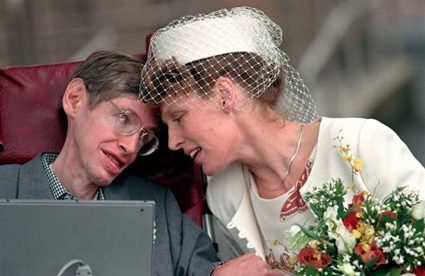
1995, second marriage with Elaine Meson
In 1995, Stephen Hawking married his nurse Elaine Mason, five
years after his divorce from his first wife. His second marriage continued for
11 years and they got divorced in 2006.
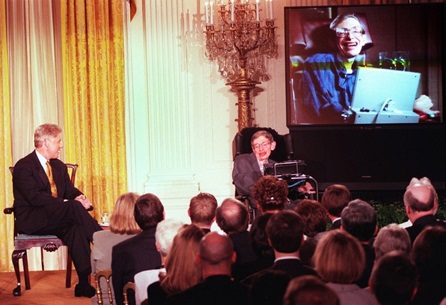
At White House in 1998
In 1998, Hawking was invited at the White House by the [then] President Bill Clinton, for an event in which he discussed prospects and developments in science during a live telecast.
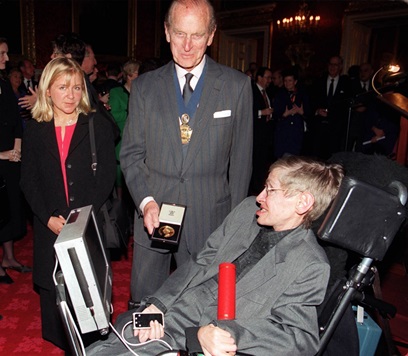
199, at Royal society of Arts
Hawking received the Albert Medal from Prince Philip of Britain in 1999. The Royal Society of Arts awarded him for popularizing physics among the general audience. He was also awarded CBE which is one of the biggest civil honors in Britain.
2001, at free University Berlin
Hawking is seen here attending a lecture in Free University,
Berlin in the year 2001. He gave many lectures and talks around the world
throughout his life.
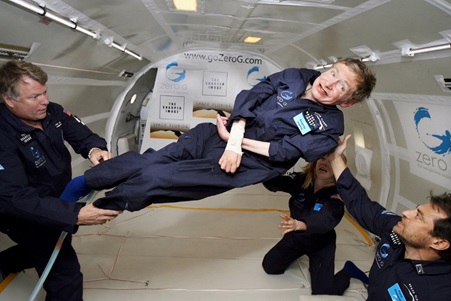
In 2007, while experiencing gravity in US
In 2007, Hawking experienced zero gravity in a US institute and was captured all smiles and happy. He always talked about never limiting himself because of his condition.
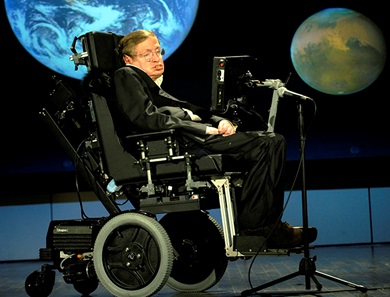
At NASA’s 50th anniversar
On April 21, 2008, Hawking gave a lecture for NASA on its 50th anniversary. His daughter also served as a moderator for the event.
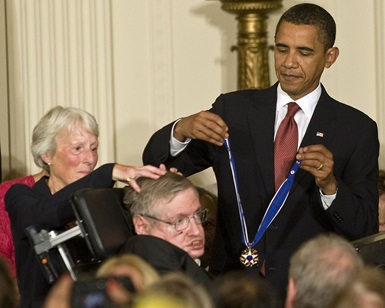
While receiving presidential medal of freedom
President of the United States of America, presented him the Presidential
Medal of Freedom in 2009 which is a big civilian honor.
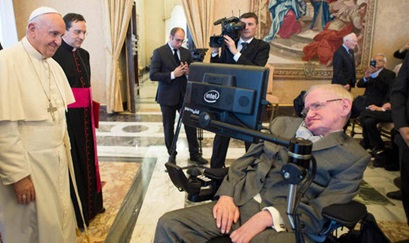
At Vatican City
He met with Pope Francis in Vatican City before a session at Pontifical Academy of Sciences. Although he was a known atheist, he still discussed the ideas of God and religion during many lectures. Stephen Hawking tries to teach POPE origins of the universe in an awkward meeting of minds.
2012, in London
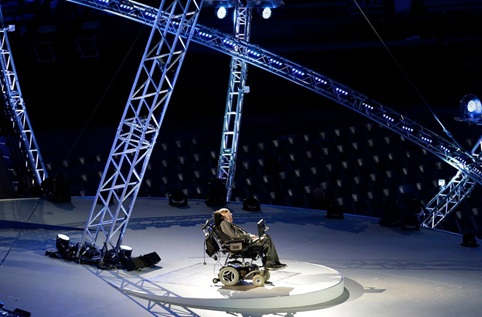
Hawking is pictured
here giving a speech during the opening ceremony of Paralympics in London in
the year 2012.
2014, with Queen Elizabeth
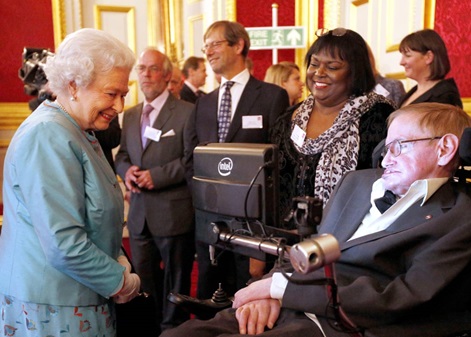
Stephen Hawking is seen here meeting the Queen at a
disability charity in 2014.
At premier, Theory of every thing
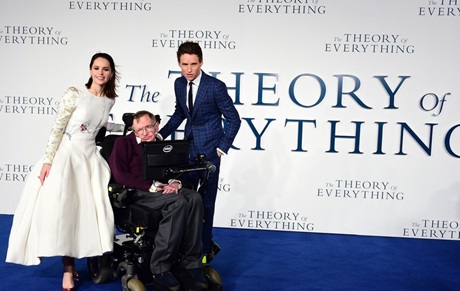
In 2014, a film based on his life was released called The Theory of Everything. Here, he pictured with the leading stars Eddie Redmayne and Felicity Jones. Stephen Hawking delighted at Redmayne’s Oscar for The Theory Of Everything.
2018, Funeral service at Great St. Mary’s Church
After an
astonishing career and life, Stephen Hawking passed away on March 14, 2018. His
funeral service was held at Great St. Mary’s Church.
Dr. Fariha Hasan is serving as the Professor of Microbiology at the Department of Microbiology in Quaid-i-Azam University, Islamabad, Pakistan. She has more than 12 years of teaching and research experience in the field of Microbiology. Her research interests are Microbial Diversity of extreme habitats, polyextremophilic microorganisms, Astrobiology, microbial metabolites and biodegradation of synthetic polymers.
She is an advisor of the Astrobiology Network of Pakistan and very eager to promote this emerging field of science in her country. She has been delivering lectures on astrobiology for three years and recently two of her MPhil students have done their research on astrobiology and their research papers are in process.
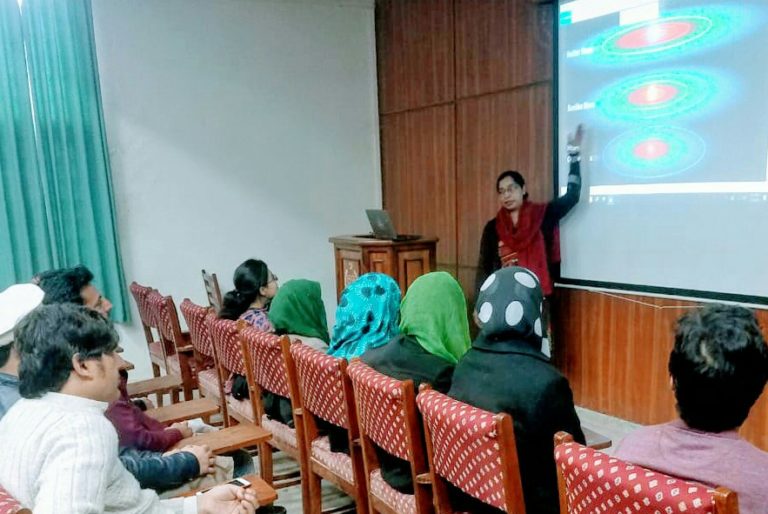
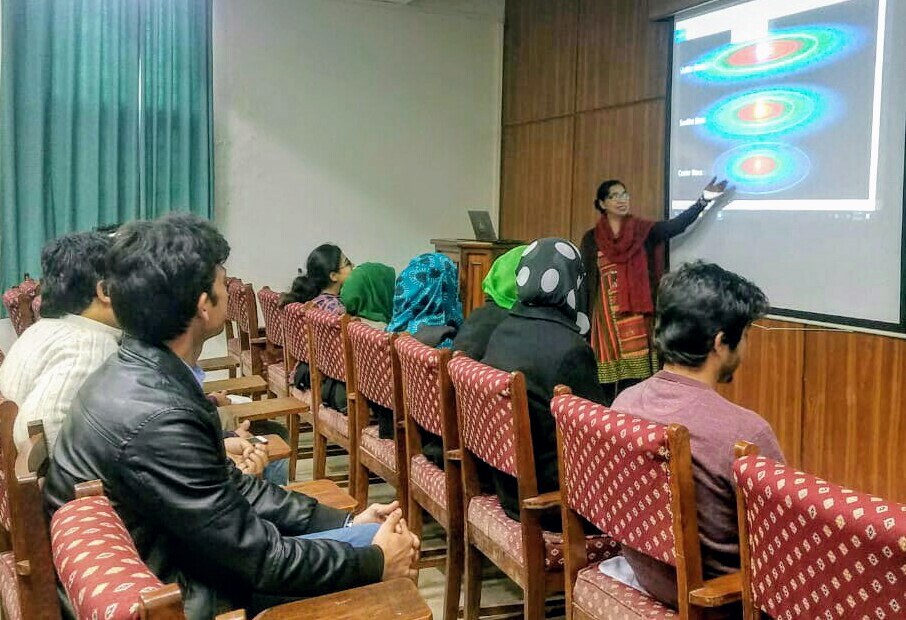
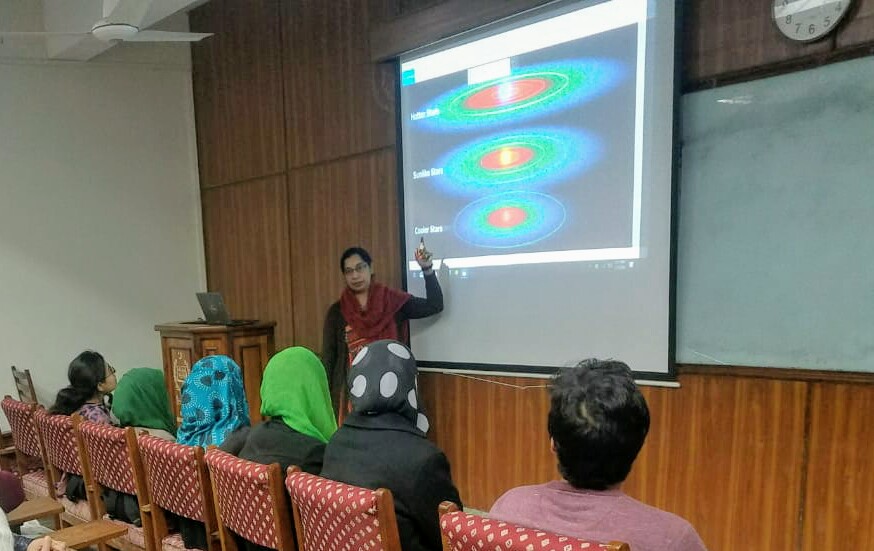
Dr. Fariha Hasan while delivering a lecture on Astrobiology
Let us know about your academics? What kind of hobbies and
interests do you have?
I cleared my Masters, M. Phil, and Ph.D. from Quaid-i-Azam University Islamabad and since 2004, I have been working here as teacher and researcher in microbiology. Usually, people think that only youngsters have hobbies, but unlike others of my age, I have managed to maintain a few of interesting hobbies after all these years, like book reading especially English classics, stamp collection, sketching, artwork, and photography.
What would you say has been the highlight of your career?
I started research on glaciers in 2006 and still pursuing it due to my interest. Later, I did my Postdoctoral from the UK in the same field. It has been around 10 years now and I think that has been one of the most important milestones of my career. I was very lucky to do my Postdoc there with a group whom I am still in contact and continue to collaborate by sending my Ph.D. students over to them.
Can you explain what Astrobiology is about?
The word Astrobiology is made by the combination of Astronomy
and Biology, in which we question and imagine life in space; planet or any
other celestial body. What are the past and the future and what kind of things
are possible which we can call life. But before going into depth one has to
define ‘life’. Beyond science jargons it can define ‘anything that can
reproduce, sustain, and carry on information’ or simply ‘survive and multiply’,
is life.
One can link it with Astrobiology in that, what we see and imagine in our minds about the extraterrestrial life. A common man thinks of it as something about a creature with one, eye, five hands, weird body, and vice versa. In reality, extraterrestrial life is what we haven’t seen and cannot be imagined clearly. Astrobiology is something that aspires to search and answer such queries about the possibilities of life in our solar system or beyond the universe.
At Quad e Azam University Islamabad
How did you develop an interest in Astrobiology?
In my childhood, I used to watch movies/shows like Star Wars, Battlestar Galactica, Space 1999 and Star Trek. Consequently, these shows helped my imagination to grow, but I just wanted to study biology. When graduated, I started working on research projects like biodegradation and the involved enzymes. Later, I decided to find a way where I can combine my interest with research in studies because then I was free.
My interest in Astrobiology was very apparent and I thought that I can pursue, but as an undergrad, you couldn’t study physics and biology together. Rather I chose microbiology and researched on extremophiles i.e. microorganisms living in extreme environments. So while teaching it, I had those concepts which I was able to take into several directions. Meanwhile, during multiple conferences organized by European Space Agency (ESA) and NASA, I got a chance to meet a few of Astrobiologists who helped me to keep my interest and soon I started teaching Astrobiology. Now I have two students of M. Phil who have done their research on Astrobiology and their papers are in pipeline.
This network is a very good initiative in Pakistan. I came to
know about ABNP while I was teaching the Astrobiology course that I have been
doing for around three years now. Interestingly, when I offered that course for
the first time, a lot of students in the class sat as if they were watching a
movie. They had something else in mind; like I would take them to a fancy
fantasyland and show a movie! Actually, I did ask them to watch “The Martian” which
was released during that time. But they wanted to know what it actually is about.
So, when I started teaching them, the concepts got clear as well
as how it can relate to other branches of science like Biology to Physics,
Chemistry, and Mathematics. Until now we only have a hypothesis about
extraterrestrial life and we still do not know whether other planets are
habitable or not? Though, there is no evidence so far. I think a network like
ABNP in Pakistan will inspire others to develop and clear concepts. We should
introduce it to a larger audience, working through it step by step. I found a
great passion for youngsters when I delivered my very first lecture on Astrobiology.
I think this is a good platform which youngsters can join, as
well as experienced individuals. Everyone should be an equal contributor, share
knowledge and take it in the right direction to make this step become
successful. To quote Neil Armstrong when he stepped on the moon, “One small
step for a man, one giant leap for mankind”.
Can a person having littleexperience or background in Astrobiology be a part of it?
Yes, they can for sure! Because Astrobiology isn’t completely based on a specific subject but having a wide spectrum of different subjects. Like I am a biologist and from my perspective, I can see that Physics matters as much as Biology does. For example, we study the movement of the planets, the plasma, light, color spectrum, and things like that are important. Similarly, unless one didn’t study the organic or inorganic chemistry, he would unable to get the idea of how connected is the chemistry of the universe with the physics, since Chemistry is the basis of life. Being a Muslim we know life won’t be possible with just chemical combinations only until a Superior source adds the soul into it.
So the force that does all of this is Allah. We can try to initiate a chemical reaction in a flask, take the required elements of life like Carbon, Hydrogen, Nitrogen, Oxygen, Phosphorus, Sulphur that we call CHNOPS in Astrobiology that are the building blocks of all life forms, but even after mixing all these elements, we can’t make a life.
We need a force and that force is a supernatural being (Allah). Other biological and physical factors show that almost all subjects are involved in life. Being a biologist you need to study or have an in-depth analysis, as well as basic concepts about Astrophysics, Astrochemistry, Astroecology, and Astrogeology would suffice.
At Quad e Azam University Islamabad
Can you give us a timeline of when Astrobiology was conceived as
a proper subject?
As a subject, the terminology was conceived in 1953 by a Russian astronomer Gavriil Tikhov. Originally, it was just like another subject Exobiology. Exobiology is also about the life that comes from places other than earth but Astrobiology is more suitable as Earth itself is a planet too and it has life in it. So the study of life on Earth is also a part of Astrobiology as we are also a part of the solar system and ultimately the universe. From the Astrobiology perspective, life on earth also comes within the present and future of the universe, and this isn’t explained in Exobiology so Astrobiology is a wider and more appropriate approach.
Slowly the concept came into limelight that if life can start here, it can also happen anywhere else in the universe, which led to the establishment of the concept of ‘panspermia’ which states that life is present in space, planets, and planetary bodies and spread through dust particles or other materials like comets, asteroids. Since then it has been spreading across the universe. Many questions are still awaited to be answered.
What do you think how can we bring Astrobiology into the
mainstream as an essential subject in Pakistan?
Until now certainly, there were no steps to introduce Astrobiology
in the mainstream. At most someone would occasionally deliver a lecture or two.
The Astrobiology Network of Pakistan has the potential of becoming a big
platform. Furthermore, there should be an awareness program including but not
limited to lecture series, student activities, and field trips at different
places for enthusiasts. I joined it as a forum from where we can spread more
awareness and it can blossom into a bigger tree.
I would suggest monthly visits to ABNP chapter leads or
volunteers to schools/colleges and public places. Normally people target
private schools and I think everyone should be made aware of and be given an
opportunity to excel with their interests.
This network is open for all to join regardless of their background, subject, and interests. I think there is a need to target wider and younger audience because now I see that at the undergraduate or even at M. Phil level students don’t have the basic knowledge. So we have to clear the basic concepts step by step without going through the complex concepts indirect but developing interest, in the beginning, is necessary.
Is there any advice that you would like to give to those who
wish to pursue this field?
First of all, expand your interest and imagination. One needs to
understand concepts and join community groups like ABNP which is providing a
platform, international and national researchers and other discipline-related
enthusiasts are part of, also there are experts from NASA and communication is
easily accessible.
One can find a lot of opportunities and different activities, those will eventually help to quench their thirst. If we don’t answer the questions of a student, his/her interest doesn’t develop and ultimately it will appear as discouraging. ABNP is a group of seniors and experienced professionals as well as students from different disciplines, who are eager to help and sort out the confusions. The next step would be to expand outreach so interest will develop and no one is left unsatisfied.