
Since the 1940s, mathematicians have looked for a way to share anything without envy using a guaranteed, manageable number of queries and cuts. Haris Aziz, who grew up in Lahore, has now found one.
How do you divide something among several people so that none of them would rather have someone else’s share? Mathematicians call such a division envy-free. Finding one for any number of people, with a guaranteed limit on the work involved, has long been one of the open problems of mathematics and computer science.
This month Haris Aziz, a Lahore-born professor of computer science at UNSW Sydney, posted a paper giving the first method guaranteed to need only a polynomial number of queries and cuts, however many people are involved.
Eighty years in the making
The question goes back to the 1940s, when the Polish mathematician Hugo Steinhaus and his colleagues Stefan Banach and Bronisław Knaster studied how to divide a resource fairly among any number of people. The stricter goal of freedom from envy appeared in 1958, in a puzzle book by the physicist George Gamow and Marvin Stern.
Because the textbook example is a cake, the field is known as cake cutting. It sits where mathematics, computer science and economics meet.
For two people, the answer is ancient: one divides, the other chooses. John Selfridge and John Conway each found a method for three around 1960. For four or more, nothing was known until 1995, when Steven Brams and Alan Taylor found a method that always succeeds but has no limit on how long it takes.
In 2016 Aziz and his collaborator Simon Mackenzie proved that a limit exists, but it was astronomically large. This year, researchers at Stanford, Carnegie Mellon and Purdue shrank it sharply, but it remained exponential.
What Aziz found
Aziz’s method is the first to guarantee a number of queries and cuts that grows only polynomially with the number of people. A query asks one person how much they value a portion, or where they would cut to get a portion of a given value. Earlier methods could only guarantee a count that grows exponentially as the group gets larger.
The breakthrough came in the hardest step, trimming portions so that no one envies anyone. Earlier methods checked the possible ways of handing out the portions one by one. Aziz’s works the way you find a word in a dictionary: open it in the middle and discard the half that cannot hold the answer.
The same tools also work for sharing chores, where everyone wants less rather than more.
“Envy-free division is a fundamental problem in mathematics and computer science,” Aziz says. “Pinning down how many queries and cuts it needs helps us understand what fairness demands, and what it takes to achieve it.”
Lahore Beginnings
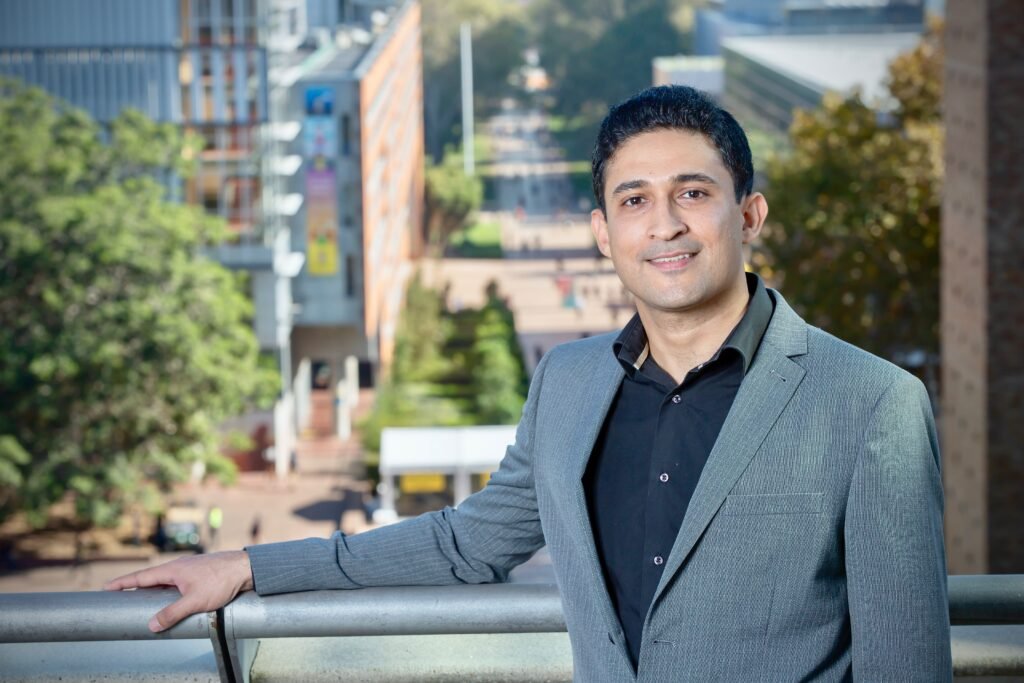
Born and raised in Lahore, Aziz graduated from LUMS in 2003 and studied at Oxford before completing a PhD at Warwick.
At UNSW he leads the Algorithmic Decision Theory group and was the director of the UNSW AI Institute, which has more than 300 academics. IEEE Intelligent Systems named him among “AI’s 10 to Watch” in 2016, and The Australian named him the country’s research field leader in game theory and decision sciences in 2020, 2021 and 2022.
Also Read: Dyscalculia in Pakistan: Understanding the Struggle With Math Learning Disorders


