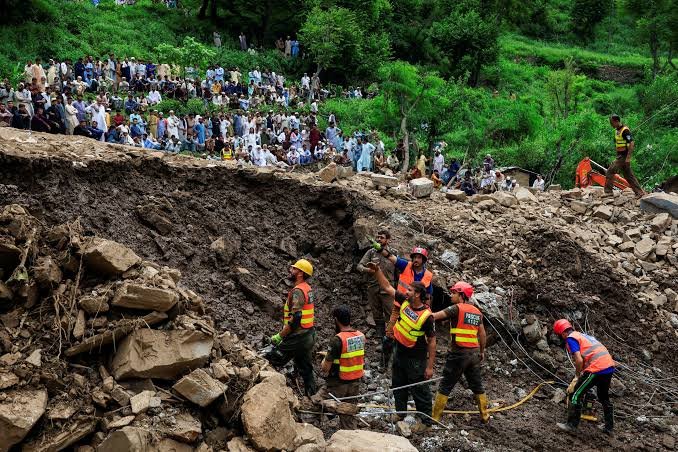
On the morning of 15th August 2025, the people of Buner District in Khyber Pakhtunkhwa, Pakistan faced a disaster which they had never seen before in their lives. In a single hour, more than 150 mm of rain fell over the mountainous area above the village, leading to water, mud, rock, and tree slides down the slope, engulfing homes in the process. A total of close to 230 people died in Buner alone, making it the deadliest single incident of that monsoon season.
This was a cloudburst. A cloudburst happens when more than 100 mm of rain falls in an hour in a small area. For a long time, people in Pakistan associated cloudbursts with the high ranges of the country’s north. Due to global warming, the National Disaster Management Authority has announced that the monsoon has shifted 100 km west of its previous range. As a result, districts like Buner, Swat and Shangla, not known previously as high-risk areas, find themselves on the front line.
Why they are so deadly
The most critical problem is that the cloudbursts are unpredictable. They come suddenly, localized, and they last only a short time. A standard weather forecast can tell people that heavy rain is coming to their region; however, it cannot tell one small village that it must leave in the next 30 minutes. Individuals often see the water coming, and then it is too late to run away. In a few days in August 2025, over 380 individuals lost their lives in Khyber Pakhtunkhwa. Many of them were at their homes when the flood came. They had no warning at all.
Life on the front line
Working as a disaster management practitioner in Khyber Pakhtunkhwa, I have witnessed how our mountain communities live with these risks every day. Many families build their houses near the streams and dry riverbeds due to flat and cheap land. For most of the year, these streams are almost empty, so the communities feel safe. However, only one heavy burst of rain can turn them into a strong river within a few minutes.
In mountain regions, narrow roads are often the first casualty of the floodwaters. The roads block official rescue teams from reaching the villages for hours or even days. So, in those crucial hours, the first people to help are the residents themselves. Most of them are youth from the same community. They evacuate them from danger zones and provide them with food supplies. Despite the lack of training and protective equipment, they are ready to help people and save lives. However, such heroic actions are fraught with danger to their own lives.
Why COP31 must listen
COP31 in Antalya, Türkiye, should talk about cloudbursts because they show how fast a climate hazard can turn into a deadly disaster. I see three discussions where this topic fits clearly.
The First is the United Nations’ Early Warnings for All plan. Its target is that every person in the world should be covered by an early warning system by the end of 2027. However, in the mountains, just getting a warning is not enough. Communities need it early enough to actually evacuate before the water gets to their homes.
Second is the Global Goal on Adaptation. Countries are still deciding how to measure adaptation, and mountain communities should have their own clear targets in it.
Third is the Fund for responding to Loss and Damage. Communities hit by sudden disasters, like the cloudburst in Buner, need help to rebuild their lives. These events do not always make world news, but for the families who lose everything, the loss is just as big.
What Pakistan can do now
Pakistan does not need to wait for the commencement of COP31. Some practical steps can begin immediately. The high-risk valleys need more automatic rain gauges and better radar coverage. To prevent individuals from constructing new homes in stream beds, the government must employ appropriate risk maps.
The most important thing we need is a warning system that operates within the village. Youth can swiftly disseminate warnings if they receive training in each community and are connected to the district disaster office. When rescue teams arrive, they guide them and assist the elderly and sick people in moving and evacuating first. Cloudbursts will come again, and they will not give us much time when they do. So our preparation has to start now, before the next one hits
Also Read: Zero Deaths, No Warning: Why Forecasts Alone Don’t Save Lives

Inkasar Aziz is a Disaster Risk Reduction (DRR) practitioner and climate advocate from Pakistan. He holds BS and MS degrees in Disaster Management from the University of Peshawar, with expertise in climate change, disaster risk reduction, adaptation, GIS/RS, and humanitarian response. He currently works with Climate Forward Pakistan and International Association of Disaster Management (IADM)

